
Al-Qaradawi and the Human Being Condemned in the Qur’an
The post:
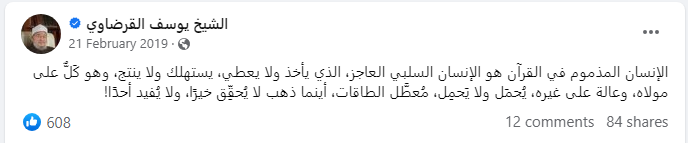
On 21 February 2019, Shaykh Dr Yusuf al-Qaradawi posted on his official Facebook page:
“The human being condemned in the Qur’an is the passive, incapable person who takes without giving, consumes without producing, burdens his master and depends on others, is carried but carries nothing, leaves his abilities idle, and wherever he goes achieves no good and benefits no one!”
Commentary:
1. One can scarcely cease wondering at this man’s persistence in his deviant thinking, despite earlier glimmers of hope that it might improve when his book The Major Foundational and Ultimate Questions for the Human Being: What Am I? Where Am I From? Where Am I Going? And Why? appeared, published by al-Dar al-Shamiyyah, Turkey, first edition 1438/2017, in a small volume. We commented on it in an article; kindly see the link entitled:
Al-Qaradawi and the Great Ultimate Question: A Recent Repentance or a Chronic Split?
It appears, however, to be a chronic split. One who has grown up and grown old with something finds it difficult to detach himself from it. Here he is again, adding a new concept, indeed a new distortion, concerning ‘the human being condemned in the Qur’an’.
2. No reader of God’s Book, removed from philosophies and newly invented understandings, would understand the condemned human being to be the one al-Qaradawi has discovered. How could that be, when God says: {Nothing prevented their expenditure from being accepted except that they disbelieved in God and His Messenger, come to prayer only lazily, and spend only unwillingly (54)} [al-Tawbah]? Consider: these unbelievers spent and bestowed gifts; they were not passive in the movement’s sense. Yet their deeds were not accepted because they lacked the condition of belief in God and His Messenger. God also says: {We will turn to whatever deeds they performed and make them scattered dust} [al-Furqan: 23]. Undoubtedly their deeds mentioned in this verse were beneficial and desirable, not passive in the movement’s sense. Nevertheless, they became scattered dust for the same reason. Indeed, the Prophet’s uncle Abu Talib, whose standing with the Messenger and whose death’s sorrow for him are well known, was far removed from passivity by the standards of movement ideology. He worked, strove, protected the Messenger, and defended him admirably. Yet what was his final destination? Al-Bukhari and Muslim narrated from al-Abbas ibn Abd al-Muttalib that he said to the Prophet: What have you done for your uncle? He used to protect you and become angry on your behalf. He said: “He is in a shallow part of the Fire. Were it not for me, he would be in its lowest depth.” There are many such examples.
3. Someone may ask: Has al-Qaradawi denied that faith is an indispensable condition for deeds to be accepted, or said that God rewards an unbeliever and admits him to Paradise despite his unbelief and obstinacy?
We answer: He indeed does not say that. However, when he makes the attributes of the condemned person those of ‘the passive person who takes without giving and consumes without producing’, without mentioning the centrality of belief in God and His Messenger, or qualifying it by the importance of worshipping God to seek His pleasure, attain Paradise, and be saved on the Day of Reckoning, and without stating that this is the fundamental purpose for which we were created, all the foregoing consequences follow from his words.
4. Their real problem is making public benefits, ethical dealings between people, and sacrifice for progress and advancement the goal and purpose of religion. You find them asserting without ambiguity or concealment that developing the earth is the purpose for which humans were created, while acts of worship are only means to that end. For them, belief in God and the Last Day and worshipping God matter because, they claim, they help develop the earth and advance society. The scholar al-Nadwi, may God have mercy on him, recognised and precisely described their malady when discussing the difference between Islamic groups’ call to belief in the Last Day and that of the prophets:
“The prophets’ call to belief in the Hereafter, and their praise of it, did not present it as an ethical necessity or a reformative need without which a virtuous society and sound civilisation, let alone an Islamic society, cannot exist. Though such an approach merits appreciation and admiration, it differs clearly from the prophets’ methodology and practice and that of their successors. The difference is that the first, the prophets’ method, is faith and inner awareness, feeling and emotion, a creed that takes possession of a person’s feelings, thinking, and conduct. The second is acknowledgement and formulation, a prescribed law. The former speak of the Hereafter with enthusiasm and delight and call to it fervently and forcefully; others speak of it only to the extent of ethical necessity and social need, motivated by reform and ethical organisation. What a difference there is between inner awareness and emotion, and submission to logic and social interests.” (al-Nubuwwah wa-l-Anbiya fi Daw al-Quran, p. 50.)
5. The terms ‘passive’ and ‘passivity’ entered contemporary Arabic through translation from French and English. They are ambiguous expressions of the kind about which Shaykh al-Islam said: “Using ambiguous expressions without qualification suggests corrupt meanings.” (Majmu al-Fatawa, 6/97.) Elsewhere he said: “One should resort to these invented ambiguous expressions only when necessary, accompanied by indications clarifying what is meant.” (Minhaj al-Sunnah al-Nabawiyyah, 2/554.) He also said: “As for ambiguous expressions, affirming or denying them without seeking clarification leads to ignorance and misguidance, turmoil and confusion, and endless disputation. It has been said that most disagreement among rational people arises from shared names.” (Minhaj al-Sunnah al-Nabawiyyah, 2/217.)
Such is the term ‘the passive human being’. It is not among the expressions used in the Book and Sunnah to describe and assess human deeds. The reality is that God’s words are clear and unambiguous. Using and distorting His expressions immediately exposes the speaker. An innovator therefore usually devises other words and terms to obscure matters and slip his innovation through without anyone recognising its danger and gravity. The term ‘passive human being’ is of this kind: they have substituted it for Qur’anic expressions condemning human conduct, such as corrupt and unjust. God says: {This is indeed the true account; there is no deity except God, and God is the Almighty, the Wise (62). If they turn away, God knows the corrupters (63)} [Al Imran]. He says: {Then after them We sent Moses with Our signs to Pharaoh and his chiefs, but they wrongfully rejected them; see how the corrupters ended (103)} [al-Araf]. He says: {Rather, they denied what they had not encompassed in knowledge and whose fulfilment had not yet come to them. Those before them denied in the same way; see how the wrongdoers ended (39). Among them are those who believe in it and those who do not; your Lord knows the corrupters best (40)} [Yunus]. All these deserved to be described as corrupters because they disbelieved in God. Other corruption is assessed according to its extent; the unqualified description is deserved only by an unbeliever, a polytheist, or someone approaching them. Passivity, however, has several possible meanings and does not always entail blame. Sometimes it may even indicate praise. During turmoil a Muslim must be passive in the sense of not participating and withdrawing to himself and his family. When weak and without strength, he must be passive in the sense of patiently bearing harm from unbelievers and oppressors and restraining his hand. The description can even differ between a person’s condition in this world and the Hereafter. An unbeliever may perform righteous deeds in this world and God rewards him for them in this world alone. In that respect he is not passive, though his final destination is the Fire. A believer, by contrast, is rewarded for his righteous deeds in this world and the Hereafter. Muslim (2162) narrated from Anas ibn Malik that the Messenger said: “God does not wrong a believer in any good deed: he is given something for it in this world and rewarded for it in the Hereafter. As for the unbeliever, he is fed in this world for the good deeds he has done for God, until, when he reaches the Hereafter, he has no good deed left.” Muslim also narrated: “When the unbeliever does a good deed, he is given worldly sustenance for it. As for the believer, God stores his good deeds for him in the Hereafter and grants him sustenance in this world for his obedience.”
6. Remarkably, he quoted part of a Qur’anic verse that, had he cited it fully, would have indicated the opposite of his deviant interpretation of the human being. He wrote, ‘He is a burden to his master’, a verbatim quotation, and also quoted its meaning: ‘Wherever he goes, he achieves no good and benefits no one.’ Both come from a single verse: {God presents a comparison of two men. One is mute, unable to do anything, and a burden to his master; wherever he directs him, he brings no good. Is he equal to one who commands justice and is on a straight path? (76)} [al-Nahl]. Its correct meaning is what Imam Ibn al-Qayyim explained:
“This is a comparison God presents for idols, which do not hear, speak, or understand, and burden their worshippers. An idol needs its worshipper to carry it, set it down, erect it, and serve it. How then do they equate it in worship with God, who commands justice and the oneness of God? He is powerful, speaking, self-sufficient, and on a straight path in His words and deeds. His words are truth, right guidance, counsel, and direction; His deeds are wisdom, justice, mercy, and benefit. This is the soundest interpretation of the verse, and many commentators mention no other.” (Madarij al-Salikin, 1/28, Ataat al-Ilm edition.)
Among the fine titles of Shaykh al-Islam Ibn Taymiyyah’s principles is: “A section containing a noble principle: every scriptural or rational proof cited by someone advocating falsehood actually indicates the truth, not the false claimant’s position.” (Majmu al-Fatawa, 6/288.)
7. Finally, holding fast to the Prophet’s words is far better than these ambiguous formulations, which require strained interpretation to give them a good meaning, if that was what was intended. He was granted comprehensive speech. When he wished to direct Muslims towards diligence, effort, and general benefit, urging them to raise their aspirations and dispel laziness, he said: “The strong believer is better and more beloved to God than the weak believer, though there is good in both. Be keen on what benefits you, seek God’s help, and do not give up. If something befalls you, do not say: Had I done this, such and such would have happened. Rather say: God decreed, and He does what He wills. For ‘if’ opens the way for Satan’s work.” (Sahih Muslim: 2052.)
He thus emphasised that faith is an indispensable condition, encouraged diligence and activity, and stated that the believer possessing these qualities is more beloved to God. He did not condemn ‘the passive person’ without qualification. Rather, he described him as possessing goodness and stated that God loves him for his faith. It is therefore impermissible to condemn him and apply to him verses revealed concerning polytheists. He reminded people of the need to seek God’s help, then warned against Satan’s avenues of entry. These few eloquent, concise words fulfilled the purpose. O God, send blessings and peace upon Your servant and Prophet Muhammad, his Companions, and those who follow his guidance and path until the Day of Judgement.
For more articles observing al-Qaradawi’s and others’ thought concerning the reality of Islam and religion, see:
The Reality of the Creed of God’s Oneness According to al-Qaradawi.
Were Acts of Worship Prescribed to Protect Souls from Aggression, Oppression, and Injustice?
Amr Khaled and the Wisdom of Creation.
Succession Means Developing the Earth.
Encouraging Prostration by Magnifying Its Worldly Benefits.
Did Religion Come to Organise Life and Develop the Earth?
The Qur’an and Strengthening Intellectual Faculties.