
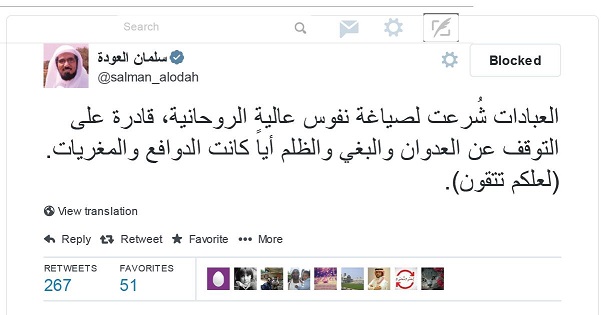
Salman al-Awdah said in a tweet:
“Acts of worship were prescribed to shape highly spiritual souls capable of refraining from aggression, oppression and injustice, whatever the motives and temptations: ‘So that you may become mindful of God.’”
Comment:
1. This statement distorts the meaning and purpose of worship, elevating its benefits into its aim and objective. It necessarily follows that whoever refrains from injustice and oppression has fulfilled the purpose for which worship was prescribed, and therefore has no need of worship once that purpose is achieved. This is the implication of his words. Were he to accept it, he would face grave danger. Some philosophically inclined Sufis have indeed accepted it. Discussing one group’s understanding of worship and why it was prescribed, Ibn al-Qayyim, may God have mercy on him, says: “The second group consists of those among the Sufis of Islam who philosophise and draw close to the philosophers. They claim that acts of worship are exercises to prepare souls, detach them and separate them from the sensory world, so that spiritual influxes and knowledge descend upon them.
“Some of them make worship obligatory only for this purpose. Once it has been achieved, a person has the choice of maintaining their regular devotions or occupying themselves instead with the spiritual influx.
“Others require the performance of regular devotions and duties without neglecting them. These too are of two kinds: some require this to preserve the rule and discipline souls; others require it to preserve the spiritual influx, fearing that by abandoning it the soul will gradually return to its original animal-like condition.” Madarij al-Salikin, 1/147–148, Dar ‘Alam al-Fawa’id edition.
2. Godly scholars use clear expressions without ambiguity or obscurity. “Highly spiritual souls” is one of the philosophers’ obscure expressions, frequent on their tongues, by which they mean unbelieving ideas rejected by adherents of the faith. It would be better to say “souls filled with faith, mindfulness of God, submission to Him and love for Him,” or something similar.
3. The correct position is that acts of worship were prescribed as devotion and humility before God. Shaykh Muhammad ibn Salih al-Uthaymin, may God have mercy on him, says: “Acts of worship are intended to be performed personally, so that a person fully realises devotion and humility before God. It is known that someone who delegates them to another does not attain this great meaning for whose sake worship was prescribed.” Majmu‘ al-Fatawa wa-l-Rasa’il, 21/136.
They undoubtedly affect the reform of souls and their restraint from injustice and oppression. Indeed, injustice and oppression may reduce or even exhaust their good deeds. Muslim narrates in his Sahih (2581), as do others, from Abu Hurayrah, may God be pleased with him, that the Messenger of God, peace and blessings be upon him, said: “Do you know who is bankrupt?” They said: “Among us, the bankrupt person has neither money nor possessions.” He said: “The bankrupt person of my community comes on the Day of Resurrection with prayer, fasting and zakat, but having insulted one person, slandered another, consumed another’s wealth, shed another’s blood and struck another. One is given some of his good deeds and another some of his good deeds. If his good deeds are exhausted before his liabilities are settled, some of their sins are taken and cast upon him, and then he is cast into the Fire.” God knows best.
For more, see: