
Praise be to God, Lord of the worlds. I testify that there is no deity but God alone, without partner, and that Muhammad is His servant and Messenger. May God bless him, his family, and all his Companions.
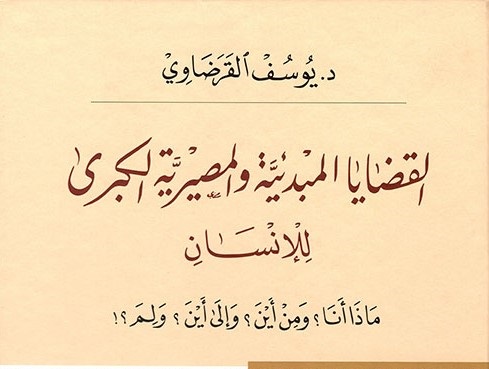
To proceed: I came across a new book by Shaykh Dr Yusuf al-Qaradawi entitled The Major Foundational and Ultimate Questions for the Human Being: What Am I? Where Am I From? Where Am I Going? And Why?, published by al-Dar al-Shamiyyah, Turkey, first edition 1438/2017, a small volume of 224 pages. I bought it without hesitation because it lies at the heart of my interests, its author is widely famous, and it distils his ninety-year life and extensive scholarly, intellectual, preaching, cultural, and movement career, spanning more than seven decades of activity, production, expertise, and experience. Naturally the author would keep this in mind while writing. He begins: “Introduction: I write this book towards the end of my life…” and ends the introduction with his name and date: “Dr Yusuf al-Qaradawi, Doha, 5 Jumada al-Akhirah 1437 AH, corresponding to 14 March 2016 CE.” He unquestionably authored it; the style is his, and it includes discussions from earlier books and articles. Yet most readers may not expect content of this clarity, completeness, and focus from al-Qaradawi. I therefore felt compelled to begin with this documentation, as though introducing a rare manuscript, lest anyone rush to accuse me of falsely attributing words to him!
Al-Qaradawi wrote this book to establish one comprehensive, central proposition: humanity’s great foundational and ultimate question is eternal life hereafter. The purpose of worldly life is working to succeed and be saved in that abode, achievable only through worshipping God, sincerity to Him, and seeking His pleasure. Worship is creation’s purpose and the condition for success and salvation. This proposition’s importance, centrality, and priority emerge through the following realities:
First: Worship is creation’s purpose.
Under “Why Was the Human Being Created?”, p. 48, al-Qaradawi writes: “God answers our question through what He explains in His eternal Book: He created humans to be successors on earth, as is clear in Adam’s creation… The first element of this succession is that humans truly know their Lord and worship Him as He deserves. God says: {God created seven heavens and the earth’s like; His command descends among them, so you may know that God has power over everything and encompasses everything in knowledge} [al-Talaq: 12]. This verse makes knowledge of God the purpose of creating heavens and earth. He says: {I created jinn and humans only to worship Me. I desire no provision from them, nor that they feed Me. God is the Provider, Possessor of strength, the Firm} [al-Dhariyat: 56-58]…” He continues, p. 49: “By innate disposition and the universe’s logic, humans therefore belong to God alone, to worship Him alone, not humans, stones, cattle, trees, sun, moon, jinn, or angels. Every worship of other than God is beautified by Satan, humanity’s enemy.”
On p. 121: “If the fool lives to eat and the sensible person eats to live, the believer lives to worship God alone. The Qur’an establishes this clearly when describing creation’s purpose: {I created jinn and humans only to worship Me. I desire no provision from them, nor that they feed Me. God is the Provider, Possessor of strength, the Firm}.”
On p. 127: “Islam condensed human purposes into one: pleasing God. It concentrated human concerns into one: working for what pleases Him.”
Second: Fulfilling servitude to God is religion’s message, task, and function.
In chapter seven, “What Does True Religion Offer the Human Being?”, under “The Human Being’s First Purpose: God-Centredness, Living for God Alone”, p. 119, he writes: “Religion corrects humanity’s purpose. Instead of stumbling blindly through life without goal or aim, or living for desires and pleasures, eating and enjoying like livestock, religion leads people to God-centred purpose and direction through worship. This means making one’s final purpose and distant goal a sound relationship with God and attaining His pleasure. This is Islam’s purpose, and therefore humanity’s purpose, direction, ultimate hope, endeavour, and toil in life: {Human being, you labour towards your Lord and will meet Him} [al-Inshiqaq: 6]; {To your Lord is the final destination} [al-Najm: 42].”
Third: Explaining God’s oneness as devoting worship exclusively to Him.
On p. 120: “The meaning of affirming God’s oneness is knowing there is no deity but God and singling Him out in worship and seeking help, associating no one and nothing with Him. This means {You alone we worship, and You alone we ask for help}, repeated by Muslims at least seventeen times daily when reciting al-Fatihah in prayer. God addressed His Messenger Muhammad with this truth and commanded him to announce and convey it: {Say: My Lord has guided me to a straight path, an upright religion, Abraham’s creed, inclining to truth; he was no polytheist. Say: My prayer, sacrifice, life, and death belong to God, Lord of the worlds, without partner. Thus I was commanded, and I am first among Muslims. Say: Shall I seek a lord other than God, when He is Lord of everything?} [al-Anam: 161-164].”
Fourth: Every message’s first call: “Worship God; you have no deity other than Him.”
Under this heading, p. 139, he writes: “Worship of God alone is the ancient covenant God took from humanity, inscribing it with the pen of power upon human nature and planting it in original dispositions, since placing understanding minds in their heads, beating hearts within them, and guiding signs in the surrounding universe: {Did I not covenant with you, children of Adam, not to worship Satan, your manifest enemy, and to worship Me? This is a straight path} [Ya Sin: 60-61]. The Qur’an depicts this covenant magnificently and eloquently: {When your Lord took from Adam’s children, from their backs, their offspring and made them testify concerning themselves: Am I not your Lord? They said: Yes, we testify, lest you say on Resurrection Day: We were unaware of this; or say: Our fathers associated partners before us, and we were their later offspring. Will You destroy us for the falsifiers’ deeds?} [al-Araf: 172-173]. It is therefore unsurprising that the greatest purpose of sending prophets and messengers and revealing sacred books is reminding people of this ancient covenant and removing the dust of heedlessness, idolatry, or imitation accumulated upon their innate nature. Nor is it surprising that messengers’ first call was: {My people, worship God; you have no deity other than Him}. Noah, Hud, Salih, Abraham, Lot, Shuayb, and every messenger sent to a denying people called thus. God says: {We sent a messenger to every nation: Worship God and avoid false gods} [al-Nahl: 36]; {We sent no messenger before you without revealing: There is no deity but Me, so worship Me} [al-Anbiya: 25]. After recounting many prophets, He says: {This community of yours is one community, and I am your Lord, so worship Me} [al-Anbiya: 92]. He also says: {Messengers, eat good things and act righteously; I know what you do. This community of yours is one community, and I am your Lord, so fear Me} [al-Muminun: 51-52].”
Al-Qaradawi thus establishes worship as creation’s purpose and humanity’s function in this life, religion’s subject in explanation, command, and legislation, and every messenger’s call. It is the reality of affirming God’s oneness, seeking His countenance and salvation hereafter. This is the central question of his Major Foundational and Ultimate Questions for the Human Being.
Abd al-Haqq al-Turkmani, may God pardon him, says: Someone may ask what is new here. These great comprehensive truths are among Islam’s clearest foundations, plainest teachings, and most decisive commands, known and affirmed by every Muslim unpolluted by philosophers’, esotericists’, and heretics’ beliefs. Movement Islamists broadly acknowledge and state them too, but most, when discussing details, say: “The intended worship is developing the earth. It is a means, not intrinsically intended; the ultimate purpose is justice and humanity’s happiness. Working for this world according to God’s methodology is the path to salvation hereafter.”
I answer: Al-Qaradawi does not stop at general concepts. He explains clearly and comprehensively that worship is God’s exclusive right, intrinsically intended for salvation in eternal life hereafter, not a means to developing the earth or establishing social and political order. Rather, those serve worship’s purpose. He thereby contradicts preceding movement Islamists such as Hasan al-Banna, Sayyid Qutb, Muhammad Qutb, al-Mawdudi, Ali Shariati, al-Khomeini, and many others who regard worship as not intrinsically intended but a means to reforming self and society and establishing social and political order, as I documented extensively in Introduction to the Interpretation of Islam.
After explaining worship as all religion’s intended purpose, al-Qaradawi says, p. 119: “Undoubtedly Islam has other human, social, cultural, economic, and political purposes. Yet reflection reveals that these actually serve the greatest purpose: God’s pleasure and good reward. This is the goal of goals, the purpose of purposes, the first and ultimate end.” This explicitly places other Islamic goals second to the first and greatest: worship.
He then explains, p. 120: “Islam contains legislation and transactions, but their purpose is to organise people’s lives so they can rest, free themselves from conflict over inferior enjoyment, and devote themselves to knowing God, worshipping Him, and seeking His pleasure.”
This is extremely important and among Islam’s great realities. Many scholars, including Fakhr al-Din al-Razi, Abu Hamid al-Ghazali, Ibn Taymiyyah, and Ibn al-Qayyim, previously explained that every religious ruling regulating individuals, society, and state is purposive and beneficial, serving the greater goal of freeing servants for the worship of their Lord for which they were created.
Al-Qaradawi continues, p. 120: “Islam includes jihad and fighting enemies, but the purpose is {until there is no persecution and religion belongs entirely to God} [al-Anfal: 39]. Islam encourages travelling through the earth and eating its good things, but the goal is gratitude for God’s blessing and fulfilling His right: {Eat your Lord’s provision and thank Him: a good land and a Forgiving Lord} [Saba: 15]. Every Islamic legislation, direction, and guidance aims only to prepare humans to become servants devoted to God alone. Thus Islam’s spirit and essence is affirming God’s oneness…” He then explains its meaning, quoted above. His statement that every legislation, direction, and guidance prepares humans for exclusive servitude makes it decisively clear that laws are means to worship, contrary to most movement Islamists’ explicit claim that worship serves social, political, and worldly utilitarian legislation.
Religious, innate, and rational necessity consequently require worship and work for the Hereafter to be, in all Muslims’ belief, the foundation of foundations, most important concern, and foremost priority. They should lead their care and attention in learning, action, preaching, conveying, advising, guiding, nurturing, reforming, guarding, and defending. All other issues should occupy secondary and subsidiary ranks, even practical religious rulings, let alone purely worldly matters and their transient details.
Shaykh al-Qaradawi recognised this religious, innate, and rational necessity and accepted its implications in several passages:
1. Explaining his motives for writing, p. 10: “We want people to pay attention to themselves and take the matter seriously, especially those living only to eat, drink, dress, dwell, and enjoy their short lives…” “These eternal questions, expressed as: What am I? Where am I from? Where am I going? And why?, and their answers are what we sought to highlight, draw attention to, and awaken all humanity to answer and prepare for. The matter is grave and deserves concern.”
2. Defining everyone’s duty regarding purpose and destiny, p. 6: “This great issue must trouble, awaken, and exhaust people, as everyone searches for identity and place in existence, especially after this existing structure, the universe, is dismantled and another comes: what will be his place in it?”
3. Lamenting distraction and heedlessness, p. 103: “Regrettably, diversion distracts people from seriousness, falsehood from truth, and Satan deceives them concerning God, their supreme Lord who created and proportioned, decreed and guided.”
4. Describing most people’s immersion in worldly concerns and details, p. 5: “Humans must apply their minds to this great issue, which should precede every political, economic, scientific, and technological question people investigate, discuss, and issue recommendations and decisions about, perhaps unable to reach any consensus.”
On p. 9: “Humanity has occupied itself with many matters: for homelands and others, livelihood and life’s demands, and other issues concerning politics, culture, and identity. People have disagreed greatly, fought, and become enemies. Sometimes they agree through impulses of goodness in some humans and leaders’ responses, but evil soon overcomes good and conflict resumes, leaving humanity suffering these calamities.” Al-Qaradawi differs: “We wished these great questions, the primary ultimate question, humanity’s origin, the world’s origin, life’s origin, and similar matters, would occupy a reasonable place and appropriate space in general culture, writers’, thinkers’, and philosophers’ works, and the media’s powerful efforts to influence private and public, material and spiritual life. Regrettably, many media practitioners show no desire to enter what they regard as a dangerous predicament.”
5. Politicians’ concern for this world leads them to call a temporary problem in a particular time and place ‘the ultimate problem’, neglecting the truly greatest one. Al-Qaradawi says, p. 11: “It is the ‘ultimate problem’ some politicians discuss in certain countries at certain times. In reality the ultimate problem is universal: every human has it. Everyone with a thinking mind and feeling conscience must investigate it and find its solution.”
6. Concerning Muslims’ failure to fulfil this greatest right, he says of inviting non-Muslims, p. 136: “But have Muslims conveyed it to them? I think Muslims fall short of their duty. They must multiply their efforts and do their utmost to achieve their purpose or part of it, perhaps gradually reaching what they seek.”
7. Expressing religious believers’ call to those heedless of life’s greatest question, p. 21: “Our people, we invite you to a grave matter, the question of destiny. Indeed, there is no true question of destiny except this one. Every great question, or what people call great among worldly affairs, is transient, beginning today and ending tomorrow, the next day, or after days or years. The question that never ends is ours: eternity and everlasting permanence.”
Abd al-Haqq al-Turkmani, may God pardon him, says: It is unsurprising that al-Qaradawi should correctly understand this great ultimate reality in accordance with the religion of prophets, messengers, and their followers until Judgement Day, establishing its importance, centrality, and priority. It is Islam’s fundamental foundation, necessarily known in religion, though philosophers, esotericists, and heretics strayed from it, and most contemporary movement Islamists dangerously deviated concerning it, without reaching philosophers’ atheism.
What is truly astonishing is the dangerous split between al-Qaradawi’s practical, preaching, and movement life and this great ultimate question, from which he has wholly distanced himself. One scarcely finds any trace of his book’s explanations in his actual work, preaching, general concerns, priorities, students, companions, or those influenced by his thought. We are entitled to address him thus:
Shaykh al-Qaradawi, may God guide you to truth, if this book represents recent repentance and sincere return, announce it openly before certainty comes to you. Your repentance may be accepted and your responsibility discharged before God: {Those concealing the clear proofs and guidance We revealed after explaining them to people in the Book are cursed by God and those who curse, except those who repent, reform, and clarify. I accept their repentance; I am the Accepter of repentance, the Merciful} [al-Baqarah: 159-160].
If this great ultimate reality was clear in your mind and rooted in your heart throughout decades of scholarship and preaching, what diverted and distracted you? What prevented you from making it your first and greatest concern on the many scholarly, preaching, and media platforms you occupied?
Knowing creation’s purpose, humanity’s function, and its greatest ultimate question so truly, what led you to occupy yourself with matters far beneath it in purpose, importance, effect, and outcome?
You criticise media practitioners’ unwillingness to enter this supposedly dangerous predicament. What prevented you from undertaking the task when God provided one of this age’s largest platforms, al-Jazeera? You participated in over 600 episodes of Sharia and Life, yet I know of no single episode devoted to the major foundational and ultimate questions. Even if some episodes addressed fundamental worship during Ramadan or pilgrimage, most concerned people’s worldly, partial, detailed, immediate problems. Your own words truly apply: “What people call great among worldly affairs is transient, beginning today and ending tomorrow, the next day, or after days or years. The question that never ends is ours: eternity and everlasting permanence.”
With such true understanding, what led you to immerse yourself in politics, governments, states, money, and business until these dominated you, especially your media appearances, for many years? When the trial of Arab devastation, falsely called the Arab Spring, arrived, you became among its strongest supporters, instigators, and backers. You even boasted from the Friday pulpit of being called the ‘preacher of turmoil’, saying: “I will not abandon this sermon of turmoil. O God, let me live among the preachers of turmoil, die among them, and be resurrected with them!” Thus you invoked harm upon yourself; perhaps it was an hour of answered supplication!
Did you not know that this turmoil distracted people from their great ultimate question, driving them into worldly conflict and away from creation’s purpose? Hence the multiply transmitted hadiths prohibit engaging in turmoil, require avoiding and fleeing it, and direct people to worship, their existence’s purpose. The Messenger said: “Worship during turmoil is like emigrating to me.”
God prolonged your life until you saw those revolutions’ results. Ask yourself: Did Muslims become closer to God, keener to work for the Hereafter, and safer from sins and destructive offences? Or did many fall into grave sins such as killing, injustice, aggression, lying, and wickedness?
The Messenger told a noble Companion who killed someone after he said “There is no deity but God”, though originally an enemy polytheist whose blood was not protected: “Did you kill him after he said: There is no deity but God?” and: “What will you do with ‘There is no deity but God’ when it comes on Resurrection Day?” Are his followers not entitled to ask you, aged shaykh: What will you do when this declaration comes on Resurrection Day with people presumed Muslim, protected in life, property, and honour, whose bloodshed, violated honour, and destroyed homes you helped cause through inflammatory sermons and incitement to revolution, demonstrations, sit-ins, and confrontation with soldiers and police in Muslim lands? Your enthusiasm and recklessness even led you to glorify and admire Muhammad Bouazizi’s self-immolation and suicide, committed because of injustice and poverty, resenting God’s decree. You became the first scholar in the history of all religions to approve this heinous act and salute its perpetrator [al-Jazeera, Sunday evening, 16 January 2011]!
You knew the Prophet’s counsel and command, definitive in transmission and meaning, to endure rulers’ injustice patiently, not rebel, not take up arms against Muslim society, restrain tongue and hand during turmoil, and remain at home. Understanding the great ultimate question, you should have been foremost in recognising that he commanded this neither to approve injustice, support oppressors, nor encourage cowardice, weakness, and surrender of rights. He commanded it out of compassion, protecting their religion and directing them to what is prior, more important, and more deserving: the Hereafter, the intended goal. As you wrote, p. 136, worldly life “is for the Muslim a tool, not a target; a means, not an end”. Revolution, rebellion, and competition over worldly life contradict religious rulings’ original purpose, which you correctly expressed: “Islam contains legislation and transactions, but their purpose is to organise people’s lives so they can rest, free themselves from conflict over inferior enjoyment, and devote themselves to knowing God, worshipping Him, and seeking His pleasure.”
Hence the Prophetic instruction, authentic through corroborating reports and routes as discussed in Ibn al-Mulaqqin’s al-Badr al-Munir, 9/8, and al-Albani’s Irwa al-Ghalil (2451), that amid turmoil, disagreement, and disorder a Muslim should choose to be “God’s servant who is killed, not the killer”. If unjustly killed as a Muslim, he gains his Hereafter though losing his world. This counsel sufficiently summarises the question to which you devoted this book. Would that you had included a section on hadiths concerning turmoil, rebellion, and worldly rivalry! They are not merely worldly rulings but lie within Islamic creed and its foundations, directing Muslims to work for God rather than personal portions, for the Hereafter rather than this world, and for eternal enduring life rather than short transient life.
Did you not know this abode is one of trial and examination, where absolute goodness and justice are impossible? Sensible people must work for the abode of absolute goodness, absolute justice, and endless happiness. This is the servitude and God-centredness you explain, saying on p. 138: “God-centredness may deprive humans of some immediate pleasures and nearby benefits, but through this deprivation protects them from evils and dangers certain to harm them, their society, or humanity.” Your and other movement Islamists’ and agitators’ encouragement of Muslims to compete and struggle over worldly life and challenge rulers, and your cries from the Friday pulpit, “Revolt! Come out!”, sought only ‘some immediate pleasures and nearby benefits’. The result corrupted people’s religious and worldly conditions alike. This is an immediate punishment for opposing the Messenger and contradicting his commands and counsel: {Had they done what they were admonished to do, it would have been better and more firmly established them. Then We would have given them a great reward from Us and guided them to a straight path. Whoever obeys God and the Messenger will be with those God favoured: prophets, truthful ones, martyrs, and the righteous. Excellent are those companions. That is God’s favour; God suffices as All-Knowing} [al-Nisa: 67-70].
Yes, Shaykh al-Qaradawi: you neglected religion and caused enormous corruption in Muslims’ worldly life. Thousands of students, preachers, and intellectuals, let alone ordinary people, were influenced by your discourse until their only concerns became politics, economics, development, and material renaissance. I can find no better concluding advice than your own words, p. 79: “Think of your end if you possess religion. Religion is no trivial matter for a person, to be forgotten, displaced by other concerns, or postponed to another opportunity in life that may or may not come.” Hasten to repent and announce it publicly, perhaps God will accept and pardon you. He is Forgiving, Merciful. His is praise in this world and the Hereafter.
Addendum:
After writing this article I saw a tweet on al-Qaradawi’s verified account, dated 22 October 2018: “The creed of God’s oneness is, in reality, nothing but a revolution to achieve freedom, equality, and brotherhood for humanity, so people do not take one another as lords besides God and human enslavement to humans is abolished.”
I say: With these latest words al-Qaradawi overturned everything he wrote in his book. Such is his condition with much of the truth written in his books and rulings: he contradicts it in speech and action. He resembles the one our Lord describes: {Like the woman who unravelled her firmly spun yarn into loose strands} [al-Nahl: 92]. There is no power or strength except through God, the Most High, the Almighty.
Written by Abd al-Haqq al-Turkmani.
Wednesday, 11 Shawwal 1438 AH, corresponding to 5 July 2017 CE.