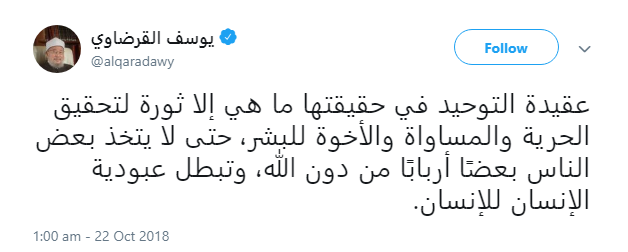
Text of the tweet
Dr Yusuf al-Qaradawi wrote on his official Twitter account on 22 October 2018:
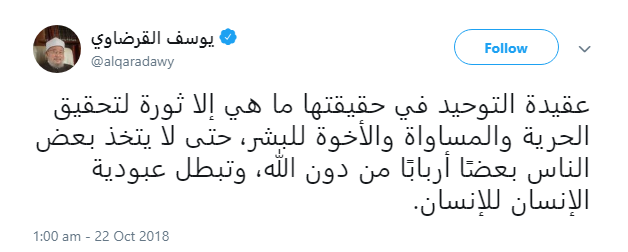
“The creed of monotheism is, in its reality, nothing but a revolution to achieve freedom, equality and brotherhood for humanity, so that people do not take one another as lords besides God and human servitude to other humans is abolished.”
Comment
1. These explicit, categorical words radically distort the reality of the “creed of monotheism” with which Muhammad, may God bless him and grant him peace, was sent. Al-Qaradawi makes its purpose “revolution to achieve freedom, equality and brotherhood for humanity”. He knows that an exception following negation expresses exclusivity, as in the declaration of monotheism, “There is no deity but God.” His words here, “nothing but a revolution”, therefore categorically confine the sole purpose of the creed of monotheism to this objective: “revolution to achieve freedom, equality and brotherhood for humanity…”
2. The objective that al-Qaradawi claims to be the exclusive purpose of the creed of monotheism has no basis as such in Islamic creed, except as an implication, result or fruit. A necessary implication of establishing the creed of monotheism is that “people do not take one another as lords besides God”, and among its good fruits and results is “abolishing human servitude to other humans”.
3. What, then, is the true purpose of the creed of monotheism? It is clear and explicit in the Qur’an and Sunnah: fulfilling God’s right by worshipping and obeying Him. The Prophet, may God bless him and grant him peace, said: “God’s right over His servants is that they worship Him and associate nothing with Him.” Violating this right, which concerns God, Lord of the worlds, is therefore the greatest and most abhorrent sin. God says in Surat al-Nisa’ (48): “God does not forgive associating partners with Him, but He forgives what is less than that for whom He wills. Whoever associates partners with God has invented an immense sin.” In verse 116: “God does not forgive associating partners with Him, but He forgives what is less than that for whom He wills. Whoever associates partners with God has strayed far astray.” This cause of exclusion from forgiveness, this immense fabrication and far-reaching error, concerns not one human being’s rights over another, but the great Creator’s right over the poor and weak human being. Rights between Adam’s descendants, however respected and exalted in Islamic law, are violated at the level of major sins, unless the violation is accompanied by declaring lawful what God has prohibited concerning lives, property and honour. Its punishment is then eternal residence in the Fire, because declaring it lawful denies God’s declaration and judgement. The matter thus returns to exalting God’s right.
Jesus son of Mary, blessings and peace be upon him, told the Children of Israel: “Worship God, my Lord and your Lord. Whoever associates partners with God, God has forbidden Paradise to them, and their refuge is the Fire. The wrongdoers have no helpers.” [Surat al-Ma’idah: 72.]
4. In reality, al-Qaradawi’s interpretation of the creed of monotheism returns to the interpretation advanced by extreme philosophers such as al-Farabi and Ibn Sina of Islamic creed, divine revelation and Muhammad’s prophethood. Many people may therefore fail to recognise the significance and danger of these words until they study the concept of the interpretation of Islam and the forms of deviation within it, ancient and modern.
5. Many contemporary Islamist thinkers make statements similar to al-Qaradawi’s. They explain the messengers’ beginning with the call to monotheism and opposition to polytheism as a means of demolishing the system of foundations upon which class divisions and injustice rested. Their call and concern are thus classified as means. This requires tracking and observation. Perhaps al-Qaradawi’s explicit statement will help researchers understand the idea clearly and recognise it within the discourse of Islamist activists.