
A study prepared by a Christian writer spread widely on social media, in magazines and news channels, and on websites. Its title was:
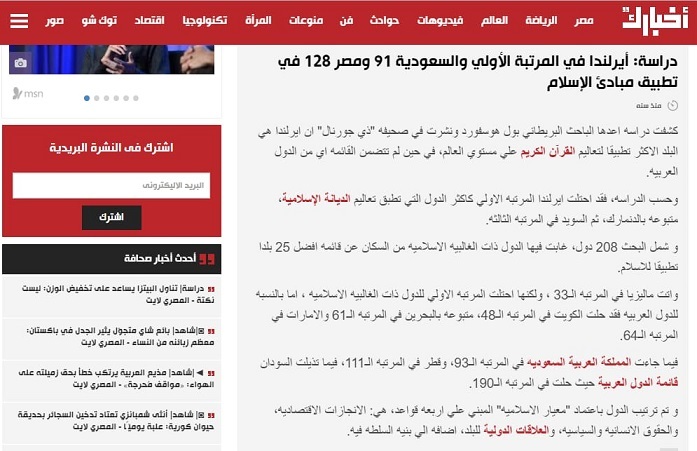
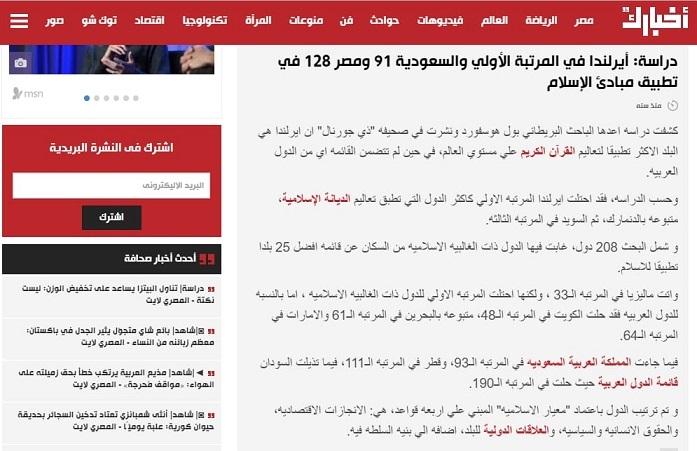
“Ireland Ranks First, Saudi Arabia 91st, and Egypt 128th in Applying the Principles of Islam.”
The text of the post:
“A study prepared by the British researcher Paul Hosford and published in The Journal revealed that Ireland is the country that most closely applies the teachings of the Noble Qur’an worldwide, while the list included none of the Arab countries.
According to the study, Ireland ranked first among countries applying the teachings of the Islamic religion, followed by Denmark and then Sweden in third place.
The research covered 208 countries. Countries with predominantly Muslim populations were absent from the list of the 25 countries best at applying Islam. Malaysia came 33rd, but ranked first among countries with predominantly Muslim populations. Among Arab countries, Kuwait ranked 48th, followed by Bahrain at 61st and the Emirates at 64th, while Saudi Arabia came 93rd and Qatar 111th. Sudan was last among Arab countries, in 190th place.
The countries were ranked using an ‘Islamicity criterion’ based on four factors: economic achievements, human and political rights, the country’s international relations, and its power structure.”
Commentary:
1. It is not surprising that such studies come from Christian writers who are not Muslims, for God says: {The Jews and Christians will never be pleased with you until you follow their religion} [al-Baqarah: 120]. What is surprising is that Muslims seize upon such studies, believe them, and spread them everywhere as though they were revelation {which falsehood cannot approach from before it or behind it}, without examining or scrutinising their reality, subject matter, or methodology.
2. Most verses of the Noble Qur’an discuss creed and its implications. The foundation of creed is explaining God’s right to be singled out in worship and veneration, and affirming His oneness in the attributes of majesty and perfection, among other matters. These verses command and encourage this, prohibit and warn against its opposites, and recount how earlier nations accepted or rejected it and what subsequently befell them. If we applied these criteria, which truly are the Qur’an’s teachings, would countries that believe that God, the Lord of the worlds, is the third of three, that He was confined within a woman’s womb and then emerged as all humans do, and that the Jews subsequently crucified Him without His having any power or strength, rank first in applying the Qur’an’s teachings? Exalted is God far above what they say!
3. The Qur’an contains more than six thousand verses. No more than five hundred concern legal rulings, and most of these discuss acts of worship whose central foundation is singling out the Creator in veneration and reverence. The criteria adopted by this study represent the small remainder of the verses on rulings. When we consider these facts, we fully understand the credibility of their statement, ‘the countries that most closely apply the teachings of the Qur’an’!
4. This alleged study based its criteria on a mistaken understanding of the Qur’an’s teachings, proceeding from what it calls the Jewish maxim, ‘The end justifies the means.’ In this study, economic achievements are the end, regardless of the means used to achieve them, whether permitted or forbidden by God. Yet the Qur’an’s teachings seek to regulate these transactions and establish restrictions that make them sound. Otherwise they are corrupt transactions, even if they produce an immediate benefit. The aim is to establish justice in society and prevent oppression, and to make transactions a means and aid towards attaining the purpose of creation: the fullest realisation of servitude to God. God therefore forbade usury, saying: {O you who believe, do not consume usury, doubled and multiplied; fear God so that you may prosper} [Al Imran: 130]. Most of the economy of countries of unbelief is based on usury. He forbade consuming wealth wrongfully, saying: {Do not consume one another’s wealth wrongfully, or offer it to judges so that you may knowingly consume a portion of people’s wealth sinfully} [al-Baqarah: 188]. Most places of gambling, betting, and wrongful consumption of wealth are in countries of unbelief and misguidance.
5. As for the supposed political rights, it is sufficient that one of the Qur’an’s foremost teachings is His saying: {O you who believe, obey God, obey the Messenger, and those in authority among you} [al-Nisa: 59]. The Qur’an’s teachings contain no political parties fighting over power, nor revolutions and demonstrations.
Ibn Abbas reported that the Prophet, God’s blessings and peace be upon him, said: “Whoever dislikes something about his ruler should be patient, for whoever withdraws a handspan from the ruler’s authority dies a death of the age of ignorance.” Al-Bukhari narrated it (7053).
Shurayh ibn Ubayd reported that Iyad ibn Ghanm said to Hisham ibn Hakim: Have you not heard the Messenger of God, God’s blessings and peace be upon him, say: “Whoever wishes to advise a person in authority should not do so publicly. Rather, he should take him by the hand and speak with him privately. If he accepts it, that is good; otherwise, the adviser has fulfilled his duty.” Ibn Abi Asim narrated it in al-Sunnah (1130), and al-Albani said its chain is sound.
All these teachings aim to establish safety and security in society, rather than stirring up turmoil and corruption on earth for political gains at the expense of the security of the country and its people.
6. In the Prophet’s time, the Romans had attained considerable civilisational and economic development. Yet this deceptive prosperity did not delude their unbelieving king, Heraclius. He was more perceptive than this researcher. When he asked Abu Sufyan several questions about the Prophet’s call, all intended to establish his truthfulness, he concluded by asking about its content: “I asked you what he commands you to do, and you said that he commands you to worship God and associate nothing with Him, forbids you to worship idols, and commands you to pray, be truthful, and remain chaste. If what you say is true, he will possess the place beneath these two feet of mine.” Al-Bukhari narrated it (7). Heraclius understood that the call to the oneness of God, and the prayer, truthfulness, and chastity that follow it, would bear the fruit of Muslims possessing his lands. This indeed occurred during Umar’s reign, may God be pleased with him, when he conquered Syria and other regions. It is in this that Muslims today have fallen short, leading to their present condition. Consider what God did to the unbelievers when they neglected the Hereafter and the purpose for which they were created: {When they forgot what they had been reminded of, We opened to them the gates of everything, until, as they rejoiced in what they had been given, We seized them suddenly, and they were plunged into despair} [al-Anam: 44].
7. Whenever economic progress obstructs the realisation of God’s oneness and invites immersion in worldly life and forgetfulness of the Hereafter, it is an evil and a trial, even if it appears pleasurable and comfortable. God says: {Do not be deceived by the movement of the unbelievers through the lands (196). It is a brief enjoyment; then their refuge is Hell, an evil resting place (197). But those who fear their Lord will have gardens beneath which rivers flow, remaining there forever, as hospitality from God; what is with God is better for the righteous} [Al Imran]. Consider how, after warning against being deceived by unbelievers’ enjoyment of worldly life and its adornment, God mentions the enduring bliss He has promised the God-fearing in the Hereafter. He does not mention worldly life, because the fundamental concern is to work for the Hereafter, even if, for argument’s sake, a God-fearing person has no share of worldly goods. God says: {This worldly life is nothing but diversion and play; the abode of the Hereafter is truly life, if only they knew} [al-Ankabut: 64]. How much more so when we know that God has also promised us elevation in this world and establishment in power if we fulfil His command to believe and do righteous deeds: {God has promised those among you who believe and do righteous deeds that He will surely make them successors on earth as He made those before them successors; that He will surely establish for them their religion which He has approved for them; and that He will surely replace their fear with security. They worship Me, associating nothing with Me. Whoever disbelieves thereafter, those are the defiantly disobedient} [al-Nur: 55]. The Prophet, God’s blessings and peace be upon him, warned his community of the evil of this prosperity, not so they would neglect work and the improvement of their worldly affairs, but so they would beware of worldly adornment diverting them from the purpose for which they were created. He said: “By God, it is not poverty that I fear for you. Rather, I fear that the world will be opened up to you as it was to those before you, that you will compete for it as they competed for it, and that it will distract you as it distracted them.” Al-Bukhari narrated it (6425). God knows best.
For further reading:
A Summary of the Principal Methodologies of the Interpretation of Islam.