Text of the publication
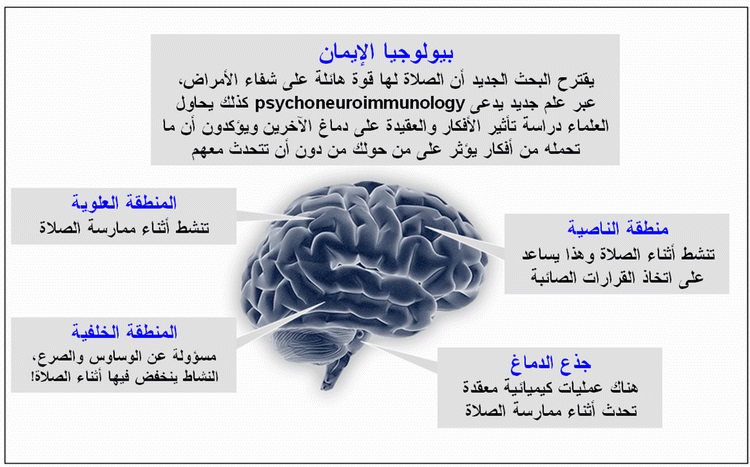
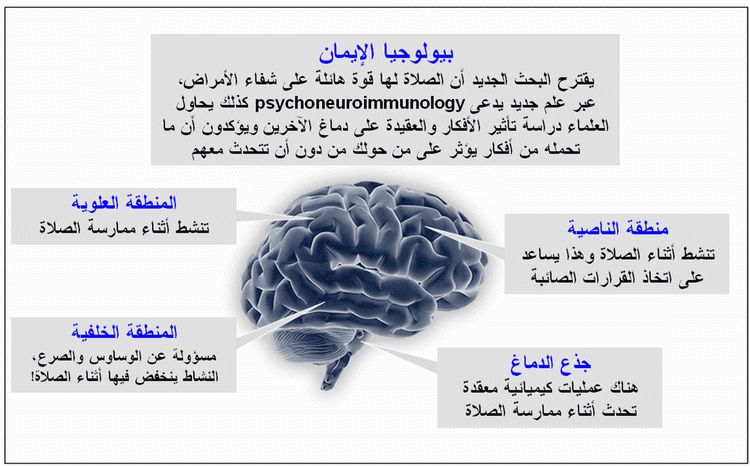
“The biology of faith: new research suggests that prayer has tremendous power to cure disease, through a new science called psychoneuroimmunology. Scientists also try to study the effects of thoughts and beliefs on other people’s brains, and affirm that the ideas you hold affect those around you without your speaking to them.
The forehead region becomes active during prayer, helping a person make sound decisions.
The upper region becomes active while practising prayer.
The brainstem: complex chemical processes occur while practising prayer.
The rear region is responsible for obsessive thoughts and epilepsy; its activity decreases during prayer.”
Comment
- The science mentioned, psychoneuroimmunology, concerns psychological and neurological immunity, or psychoendocrine immunity, and studies interactions between psychological processes and the human nervous and immune systems. It is used to observe how a person’s psychological and neurological condition influences, and is influenced by, physical health and the strength of immunity against diseases, especially cancer.
- Dr Andrew Newberg, director of the Marcus Institute of Integrative Health at Thomas Jefferson University in the United States, is known for his interest in this science and its application to religious and spiritual practices.
- Dr Andrew Newberg’s findings are based on studies of religious people, worshippers and spiritual practitioners from any religion, irrespective of the truth of their religion or belief. No distinction is made between a Muslim who affirms God’s oneness, a Christian who believes God is the third of three and that God is the Messiah Jesus son of Mary, peace be upon him, and a polytheistic pagan who worships idols. Accepting this study therefore opens the door to asserting the unity of religions, validating unbelieving and polytheistic worship and equating it with Islamic monotheistic worship.
- The influence of psychological condition on human health and immunity is apparent and well known. It does not require these contrived studies: everyone recognises it in themselves and those around them. One obvious example is that seeing someone whose company we love or receiving glad tidings brings relief and comfort to the heart, whereas seeing someone we dislike or receiving sad or frightening news causes constriction and distress. How many people, learning that their wealth has been lost or their business has failed, have suffered a fatal heart attack?
- This makes clear that anyone who undertakes an action willingly, eagerly and with a belief in its goodness and benefit may find psychological comfort, health benefits and physical strength through it, whether that person follows truth or falsehood in this world. The standard of truth and acceptance before God, however, is sincere servitude to Him and following His upright law. Thus God says in Surat al-Kahf: “Say: Shall We tell you who are the greatest losers in their deeds? (103) Those whose efforts in worldly life have gone astray while they think they are doing good. (104) Those are the ones who disbelieve in their Lord’s signs and in meeting Him, so their deeds have come to nothing, and We shall assign them no weight on the Day of Resurrection. (105)”
- In Islamic creed, prayer was prescribed to remember God and display servitude to Him, which is the true purpose of creation. One of its greatest fruits, for those who fulfil its due requirements, is protecting the worshipper from indecencies and wrongdoing that anger the Lord of the earth and heavens.
Shaykh Abd al-Rahman al-Sa‘di, may God have mercy on him, comments on God’s words, “Prayer restrains from indecency and wrongdoing, and remembrance of God is greater; God knows what you do” [al-‘Ankabut: 45]: “Prayer restrains from indecency and wrongdoing because the servant who establishes it, fulfilling its pillars, conditions and humility, has their heart illuminated and purified, their faith increased, their desire for good strengthened and their desire for evil reduced or eliminated. Necessarily, consistently maintaining prayer in this way restrains from indecency and wrongdoing. This is among its greatest objectives and fruits. Yet prayer contains a still greater and more important purpose: remembering God with the heart, tongue and body. God created His creatures only to worship Him, and the finest worship they perform is prayer. It combines forms of servitude involving all the limbs that are not found in other acts. Thus He says, ‘And remembrance of God is greater.’” [1]
As for these alleged benefits, they may be true, but remain conjectures and speculations. They may later prove false, with the harmful effect of making people doubt their religion and weakening their faith. Even if these benefits were established with certainty, they should not take first place among the fruits of this act of worship, one of the greatest expressions of humility before and glorification of God, Lord of the worlds, much less be circulated to people on cards.
On this matter Shaykh Ibn Uthaymin, may God have mercy on him, said: “On this occasion I would like to point out that, when some people discuss the benefits of acts of worship, they turn them into worldly benefits. They say, for example, that prayer provides exercise and benefits the nerves, or that fasting helps eliminate waste and regulate meals. Worldly benefits should not be made the basis, because that weakens sincerity and distracts from seeking the Hereafter.” [2]
See also
- Healing through Prayer and an Invalid Citation
- Salman al-Awdah: We Came to Prayer in Order to Train!
- Prayer in Dutch Sports Centres
Notes
[1] Taysir al-Karim al-Rahman, p. 632.
[2] Kitab al-‘Ilm, pp. 100–101.