
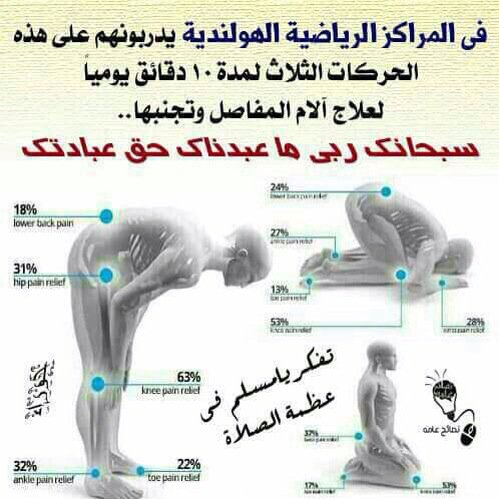
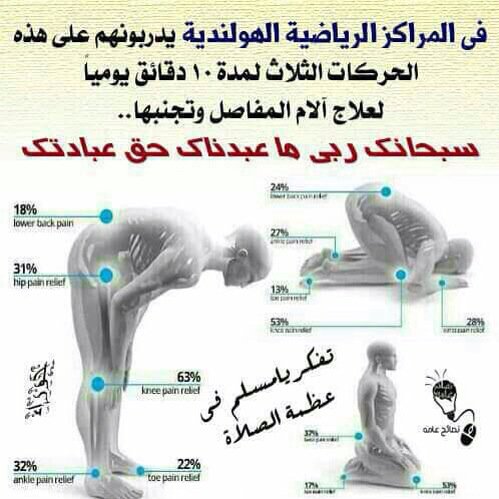
In Dutch sports centres, they train people in these three movements
for 10 minutes daily to treat and prevent joint pain.
Glory be to You, my Lord; we have not worshipped You as You deserve.
Comment:
We shall assume that this post was made by a Muslim who loves his religion, not by Arab atheists who invent false information and circulate it among ordinary Muslims to mock and sow doubt!
We know that everything God has prescribed and commanded is good, merciful, wise and beneficial. We therefore affirm that establishing prayer causes no harm to the Muslim, and we do not rule out certain health benefits from performing it. But this is not the purpose and end of prayer, such that we should say here: “Glory be to You; we have not worshipped You as You deserve.”
Joint pain and other conditions existed in the Prophet’s time, peace and blessings be upon him. Nevertheless, we do not know that he directed anyone to the movements of prayer to relieve them. We do know with certainty that he directed worshippers to avail themselves of concessions to omit certain essential elements of prayer if performing them entailed hardship and harm. Al-Bukhari (1117) reported from Imran ibn Husayn, may God be pleased with him: “I had haemorrhoids and asked the Prophet, peace and blessings be upon him, about prayer. He said: ‘Pray standing; if you cannot, then sitting; if you cannot, then on your side.’”
We also know that the Prophet’s feet swelled when he prolonged standing in prayer. Al-Bukhari (4837) reported from A’ishah, may God be pleased with her, that God’s Prophet, peace and blessings be upon him, would stand in prayer at night until his feet cracked. A’ishah asked: “Why do you do this, Messenger of God, when God has forgiven your past and future sins?” He said: “Should I not love to be a thankful servant?” When he gained weight, he prayed sitting; when he wished to bow, he stood, recited and then bowed.
This hadith shows that prayer does not prevent the natural physical effects of bodily movement and the hardship and fatigue it entails. The Prophet, peace and blessings be upon him, experienced hardship from prolonged standing and also took the concession concerning standing in voluntary prayer.