
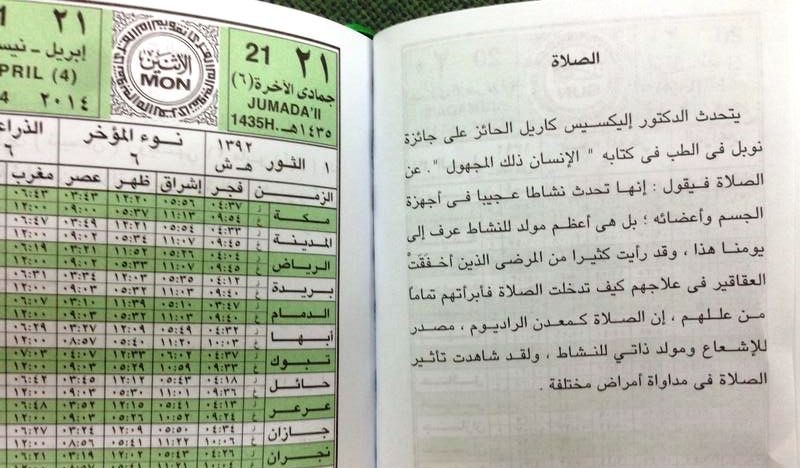
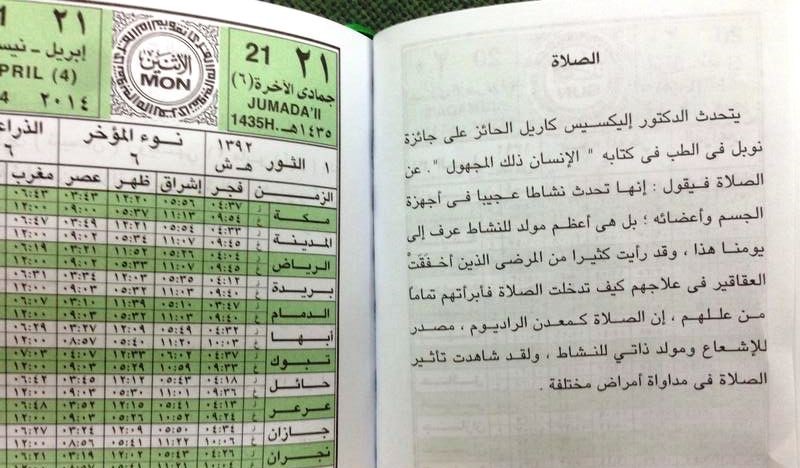
Dr Alexis Carrel, winner of the Nobel Prize in Medicine, discusses prayer in his book Man, the Unknown:
“It produces remarkable activity in the body’s systems and organs. Indeed, it is the greatest generator of activity known to this day.
“I have seen many patients whom drugs failed to treat, and how prayer intervened to cure them completely of their illnesses.
“Prayer is like radium: a source of radiation and a self-generating source of activity. I have witnessed prayer’s effect in treating various diseases.”
Comment:
-
The author of Man, the Unknown is the French physician and surgeon Alexis Carrel, born in Lyon in 1873 and, according to this account, deceased in Paris in 1944 in prison, where he had been imprisoned on charges of Nazi affiliation. He was not Muslim, and does not appear to have been observant in his Christianity. His book centres on the idea that humanity can improve itself by following the guidance of an intellectual elite and imposing a compulsory eugenics system. He therefore sees religious rituals, of whatever religion, even polytheistic and idolatrous ones, as means of strengthening people’s spiritual and emotional side to assist recovery.
-
Once this is understood, how can the words of a Christian, an atheist or a utilitarian physician about Christian prayer or polytheistic, idolatrous prayer be cited as evidence about Muslim prayer? Muslim prayer is the second pillar of Islam and among Muslims’ most distinctive practical characteristics in its form, remembrances, conditions, essential elements and times. This undoubtedly opens the way to confusing religions.
-
A settled principle of Muslim creed is that false worship, involving unbelief or associating partners with God, does not benefit its practitioner. Rather, it increases error and confusion and fills the heart with sorrow and constriction. It does not bring a person nearer to God, but becomes a burden upon them in this world and the hereafter. God says: “Whoever turns away from My remembrance will have a constricted life, and We shall raise him blind on the Day of Resurrection. He will say, ‘My Lord, why have You raised me blind when I used to see?’ He will say, ‘Thus Our signs came to you and you disregarded them, and thus today you are disregarded’” (Ta Ha 20:124–126). The relevant point is the condemnation for not following God’s signs, His message and law.
God says: “Avoid the filth of idols and avoid false speech, inclining to God and associating no partners with Him. Whoever associates partners with God is as though he had fallen from the sky and been snatched away by birds, or the wind had blown him to a far-off place. So it is. Whoever honours God’s sacred rites, that comes from the mindfulness of hearts” (al-Hajj 22:30–32).
He says: “Say: ‘We believe in God, in what has been revealed to us, in what was revealed to Abraham, Ishmael, Isaac, Jacob and the tribes, and in what Moses, Jesus and the prophets were given by their Lord. We make no distinction between any of them, and to Him we submit.’ Whoever seeks a religion other than Islam, it will never be accepted from him, and in the hereafter he will be among the losers. How would God guide people who disbelieved after their faith, after testifying that the Messenger was true and after clear proofs had come to them? God does not guide wrongdoing people. Their recompense is the curse of God, the angels and all humanity, remaining therein; their punishment will not be lightened, nor will they be reprieved, except those who repent afterwards and mend their ways, for God is Forgiving, Merciful” (Al ‘Imran 3:84–89).
-
Sound Islamic creed undoubtedly holds that prayer is among the greatest causes of an open heart, happiness of soul and healing from psychological and bodily illnesses and pain. But this is not in the material, utilitarian, psychological or philosophical manner Dr Carrel explains in his book. Nor does it arise from the movements of prayer themselves, which Muslim and unbeliever alike can perform and which different religions may share or resemble.
In Islamic belief, prayer’s benefits, advantages and fruits arise because it is among the greatest acts of worship bringing a servant close to God, Lord of the worlds, in whose hand lies every affair. Abraham, peace and blessings be upon him, described Him: “Who created me and guides me; who feeds me and gives me drink; when I am ill, He heals me; who will cause me to die and then bring me to life; and who I hope will forgive my sin on the Day of Judgement” (al-Shu‘ara’ 26:78–82). The Messenger of God, peace and blessings be upon him, said: “The closest a servant is to his Lord is while prostrating.”
Prayer is therefore worship devoted exclusively to God, bringing the servant close to their Lord and Creator. They humble themselves before Him and ask for guidance, happiness, right direction and healing from psychological and bodily illnesses. God answers supplication and hears the call. A person may therefore expect to benefit through God’s response, help, kindness and granting of success. Prayer’s benefits and advantages truly come from God, who grants them to whom He wills and withholds them from whom He wills. He judges, and none can overturn His judgement. These benefits do not arise from bare acts and movements of prayer, equally performable by the sincere and the ostentatious, believers and hypocrites, indeed Muslims and unbelievers.