Text of the publication
Prostration
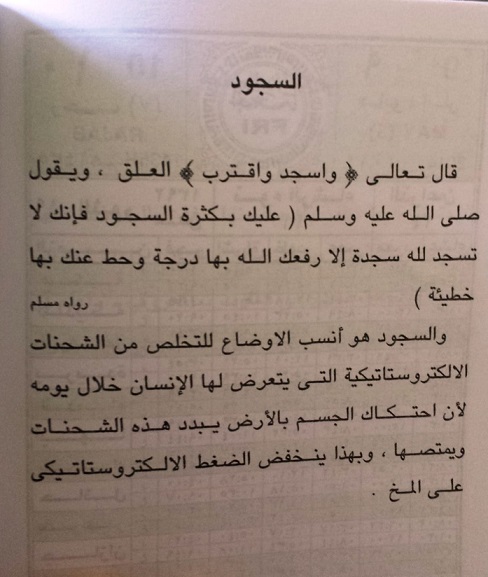
God says, “Prostrate and draw near.” [al-‘Alaq: 19.] The Prophet, may God bless him and grant him peace, says: “Prostrate frequently, for you do not perform a single prostration to God without His raising you a degree by it and removing a sin.” Prostration is the most suitable position for getting rid of the electrostatic charges to which a person is exposed during the day, because contact between the body and the ground dissipates and absorbs those charges, thereby reducing electrostatic pressure.
Comment
1. Despite the lack of credibility of claims about charges and energy associated with prostration and prayer, as we explained in “Alleged Energy and Prostration”, such assertions remain popular among many people. They offer tangible, immediate worldly benefits that accord with human nature as originally created. God says: “The human being was created of haste.” [al-Anbiya’: 37.] This is what the Center for Studies in the Interpretation of Islam seeks to address, reminding ordinary people and specialists alike of the need for sincerity in word and deed. Their worship must rest on affirming God’s oneness and following the Prophet: singleness of intention, purpose and seeking, and exclusive adherence to the Prophet, may God bless him and grant him peace.
2. Prostration is a great act of worship intended to bring nearness to God, attain His pleasure and enjoy communion with Him. The person praying should sense God’s nearness in this state. That is the intended end. After that, whether electrostatic charges are removed or not is of no concern. This is merely contrivance and excessive absorption in the details of worldly benefits that take worship away from its true meaning. How excellent, therefore, are the words of Shaykh Muhammad al-Khidr Husayn, may God have mercy on him, formerly mufti of al-Azhar: “As for acts of worship such as prayer, fasting and Hajj, their foundation for the person legally responsible is devotional obedience. Their general wisdom is submission to God’s commands and singling Him out for humility and glorification. The Lawgiver may explain a particular rationale. Drawing near to God through something whose wisdom He has not disclosed to us, however, more strongly demonstrates complete servitude to Him and sincerity in turning to Him. Performing acts of devotion whose fitting wisdom we understand is not free from some admixture of seeking the benefits that result from them. Although that does not invalidate the act, it diminishes its purity slightly. If someone who does not follow Islamic law asks, ‘Why is the noon prayer four units and the sunset prayer three?’, silence that person with this point of wisdom. If a follower of Islamic law asks it, we say: God and His Messenger know best.” Encyclopaedia of the Complete Works of Imam Muhammad al-Khidr Husayn, 12/2/101.
3. Such cards and calls proliferate in a society dominated by material concerns that has forgotten, or almost forgotten, spiritual meanings: love of God, hope in Him, fear and awe of Him. This explains why such publicity did not gain currency among the early generations, whose lives expressed God’s wisdom in creation: “I created jinn and human beings only to worship Me.” (56) [al-Dhariyat.] God knows best.
Further reading
- Were Ablution and the Face Veil Prescribed, and Mixing Prohibited, to Prevent Epidemics?
- Comment on Dr Muhammad Ratib al-Nabulsi’s Article on the Health Benefits of Prayer
- The Two Wedding Prayer Units and Electrical Charges
- Prostration and Good Thinking
- Encouraging Prostration by Magnifying Its Worldly Benefits
- Humility in Prayer and the Hormone Endorphin
- Worship and Physical Health