
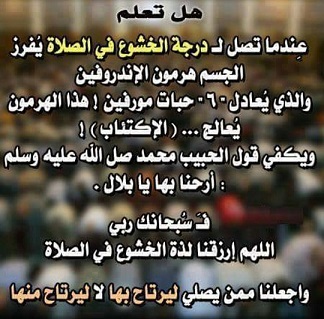
Text of the post:
“Did you know that when you reach a state of humility in prayer, the body releases the hormone endorphin, equivalent to six morphine tablets? This hormone treats depression! The words of our beloved Muhammad, peace and blessings be upon him, are sufficient: ‘Give us rest through it, Bilal.’
“Glory be to You, my Lord. God, grant us the sweetness of humility in prayer, and make us among those who pray to find rest through it, rather than rest from it.”
Comment:
1. Worship was not originally prescribed for psychological comfort in this world or immediate happiness. Such comfort may be one of its benefits, but it is not the foundation or intended purpose. Otherwise, there would be no difference between worship in Islam and in other religions. If the experiments are correct, this hormone is released during feelings of tranquillity and comfort, even during sleep and sexual intercourse. It is not exclusive to worship, much less suitable as publicity to attract people to religion. The call to Islam should be distinguished from others by showing its distinctive characteristics: it is truly a relationship between the servant and their Lord, whose purpose is to glorify the Lord and humble oneself before Him in order to attain Paradise and the home of the hereafter.
2. Encouraging religion by foregrounding experimental information that may be confirmed today and refuted tomorrow undermines people’s confidence in their religion and worship.
3. The humility commanded and encouraged is not any kind of humility or any feeling of tranquillity. Such feelings may occur in unbelievers, the immoral and the disobedient who rely on worldly life and feel secure in it. Their fate is as God says: “Those who do not expect to meet Us, who are content with worldly life and feel secure in it, and those heedless of Our signs: their refuge will be the Fire because of what they used to earn” (Yunus 10:7–8). Yet of believers He says: “Those who believe and whose hearts find peace in the remembrance of God. Surely in the remembrance of God do hearts find peace” (al-Ra‘d 13:28). Both groups may release this hormone. Reflect on that.
4. The true benefit of humility does not lie in whether this hormone is present. It lies in fulfilling humility in the manner God loves. That is what the hadith “Give us rest through it, Bilal” means. Shaykh Abd al-Rahman al-Sa‘di writes in his commentary: “Humility in prayer is the heart’s presence before God, conscious of His nearness. The heart consequently becomes still, the soul at peace, movements quiet and glances elsewhere few, observing proper conduct before the Lord and attending to everything said and done in prayer from beginning to end. This removes intrusive thoughts and corrupt ideas. It is prayer’s spirit and purpose, and what is recorded for the servant. A prayer lacking humility and presence of heart, even if it fulfils the obligation and is rewarded, is rewarded according to what the heart understands of it.” Taysir al-Karim al-Rahman, p. 547.
5. God undoubtedly prescribed acts of worship suited to the nature with which He created us. This confirms that Islamic law imposes nothing beyond our capacity. In His mercy, He facilitates causes arising from worship that assist and encourage its continuity and regular observance. This is His mercy and favour: “If the people of the towns had believed and been mindful of God, We would have opened to them blessings from heaven and earth. But they denied, so We seized them for what they used to earn” (al-A‘raf 7:96).
Finally, there is no objection to a Muslim turning to God in humble supplication through prayer, prostration and supplication when afflicted by anxiety, distress or depression. When a matter troubled the Prophet, peace and blessings be upon him, he prayed. This fulfils reliance on God, who alone removes harm and lifts affliction. But this occurs occasionally in response to incidental circumstances. Muslims must understand that this is neither the reason for the humility commanded nor the purpose of prayer and prostration. The aim and purpose of all worship, inward or practical, is to glorify God and draw near to Him with love, fear and hope, to gain His pleasure and attain the everlasting abode of bliss.
God knows best.
For more, see:
People’s positions on the benefit and wisdom of worship