
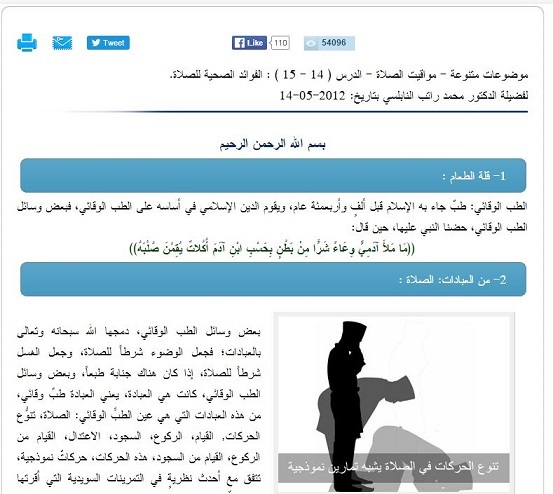
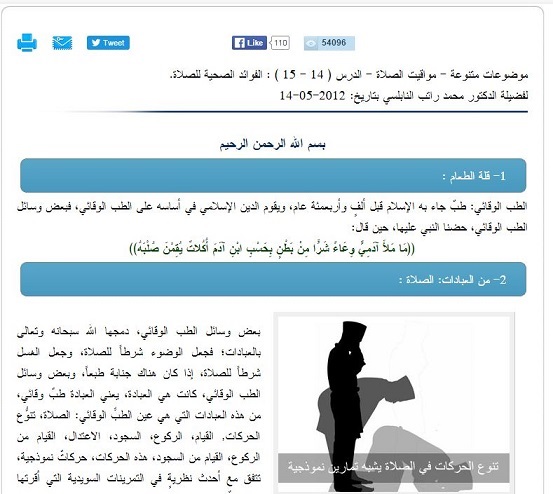
Dr al-Nabulsi wrote an article on prayer’s health benefits, published on his website, The Nabulsi Encyclopaedia, entitled “Prayer Is the Pillar of Religion”.
http://www.nabulsi.com/blue/ar/art.php?art=11549
We have observations on this article, set out below:
Comment:
1. The article details many health benefits of prayer, giving the reader the impression that prayer was prescribed only for this purpose. This is religiously objectionable, because the fundamental objective of worship is its devotional dimension: humility, submission and reverence for God, His right over His servants and the end and purpose of human creation. Concentrating on these benefits leads away from the fundamental objective of prescribed worship.
2. The article does not discuss the place of these benefits in performing this great act of worship. When such benefits are mentioned, the true purpose should be emphasised and readers reminded of the need to make their intention sincere to God, so that sincerity is not impaired and worship does not become primarily intended solely for its health benefits rather than the purpose for which it was prescribed.
3. The article displays cards about prayer and prostration with statements such as “Prostration gives the brain’s arteries elasticity that protects them against blood-supply disorders” and “Poor blood supply is one cause of migraine, and prostration prevents it”. These statements and cards, without clarification or guidance, help spread the utilitarian interpretation of religion, a deviation from the correct interpretation of religion and worship.
4. The article contains unqualified statements reflecting the distorted conception of religion held by those who make health, social and psychological benefits the objective of worship. For example: “Some methods of preventive medicine were acts of worship; that is, worship is preventive medicine. Among these acts of worship that are preventive medicine itself is prayer: the variety of movements, standing, bowing, prostrating, straightening, rising from bowing and rising from prostration. These are ideal movements corresponding to the latest theory of Swedish exercises approved by a group of scholars in this field of physical education.” This is clear excess in interpreting worship and a distorted conception of religion’s objectives.
5. Another manifestation of excess is the article’s discussion of morning sunlight and its connection to the dawn prayer: “According to doctors, the best times to benefit from sunlight are sunrise and sunset. Hence the dawn prayer is highly important for human health, because peoples who are not exposed to sunlight and sleep for extended periods suffer from softening of the bones and rickets. Even when God’s command is devotional and constitutes worship, we cannot overlook its health aspects.” This contradicts the religious and practical reality of the dawn prayer: it is not valid at sunrise, a time when prayer is prohibited, and the Sunnah is to perform the dawn prayer while it is still dark. This is agreed upon in the report from Jabir ibn Abd Allah, may God be pleased with him, in al-Bukhari (560) and Muslim (646). God says: “Glorify your Lord with praise before sunrise and before sunset” [Qaf: 39]. Perhaps the doctor sensed the recklessness of his assertion and resorted to speculative attributions to doctors, saying: “Scientists may say that direct exposure to the rays is not what matters; the scattered rays at these two times help the skin form vitamin D, which contributes to bone growth, pancreatic function, bone-marrow growth and skin cells!” There is no explanation for this confusion except excess in this area. As the old saying has it: “Your love of a thing blinds and deafens.” God knows best.
For more, see:
– People’s Positions on the Benefit and Wisdom of Worship.
– Prostration and Good Thinking.
– Encouraging Prostration by Magnifying Its Worldly Benefits.