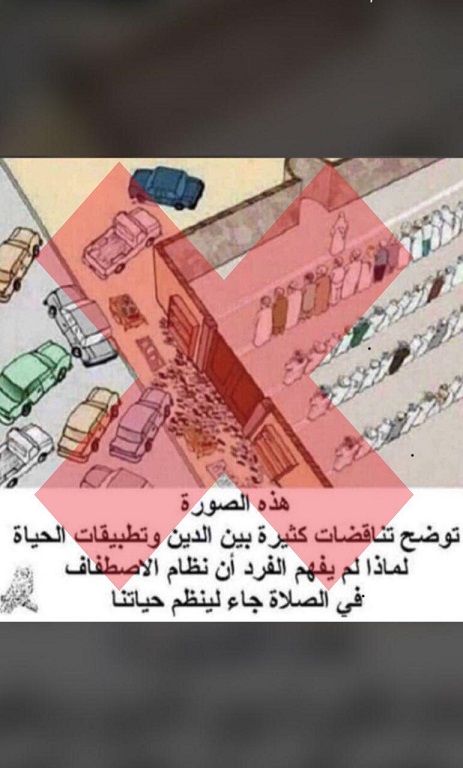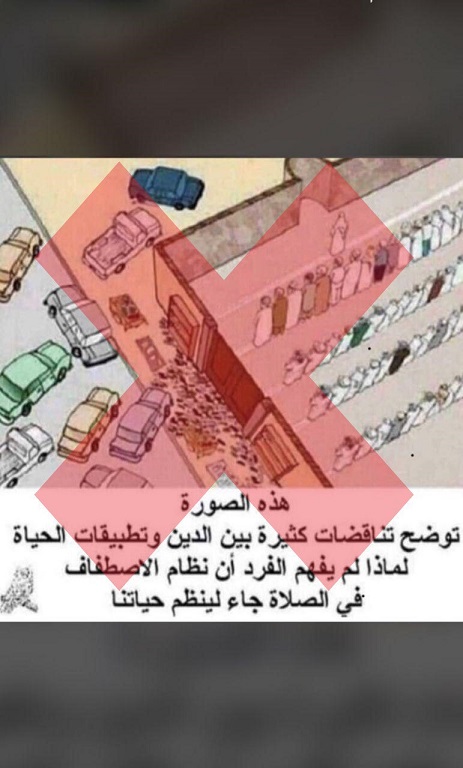
Text of the publication
“This picture shows many contradictions between religion and everyday practice. Why has the individual not understood that lining up in prayer came to organise our lives?”
Comment
1. Order and organisation are among the merits of this religion, encouraged by Islamic law and called for by reason. There are many ways to encourage order and organisation, so why turn to acts of worship and link them to worldly benefits? Had God wanted that from us, He would have explained it through His Messenger, may God bless him and grant him peace.
2. Islamic law commands the ordering of prayer rows in a specific, simple act whose observance entails neither hardship nor difficulty. As for organising worldly affairs, the Wise Lawgiver left this to people’s reason, customs, habits and traditions. Peoples differ greatly in such matters according to these characteristics and the environmental and material conditions around them. Imposing one particular system on them would entail severe difficulty and hardship, contrary to the forbearance of Islamic law. The comprehensive legal principle concerning worldly affairs is therefore: “The original rule concerning customs and transactions is permissibility.” Each people organises its affairs according to its disposition and customs, provided it does not contravene an established rule of Islamic law or neglect a command. This accommodating law nevertheless places limits and rules on their actions. It commands justice, truthfulness, fidelity, observance of pledges and covenants, obedience to those in authority in organising society’s affairs, and protection of people’s lives, property and honour. It prohibits injustice, violating others’ rights, treachery, betrayal, waste and extravagance. It also prohibits undermining people’s security and safety and strongly forbids placing harmful obstructions on roads or blocking them. Someone who avoids all these things, neglecting no command and committing no forbidden act, is free in their conduct and behaviour. This differs from modern ideas and contemporary systems that restrict people like slaves and prisoners. When individuals or societies differ through a distinctive action or practice, without committing a forbidden act or infringing anyone’s rights, they are criticised, shamed and described in the ugliest terms. This is, in reality, intellectual extremism, racism and a failure to respect differences in peoples’ customs and cultures.
3. The Sunnah explains the reason for lining up in prayer and its effect. Muslim (430) narrates from Jabir ibn Samurah, may God be pleased with him: the Messenger of God, may God bless him and grant him peace, came out to us and said, “Will you not form rows as the angels form rows before their Lord?” We asked, “Messenger of God, how do the angels form rows before their Lord?” He replied, “They complete the first rows and stand closely together in the row.” This is the reason.
As for the effect, al-Bukhari (717) narrates from al-Nu‘man ibn Bashir, may God be pleased with them both, that the Prophet, may God bless him and grant him peace, said: “You must straighten your rows, or God will cause discord between your faces.” A narration in Abu Dawud (662) says, “between your hearts”. This clearly shows that abandoning this outward Sunnah causes disagreement between hearts and faces, an inward matter. This is the effect that should be highlighted and made clear, rather than saying that rows came to organise life!
4. One could say: God made worship, the purpose of creation, orderly in its times, forms and other aspects. Why, then, do we not organise our worldly lives, in which God has authorised us to act, and abandon disorder? This is better than making organising worldly life and managing it well the purpose of worship.
5. This claim destroys sincerity in performing worship. The purpose of obeying God by ordering the prayer rows is to perform worship in the manner He loves and approves, so that we may gain His pleasure, attain His Paradise and unite our hearts in love and reverence for Him. The other guidance, however, ties worship to worldly life, so that one hears, “There is no good in your prayer unless you improve your worldly affairs and organise your traffic!” How different revelation is from human thought. God knows best.
Further reading
- Alleged Energy and Prostration
- Were Acts of Worship Prescribed to Protect People from Aggression, Oppression and Injustice?
- Worship and Physical Health
- Have You Heard of Penguins’ Fasting?
- Prostration and Good Thinking
- Encouraging Prostration by Magnifying Its Worldly Benefits
- Humility in Prayer and the Hormone Endorphin