Supplication and Psychological Anxiety
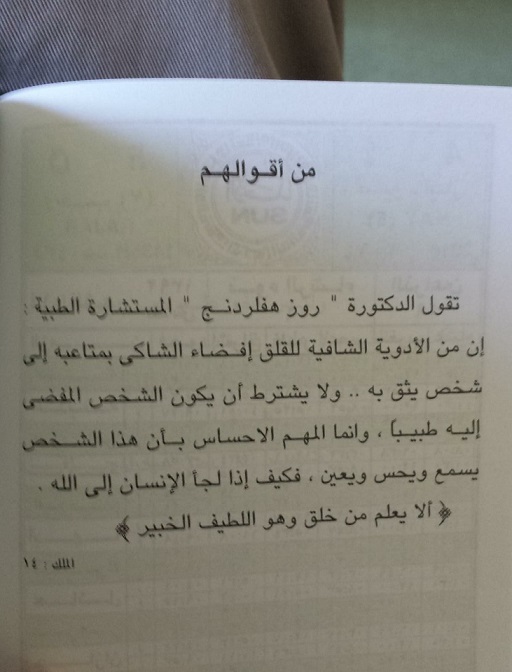
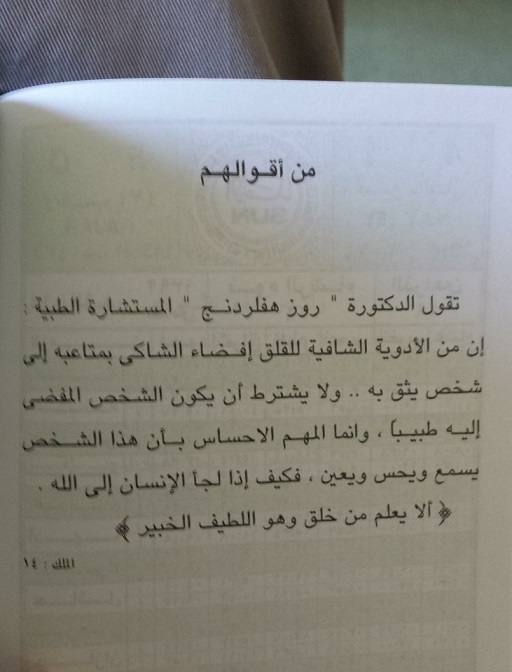
The Text Published in the Umm al-Qura Calendar
Among their sayings: medical adviser Dr. Rose Hilferding says that one of the remedies that heal anxiety is for the sufferer to tell his troubles to someone he trusts. That person need not be a physician. What matters is feeling that this person listens, empathizes, and helps. How much more so, then, when a person turns to God: “Does He who created not know, when He is the Subtle, the All-Aware?” [al-Mulk: 14].
This quotation also appeared on several Islamic websites, including the English-language website Prayer in Islam: Psychological Benefits of Prayer.
Comment
1. These words of Dr. Rose Hilferding have a story and context mentioned by Dale Carnegie in How to Stop Worrying and Start Living (Arabic translation by Abd al-Mun‘im Muhammad al-Ziyadi, al-Khanji Library, Cairo, 16th edition, 1994, p. 259). In chapter twenty-five, “Wives: Avoid Fatigue to Preserve Your Youth”, he mentions that a psychological clinic called the “School of Applied Psychology” was established in a Boston hospital in the United States to treat, through psychotherapy, certain patients who displayed symptoms of physical illness. Several women had come to the hospital, but thorough medical examination showed that they had no illness whatsoever and that giving advice to these women who imagined illness was unhelpful. Psychological treatment was therefore necessary. At this point Carnegie said:
“Dr. Rose Hilferding, the medical adviser to this school, says: ‘One of the remedies that heal anxiety is for the sufferer to tell his troubles to someone he trusts. [We call this catharsis.]’ She says: ‘When patients came to this school and were able to discuss their troubles at length and in detail, worry disappeared from their minds. Merely brooding over a grievance, storing it in the mind, and keeping it to oneself can create considerable nervous tension. [We all have to share our troubles. We have to share worry. We have to feel that someone in the world is willing to listen and able to understand.]’”
Carnegie said:
“My secretary, who was taking a course at that school, saw Dr. Rose’s statement put to the test. One of the school’s students stood up to speak about what worried her. She was experiencing family problems. When she began talking, her words came out like the broken gasps of a wounded person. Then her voice grew clearer, her tone became more distinct, and her breathing gradually became regular. Relief began to spread through her and appear on her face, until, when she finished speaking, she was smiling brightly. Had her problem been solved? No! Solving the problem is not so easy. What produced this transformation was simply talking to someone who listened, understood, cared, and advised. Yes, the transformation came from the great healing power contained in words.
“Psychoanalysis relies to a large extent on this healing power contained in words. Psychoanalysts have come to believe that patients can free themselves from psychological crises if they keep talking about them. Why is this so? Perhaps because talking allows us to gain a deeper perspective on our problems, or perhaps because by talking we release the problem weighing on our chests. So the next time worry overtakes us, let us find someone we trust and tell that person the full story of our troubles.
“I do not mean making ourselves a burden on people and weighing down everyone we happen to meet with our problems. Let us choose someone we trust and arrange a visit. This person may be a physician, a lawyer, or a clergyman. When you sit with him, say: ‘I have come to ask your advice. I have a problem that I hope you will listen to. Perhaps you can guide me toward what I should do. If you can help me, I will be deeply indebted to you. If you cannot, simply listening to my problem will be a great help.’
“If you find no one you trust available, let me tell you about the Save-a-Life League, the strangest organization in the world. It was originally established to save the lives of people attempting to end their lives by suicide. Over time, however, its remit broadened, and it began offering advice to any unhappy person who requested it. I recently spoke to Miss Lona B. Bonnell, who is responsible for meeting those who come to the League for advice. She kindly offered to answer any letter sent to her by readers of this book. If you write to the Save-a-Life League, therefore, be confident that your problem’s secrets will be kept safe and that an honest adviser will respond. Frankly, however, I believe it is better to tell your problem to someone who sits with you and listens. If that is impossible, there is no harm in writing to the League.”
Here Carnegie’s words end. We have corrected parts of the translation and restored the passages placed in square brackets from the English original: How to Stop Worrying and Start Living, by Dale Carnegie, Kingswood, Surrey: World’s Work, 1953, pp. 209–211.
2. Once we know the reason and context of these words, it becomes clear that they concern people suffering from anxiety disorders and psychological disturbance. Those physicians used this method to give them an outlet and empty out the delusions within them. We also find that Dale Carnegie recommended this method for expressing grievances to created beings. Anyone unable to find someone to speak to directly should write to an organization specializing in helping this category of psychologically ill patients. Neither before nor afterward did he mention turning to the great Lord, majestic is His glory, because this writer and others like him belong to the atheists whose relationship with God, mighty and majestic, has been severed, even a relationship through following distorted, false religions.
This method of treating psychological illness represents the materialist, atheistic approach entrenched in Western societies. Projecting it onto the Islamic approach and Muslim societies is a matter of great ignorance and misguidance. It is noteworthy that Shaykh Muhammad al-Ghazali (d. 1416 AH / 1996) passed over this chapter in his book Renew Your Life, which he wrote as a comparison between Carnegie’s book and the Islamic approach to purifying and reforming souls.
3. The first thing a sincere believer hastens to do is complain to God Most High and speak intimately to Him. This is the condition of the finest of His creation, His prophets and righteous servants. Jacob, peace and blessings be upon him, said when afflicted by the loss of his son Joseph, peace and blessings be upon him: “I complain of my anguish and grief only to God, and I know from God what you do not know” [Yusuf: 86]. Likewise God Most High tells us of Job, peace and blessings be upon him: “And Job, when he called to his Lord: ‘Affliction has touched me, and You are the most merciful of the merciful.’ So We answered him and removed his affliction, and gave him his family and their like with them, as a mercy from Us and a reminder to those who worship” [al-Anbiya’: 83–84].
Complaining to people is generally permissible when it contains nothing prohibited, such as resentment against God’s decree and predestination. But it is a state of weakness and deficiency, not strength and perfection. Hence verses and hadiths encourage patience, seeking reward, and turning to God Most High. Scholars have discussed complaining to God Most High and complaining to created beings. These have rulings and manners that this discussion does not have room to address.
4. The Muslim’s creed is founded on reality, not imagining and fantasizing. God Most High hears supplication, answers the call, and aids those who seek help. The Exalted says: “When My servants ask you about Me, I am near. I answer the supplicant’s call when he calls upon Me. So let them respond to Me and believe in Me, so that they may be rightly guided” [al-Baqarah: 186]. He, exalted is He, says: “Your Lord says: ‘Call upon Me; I will answer you. Those who are too proud to worship Me will enter Hell humiliated’” [Ghafir: 60]. The Mighty and Majestic says: “Who answers the distressed when he calls upon Him, removes harm, and makes you successors on the earth? Is there a god alongside God? Little do you take heed” [al-Naml: 62]. The verses establishing these meanings are very numerous.
This other method, however, rests on “venting” and “relief” through speech alone, without any solution at all, as Carnegie said. It is thus a method of illusion and imagination. Turning to God Most High, by contrast, rests upon and produces definite worldly and otherworldly realities, concerning which there is no doubt or uncertainty for one who believes in God Most High, is certain of His promise, and seeks the abode of the Hereafter.
5. How far this materialist approach is from fulfilling God’s right through worshipping Him, drawing near to Him, and submitting and humbling oneself before Him! This is the primary and greatest purpose, which must always be present in the supplicant’s heart and intention. Hence frequent supplication in times of ease helps bring a swift answer in adversity. He, peace and blessings be upon him, said: “Whoever would be pleased for God to answer him in hardships and distress should supplicate frequently in times of ease.” [A sound hadith, reported by al-Tirmidhi, 3382.]
Servitude to God is more manifest in supplication during ease than during hardship, because in the former a person pays less attention to his own benefit. For that reason most people neglect supplication in times of ease. Removing anxiety by turning to God, pleading before Him, and supplicating to Him is among the benefits of supplication that God may hasten to grant the supplicant in this world through His favor and generosity. Some of these may also be the soul’s share of comfort in turning to its Creator and Maker.
6. Adopting this method from materialist Western psychiatry arises from being influenced by a materialist view of religion and worship. That view recognizes the reality of religious commitment and worship only to the extent that they produce worldly benefits, whether health-related, social, material, or political. This is the affliction of adherents of the political and utilitarian interpretation of religion. They have begun citing atheists’ words to serve their outreach, stripping acts of worship, among the greatest of which is supplication, of their most important purpose and turning them into medical prescriptions solely for treating worldly problems.
In this connection we found that preachers of the Jehovah’s Witnesses, a Christian sect that emerged in modern times in the late nineteenth century and was officially established in 1931, use Dr. Rose’s statement in their publications. Its worldwide publication The Watchtower, volume 113, issue 8, dated 15 April 1992, stated under the title “We Need Someone to Listen to Us”:
“As humans, we try to find joy and satisfaction in life. But when personal problems arise, how helpful and comforting it is to have someone to talk to about them! Dr. George S. Stevenson says: talking things over helps relieve pressure, helps you see your anxiety more clearly, and often helps you understand what you can do about it. Dr. Rose Hilferding observed that we all need to share our problems. We need to share worry. We need to feel that someone in the world is willing to listen and able to understand.
“Of course, no human can fully meet this need. Because of limited time and other factors, those close to us may not be available when we need them most, or we may hesitate to discuss certain matters even with our closest friends. Nevertheless, true Christians are not completely deprived of someone to listen to them, because the avenue of prayer is always available. The Bible repeatedly encourages us to pray to God, our Creator, whose name is Jehovah. We are directed to pray sincerely in Jesus’ name and in harmony with God’s will. Even personal and private matters are suitable subjects for prayer…”
This practice of the Jehovah’s Witnesses reveals how advocates of modern movements try to use psychological experiments in religious discourse. This reverses the proper order. For the believer, creed is the absolute truth, and psychological experiments are judged by it, not the reverse. Regrettably, some Islamic preachers have begun following this method in their desire to widen the reach and influence of their outreach, even through illusion, falsehood, and things with no basis in God’s religion, indeed even things contrary to correct Islamic creed.
7. Many people overlook the meanings of drawing near to God through supplication. They know no meaning for it beyond the benefit to themselves of obtaining a worldly advantage or warding off a worldly harm. On this, the eminent scholar Abd al-Rahman ibn Nasir al-Sa‘di, may God have mercy on him, says:
“Someone who supplicates to his Lord to obtain something desired or avert something feared should not confine his purpose and intention to obtaining the request for which he supplicated. Rather, through his supplication he should intend to draw near to God by supplication and worshipping Him, which is the highest of ends. He will then be certain of the benefit of his supplication. Supplication is the marrow and essence of worship: it draws the heart toward God, and the person’s need compels him to humble himself and plead before God, which is the greatest purpose of worship.
“Someone whose purpose in supplication is both drawing near to God through it and obtaining his request is far more complete than someone who intends only to obtain his request, as is the case with most people. The latter is deficiency and deprivation of this great merit. For such a thing let those who compete compete. This is one of the fruits of beneficial knowledge. Ignorance has prevented many people from noble purposes and beautiful means that they would pursue if they knew them and seek to attain if they were aware of them. God grants success.”
Al-Fatawa al-Sa‘diyyah, al-Ma‘arif edition, pp. 51–52. God knows best.
For Further Reading
- People’s Doctrines Concerning the Benefit and Wisdom of Worship
- Prostration and Good Thinking
- Encouraging People to Prostrate by Magnifying Its Worldly Benefits
- Worship and Physical Health
- Were Acts of Worship Prescribed to Protect Souls from Aggression, Oppression, and Injustice?