Text of the publication
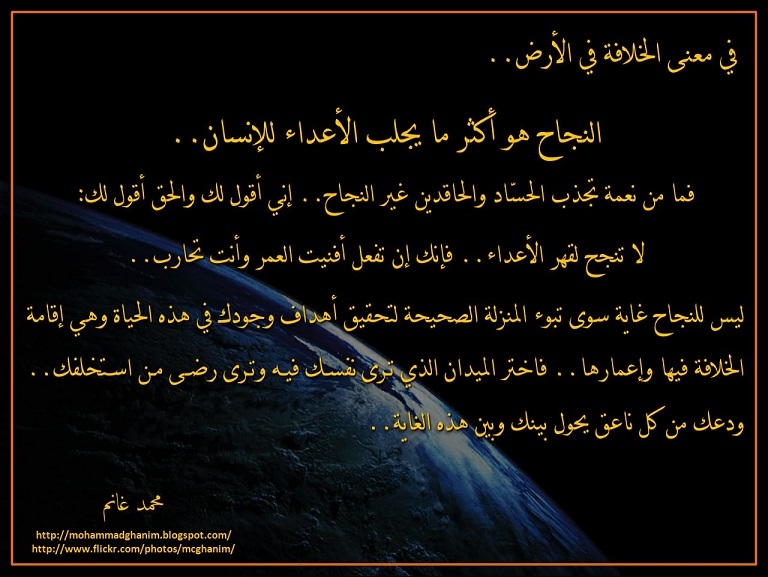
On the meaning of succession on earth
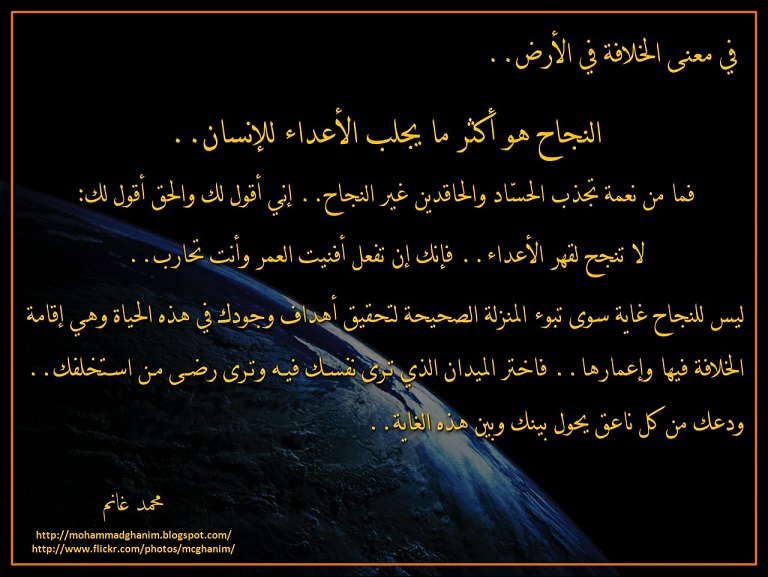
“Success brings a person more enemies than anything else. No blessing attracts the envious and spiteful like success. I tell you, and I speak truly: do not succeed to defeat your enemies, for if you do, you will spend your life fighting. Success has no purpose other than attaining the right position to fulfil the objectives of your existence in this life: establishing succession on earth and developing it. Choose the field in which you see yourself and the pleasure of the One who appointed you as successor, and ignore every clamouring voice that comes between you and this goal.” Muhammad Ghanem.
Comment
1. God created us to worship Him, saying: “I created jinn and human beings only to worship Me.” (56) [al-Dhariyat.] The Arabic particle here is called the particle of purpose. The real reason for creating a human being is that they should freely choose to be an obedient servant of God. If they do so, they have fulfilled the true purpose of their existence and the cause of their happiness, flourishing and success. God says: “Whoever is drawn away from the Fire and admitted to Paradise has truly triumphed. Worldly life is only a deceptive enjoyment.” [Al ‘Imran: 185.] Ibn al-Qayyim, may God have mercy on him, said: “The praiseworthy end through which Adam’s descendants attain perfection, happiness and success is knowing God, loving Him and worshipping Him alone without partner. This is the reality of the servant’s declaration, ‘There is no deity but God.’ For it the messengers were sent and all scriptures revealed. The soul becomes sound, pure and complete only through it.” [Miftah Dar al-Sa‘adah wa-Manshur Wilayat al-‘Ilm wa-l-Iradah, 2/1160–1161, ‘Alam al-Fawa’id edition.]
2. Many writers replace the term falah, frequently used in the Qur’an for true flourishing, with najah, success, although their meanings are very close: both indicate triumph, achieving goals and attaining happiness. Examining falah in the Qur’an, we find it denotes success in the Hereafter; those who attain it are believers who worship and obey their Lord, and flourishing in this world lies in worshipping and obeying God. This is very frequent; Surat al-Mu’minun alone suffices. There is no objection to using najah with the same meaning as the Islamic term falah. The problem concerns those whose concepts have become confused and whose ends have been reversed, so that means become ends and developing worldly life becomes the objective for which humanity was created. Such people move from the Qur’an’s frequent term falah to najah with a new meaning, avoiding accusations of criticising or distorting God’s Book. They then apply it to their distorted conception of succession in God’s words, “I am placing a successor on earth” [al-Baqarah: 30], changing human beings’ succession to one another, as the early generations interpreted it, into acting as God’s vicegerents in developing the earth. Someone working for worldly life thereby becomes the successful person who realises true succession! This is precisely the political interpretation of religion, which makes all Islamic law, including worship, into means of achieving worldly superiority and material gain through which Paradise is attained. This is the view of Islamist activists who acknowledge resurrection, judgement, Paradise and Hell. For atheist philosophers such as Ibn Sina and al-Farabi, however, there is no Paradise, Hereafter or resurrection, only imaginative representation. They agree on the foundation and differ in the conclusion.
3. The Islamic understanding of success and flourishing – gaining God’s pleasure and true happiness through entering Paradise and escaping the Fire – does not mean neglecting worldly life, its development or the means of worldly progress and advancement. These should, however, be obtained to the extent that they assist in worshipping and obeying God, affirming monotheism and abolishing polytheism, with action for God as the intended end. When progress and advancement conflict with the true purpose, they count as worldly life’s ornament and adornment. By this standard success and flourishing must be measured. Whatever helps realise worship of God alone and eases its paths is undoubtedly successful work, and its doer is among the triumphant if sincere. By contrast, making developing the earth the purpose for which humanity was created, still more making it the intended meaning of succession and declaring the possessor of worldly power the successor God placed on earth, changes human nature so that life becomes material, with no meaning beyond competing for its fleeting goods under the pretext of development. This brings resentment and envy, as the publication’s author noted. If the means of such development are unavailable, as is the case among Muslims, despair and despondency creep into some people, while others may turn to extremism and terrorism through resentment and envy over worldly goods: the desired goal has failed, so perhaps force and violence will achieve it.
4. In the Qur’an and Sunnah, righteous action refers to obeying and worshipping God, not simply every beneficial act, although a person doing good in general may be rewarded for their intention. God says: “Whoever does righteous deeds, male or female, while believing, We shall grant them a good life and reward them according to the best of what they did.” (97) [al-Nahl.] Ibn Kathir, may God have mercy on him, said: “This is God’s promise to any male or female descendant of Adam who performs righteous action – action following God’s Book and His Prophet’s Sunnah – with a heart believing in God and His Messenger and that this commanded action is prescribed by God: God will grant them a good life in this world and reward them for their best deeds in the Hereafter. The good life includes every form of comfort, from whatever source.” [Tafsir Ibn Kathir, 4/601, Taybah edition.] God knows best.
Further reading
- The Foremost Purpose of Worship: Between Obedience and Accumulating Good Deeds
- Were Acts of Worship Prescribed to Protect People from Aggression, Oppression and Injustice?
- Amr Khaled and the Wisdom of Creation
- ISIS: A Product of the Political Interpretation of Islam
- Succession Means Developing the Earth
- Scholarly Efforts to Refute the Political Interpretation of Islam
- Rather, the Political Interpretation Is a Bridge to Secularism