
Text of the post:
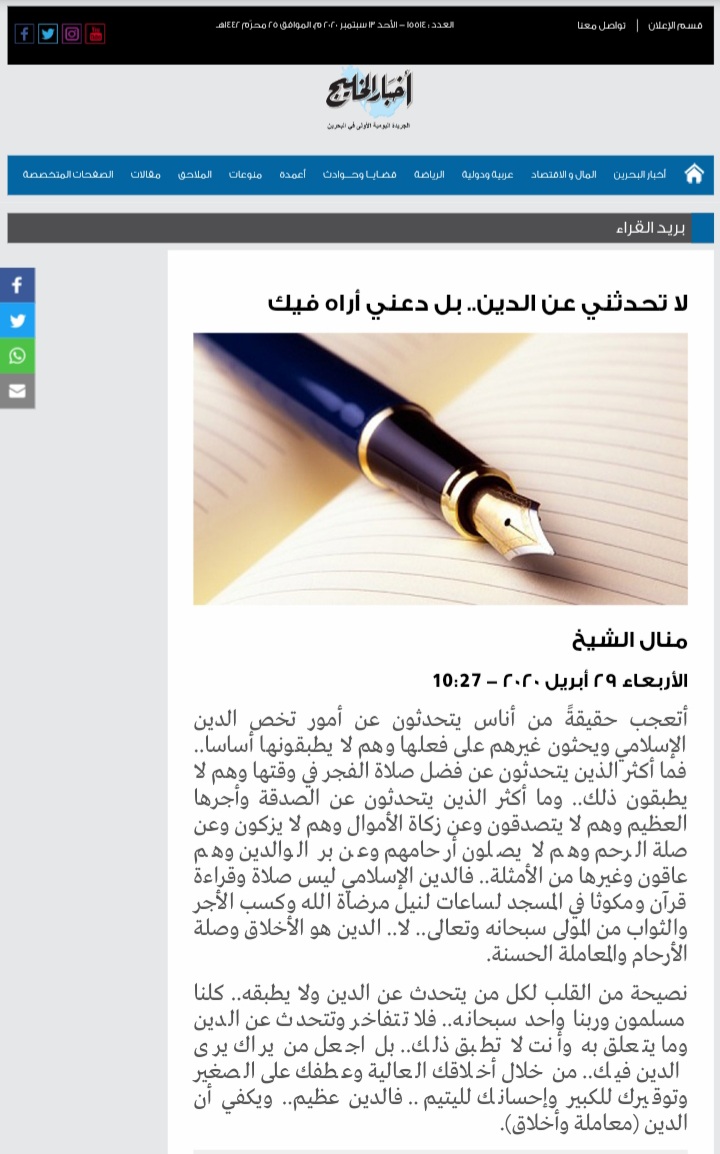
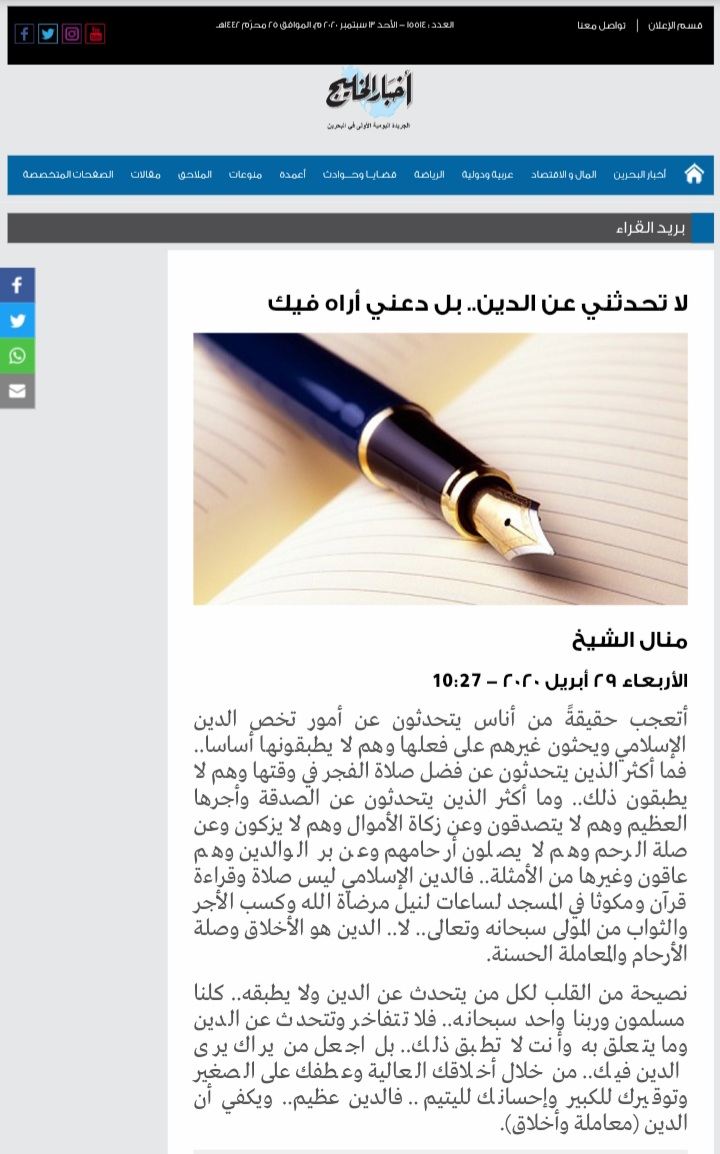
On 29 April 2020, Manal al-Shaykh wrote an article on the Akhbar al-Khaleej newspaper’s website entitled “Do Not Talk to Me about Religion; Let Me See It in You”. She wrote:
“I am genuinely astonished by people who speak about matters of Islam and urge others to practise them when they do not practise them themselves. How many talk about the merit of praying at dawn on time but do not do so; about charity and its great reward but do not give charity; about obligatory alms on wealth but do not pay them; about maintaining family ties but neglect their relatives; about kindness to parents while being disobedient, and other examples. Islam is not prayer, reciting the Qur’an and spending hours in the mosque seeking God’s pleasure and reward from the Lord. No: religion is morals, family ties and good treatment. Heartfelt advice to everyone who talks about religion without practising it: we are all Muslims and our Lord is one. Do not boast and talk about religion and its matters without practising them. Instead, let whoever sees you see religion in you through your high morals, kindness to children, respect for elders and goodness to orphans. Religion is great, and it is enough that religion is ‘good dealings and morals’.”
Comment:
1. Anyone calling to God must embody what he advocates as far as he can, especially the worship for which God created humans and jinn. Contradiction between conduct and speech harms religious outreach and brings God’s detestation and disapproval. God says: “Do you command people to righteousness and forget yourselves while reciting the Book? Will you not reason?” [al-Baqarah: 44]. Yet it should be noted: “The verse does not say that someone who fails to fulfil what he was commanded should abandon commanding good and forbidding evil. It rebukes failure in both duties. A person has two duties: commanding and forbidding others, and commanding and forbidding himself. Neglecting one gives no licence to neglect the other. Perfection is to perform both; complete deficiency is to abandon both. Performing one without the other is neither the first condition nor as bad as the last. Moreover, souls are naturally reluctant to follow someone whose conduct contradicts his speech, and imitation of actions is more powerful than imitation of bare words.” Taysir al-Karim al-Rahman, 1/51, Dar Ibn al-Jawzi edition.
2. Many writers exploit this flaw in certain self-styled preachers and guides, observing that their words do not match their actions, then generalising and establishing a new belief and methodology that, intentionally or otherwise, distorts religion’s meaning. This article is a clear example. Starting from that problem, the author declares that “religion is not prayer, reciting the Qur’an and spending hours in the mosque seeking God’s pleasure and reward from the Lord”, disregarding all the explicit Qur’anic and Prophetic texts stating that worship and obedience are God’s most beloved deeds and that seeking His pleasure and reward is an end intended for its own sake. She replaces them with “morals, family ties and good treatment”, making worship merely a means to this new conception of religion. This is the reality of the utilitarian interpretation of religion advocated by many Islamic and non-Islamic writers who see no religious benefit except what improves worldly and moral dealings between people and develops and reforms the earth. It is what earlier philosophers such as Ibn Sina, al-Farabi and others advocated: religion’s end is only governing the masses and reforming the earth.
3. Worship and righteous deeds have good effects in reforming and purifying hearts and improving conduct. Yet exaggerating these effects, even declaring that worship and seeking reward are not religion and that it is enough to know religion as good dealings and morals, opens the door to distorting religion. It contradicts the Prophet’s methodology in teaching the community and guiding it to the best deeds, which is the most knowledgeable, wise and upright methodology. In both Sahih collections, Ibn Mas‘ud, may God be pleased with him, said: “I asked the Prophet: which deed is most beloved to God? He said: ‘Prayer at its proper time.’ I asked: then which? He said: ‘Kindness to parents.’ I asked: then which? He said: ‘Jihad in God’s cause.’” Both also report from Abu Hurayrah that the Messenger was asked which deed was best. He replied: “Faith in God and His Messenger.” Asked what came next, he said: “Jihad in God’s cause”; then: “An accepted pilgrimage.” Both likewise report from Abu Dharr, may God be pleased with him: “I asked the Prophet which deed was best. He said: ‘Faith in God and jihad in His cause.’ I asked: which slaves are best to free? He said: ‘Those highest in price and most valued by their owners.’ I asked: what if I cannot? He said: ‘Help someone in need or perform a task for someone unskilled.’ I asked: what if I cannot? He said: ‘Spare people your harm; that is charity you give for yourself.’” Thus, “These hadiths teach us to honour outward actions, particularly worship and foremost obligatory acts. They are honoured and intended for their own sake as worship of God, nearness to Him, obedience to His command and compliance with His law, in faith that He desires, loves and approves them, and in hope of the great reward He attached to those deeds themselves. Anyone examining the Qur’an and the Sunnah knows with certainty that outward acts are independently intended by the wise Lawgiver, subject to intention and sincerity.”
4. These people’s problem is failure to understand this religion’s distinctive nature and “that adherence to Islam is initially and fundamentally an individual obligation and personal responsibility. A person follows it inwardly, where none but God can see, and outwardly according to his available knowledge and ability. Collective adherence to Islam, including high morals, kindness to children, respect for elders, goodness to orphans and other matters, and implementing its rulings in society through authority and state, is a fruit and consequence of that individual adherence when properly fulfilled. The political and utilitarian interpretation of Islam overturns this great religious truth: collective adherence becomes the foundation, objective and end, while individual adherence becomes subordinate. In this light we can understand the thin religiosity, weak commitment, neglect of worship and established practices, and pursuit of aberrant opinions and concessions among those bearing this deviant thought.” Thus, when someone says, “Do not talk to me about religion; let me see it in you”, understand that for such people the value of worship and Islam’s pillars lies in their worldly effects and results. If those results fail to appear in some people, there is no reason to discuss religion and its pillars because, for them, the goal has not been achieved. God’s help is sought.
5. This article reveals the influence of pragmatism and utilitarianism on many educated Muslims. These are pernicious doctrines contrary to religion, innate nature and reason, making utility the criterion of truth: truth is whatever is useful in practice, whether consistent with God’s religion or contrary to it, and falsehood is whatever fails to produce practical benefit, even if in itself, by religion, innate nature and reason, it is pure truth. Pragmatism and utilitarianism are materialist doctrines that arose in the West alongside declining religiosity and the emergence of atheistic doctrines and purely material tendencies. Through Western culture’s powerful influence, they have strongly affected Muslims, as this article and similar ones demonstrate. God’s help is sought.
For more, see:
– The Foremost Purpose of Worship: Obedience or Accumulating Good Deeds?.
– The Benefits of Worship and the Ordering of Priorities.
– Regular Worship and Psychological Comfort.
– Dr Husam Muwafi and Placing Consoling Others before the Pillars of Islam.
– People’s Positions on the Benefit and Wisdom of Worship.