
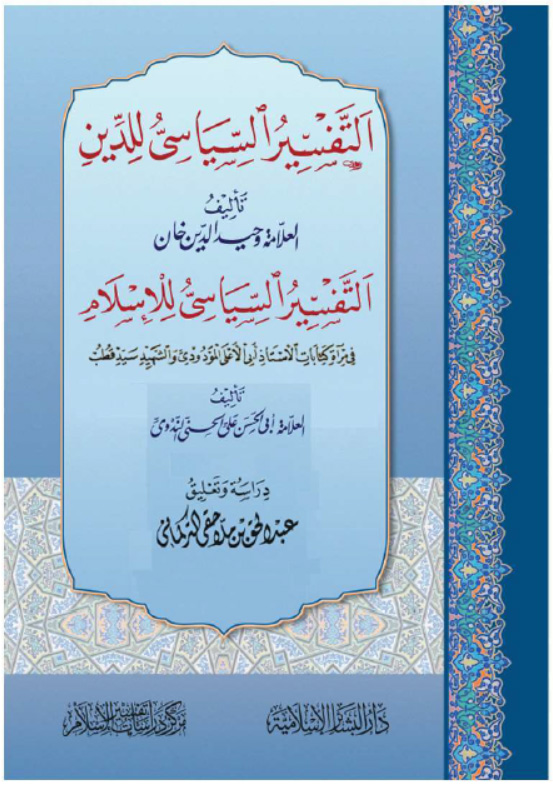
Introducing the book: The Political Interpretation of Islam (Religion)
Book title: The Political Interpretation of Islam (Religion)
Author: the Indian thinker and scholar Wahiduddin Khan
Author: the scholar Shaykh Abu al-Hasan al-Nadwi, may God have mercy on him
Study and editing: Shaykh Abd al-Haqq al-Turkmani
Publisher: Center for Studies in the Interpretation of Islam, Britain
Year of publication: 1435 AH/2014 CE
Hardback; number of pages: 342
Appendix: “A Summary of Creed and Advice to Muslim Men and Women”, by Shaykh Abd al-Haqq al-Turkmani.
The subject of the book:
Through its three studies, this book introduces, examines and criticises the theory of the political, utilitarian and social interpretation of Islam. It seeks to draw the attention of scholars, students of Islamic knowledge, preachers, intellectuals, opinion-formers and decision-makers to its grave danger and harmful effects on contemporary Islamic discourse and the present and future of Islamic outreach. Today it represents the most dangerous distortionist ideas threatening the essence and spirit of religion, its objectives and its major truths.
Professor Wahiduddin Khan says:
“‘The political interpretation of religion’ has interpreted religion comprehensively and as a total picture, so that the political dimension emerges as a fundamental unit of religion. The purpose of the prophetic message cannot be known without politics, the full meaning of beliefs cannot be understood, the importance of prayer and other acts of worship cannot become clear, the stages of piety and excellence cannot be traversed, and the purpose of the Night Journey and Ascension cannot be comprehended except through politics! In short, without politics, the entire religion remains empty and unintelligible, as though three quarters of it had been removed.”
The scholar al-Nadwi, may God have mercy on him, says:
“A methodology that differs from the original Islamic methodology in spirit and motives, psychology and mentality, objectives and ends, ideals and values. It weakens what the Messenger, peace and blessings be upon him, and his Companions strove for: devoting religion sincerely to God, working for the hereafter, and the spirit of ‘faith and seeking reward’ that governs the whole of life and permeates all actions and conduct. This striving turns into a mere process of collective organisation or an attempt to obtain rule and authority for Muslims. It may be a transformation after which there is no return to the origin and source, as has repeatedly happened in the history of religions, sects, calls and movements. We therefore felt compelled, as God knows, to draw attention to this danger, even if it were obscure or distant. Love prompts concern, and sincere counsel impels warning.”