
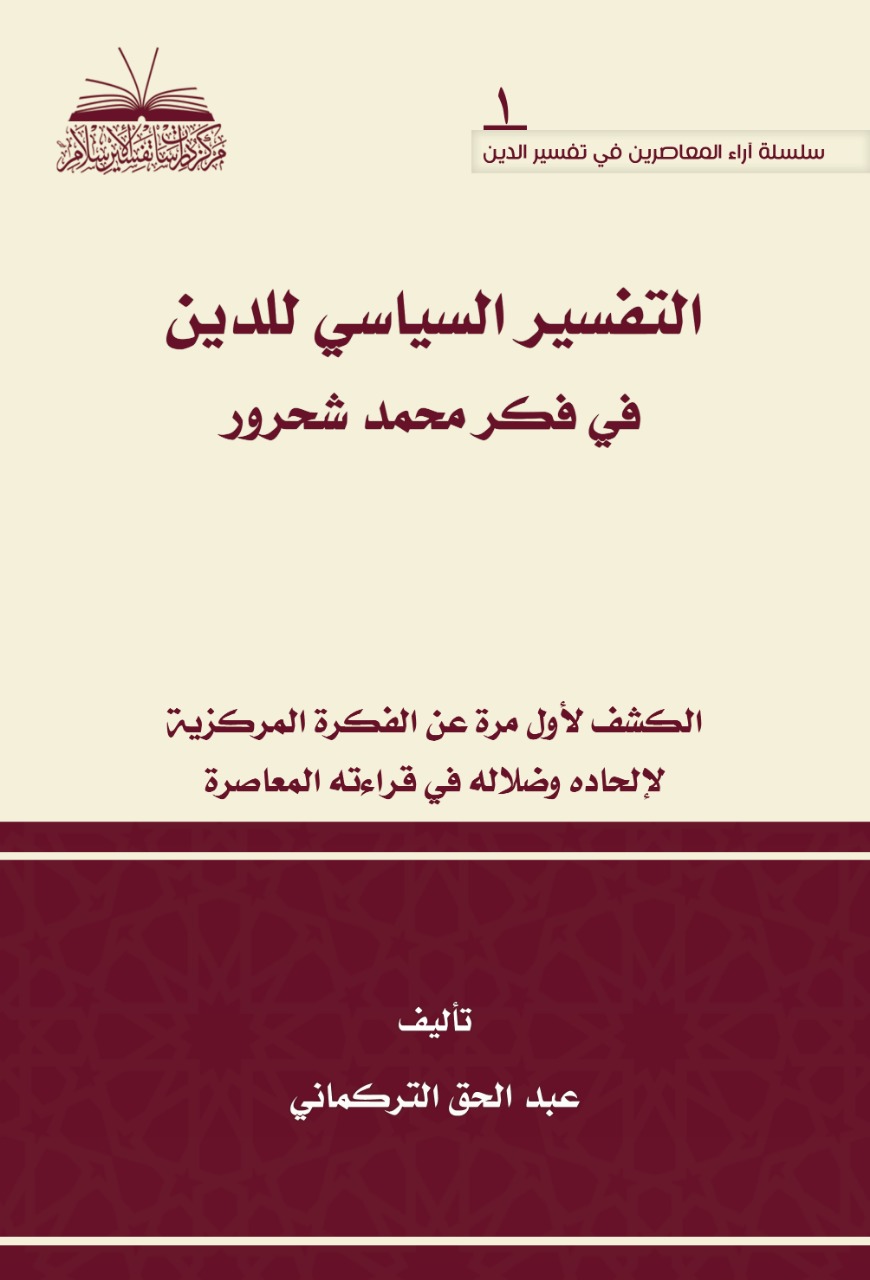
Some people thought that Shahrur was presenting a peaceful modern project, far removed from extremism and violence. Yet we discover that he categorically denies the legitimacy of rulers of Muslim states and calls for revolution against them. He interprets purely religious concepts, such as rejection of false objects of worship, disavowal of polytheism and its adherents, and fighting in God’s cause, as confronting despotic rulers and mobilising supporters of freedom throughout the world into a united front to revolt against and fight them. Shahrur presented this extremist project throughout his books, especially Draining the Sources of Terrorism, through obfuscation and deception. In reality, he, this book and his other books are among the most dangerous “sources of terrorism”, particularly because he employs his contemporary reading of the Noble Qur’an for this purpose. Unlike outright secularists, he clothes his aberrant thought in a religious mantle and makes his new creed serve every form of struggle for worldly power, from the slave revolt in Rome to Guevara and the revolutions of the Arab ruin. It is thought inclined towards violence. In Shahrur’s own words, violence is “justified armed jihad for freedom”.
Contents of the book
Author’s introduction
The interpretation of religion in Muhammad Shahrur’s words
The purpose of creation according to Shahrur
The call of the messengers, peace and blessings be upon them, according to Shahrur
The objective of Muhammad’s message according to Shahrur
The concepts of monotheism and polytheism according to Shahrur
Worship, the pillars of Islam and despotic tyrants
Achieving religion’s purpose through any religion whatsoever
Humanity’s independence from prophetic messages and the necessity of secularism and democracy
Freedom as the holy of holies according to Shahrur
The objective of preserving freedom, not preserving religion
Jihad for freedom
Tyranny and despotism
Allegiance to advocates of freedom and disavowal of tyrants, their helpers and supporters
Revolution against rulers to fulfil the purpose of creation
Why did the revolutions of the Arab ruin fail?
Breaking with the heritage and building a developed epistemological system
A necessary introduction
Comprehensive agreement despite differences and divisions
The creed of the extremist esoteric philosophers
The philosophers’ theory in contemporary Islamic thought
The overarching foundations of the political interpretation of religion
Muhammad Shahrur: confusion without reason or revelation
Explicit statements of unbelief through which Shahrur opposed all Muslims
Study One: Freedom and Revolution against Tyrants
The revolutionary for freedom and democracy and confrontation with tyrants and despotic rulers
The false object of worship is the despotic ruler
The jurists devised the “pillars of Islam” to serve despotism
The “objective of preserving religion” is also an invention of the jurists
The correct interpretation of the two verses concerning change
Excess and extremism concerning “freedom”
Freedom and rejection of tyranny as God’s word, the firmest bond and the criterion
Laying foundations for a clash of civilisations and a great world war
Mocking obedience to rulers and calling for rebellion against and fighting them
Study Two: The Function of the Messengers, Peace and Blessings Be upon Them
Islam as a political and social revolution and upheaval
The finality of the prophetic message and human sovereignty
A consequence of the political interpretation of the divine message: the messengers’ failure to achieve the purpose of their call
A consequence of the political interpretation of the messengers’ call: the possibility that humanity could dispense with it
The concept of the universality of Muhammad’s message
Study Three: The Purpose of Creation
Study Four: The Concept and Purpose of Worship
Severing the connection with God, mighty and majestic
Distinguishing between ubudiyyah and ibadiyyah
Worship as contrary to innate nature
The difference between innate nature and instinct
Returning to Shahrur’s interpretation of innate nature as instinct
Emptying acts of worship of their substance
The relationship of acts of worship to human conduct
Acts of worship are limited, while the movement of life is broad
Human conduct is the intended worship
The concepts of monotheism and polytheism according to Shahrur
Why polytheism is described as a great injustice; the concept of the false object of worship and its rejection
The concept of kindness to parents and conflict between generations
Conclusion
Editions of Dr Muhammad Shahrur’s books
The best-known published books and studies responding to Muhammad Shahrur