
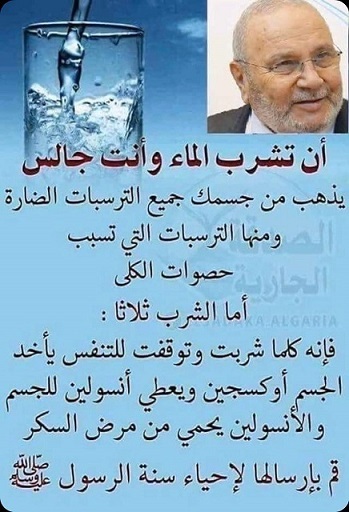
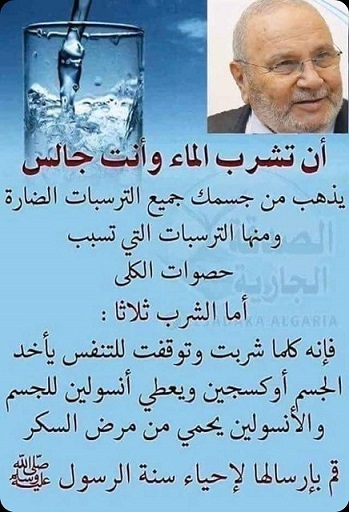
Drinking water while sitting removes all harmful deposits from your body, including those that cause kidney stones. As for drinking in three stages, each time you drink and pause to breathe, the body takes in oxygen and supplies insulin, which protects against diabetes.
Comment:
This image entrenches a purely utilitarian understanding of following the Prophetic Sunnah.
Its problematic aspects include:
The prohibition of drinking while standing is a disputed question. In Sahih al-Bukhari and Sahih Muslim, Ibn Abbas, may God be pleased with them both, said: “The Prophet, peace and blessings be upon him, drank Zamzam water while standing.” In Sahih al-Bukhari, al-Nazzal ibn Sabrah reported that Ali, may God be pleased with him, came to the gate of al-Rahbah and drank standing, then said: “Some people dislike drinking while standing, but I saw the Prophet, peace and blessings be upon him, do as you have seen me do.” There are also hadiths prohibiting standing while drinking, including the reports in Sahih Muslim from Anas ibn Malik and Abu Sa‘id al-Khudri, may God be pleased with them both, that the Prophet, peace and blessings be upon him, rebuked, or in another wording prohibited, drinking while standing. Many scholars gave preference to the reports permitting it, others to those prohibiting it. A third group reconciled them by understanding the prohibition as discouragement rather than strict prohibition and the permission as demonstrating lawfulness. Others said that drinking standing is allowed when needed but disliked otherwise. This was the preference of Ibn Taymiyyah and his student Ibn al-Qayyim.
It corrupts people’s intention in following the Sunnah, so that they gain no reward in the hereafter: “Among people are those who say, ‘Our Lord, give us in this world’, and they have no share in the hereafter.”
It makes certain conjectural wisdoms the effective cause of religious law. This corrupts legal foundations, especially analogy, when people conceive of rulings on different issues. They imagine that the Sunnah generally was prescribed merely as a means of obtaining these worldly health benefits, so that the world becomes the worshipper’s goal. Admittedly, this particular question is not purely devotional: explaining it through health benefit, without strained claims about its wisdom or false reasoning, is sound and acceptable. Yet the motive for following the Sunnah should be worship of God through believing the Prophet, peace and blessings be upon him, complying with his command and following his guidance.
It opens a route to corrupting faith in the Prophetic Sunnah. If someone disproves these benefits, the Sunnah becomes exposed to doubt and abandonment, because those who have misconstrued its rationale no longer have a reason to practise it. A speaker who defends religion in the manner of speculative theologians may then, when silenced and defeated in argument, deny that the practice is part of the Sunnah at all, labelling the hadith weak for fear of criticism.
It opens the door to manipulators, who may mention unverified, unscientific things, sometimes obviously false even to the most ignorant layperson. An example is the statement that pausing drinking to breathe increases oxygen and insulin. If increasing oxygen were the purpose of the Prophetic Sunnah, one could object that breathing while standing and drinking, contrary to the Sunnah, does not affect the amount of oxygen. It is also possible to breathe without moving the cup or vessel away, contrary to the Sunnah. Indeed, following the Sunnah by exhaling only outside the vessel delays exhalation until the cup is moved away, and delaying breathing reduces the air drawn in by inhalation. Here, following the Sunnah has not increased breathing; acting contrary to it supplies the same amount of oxygen or more.