
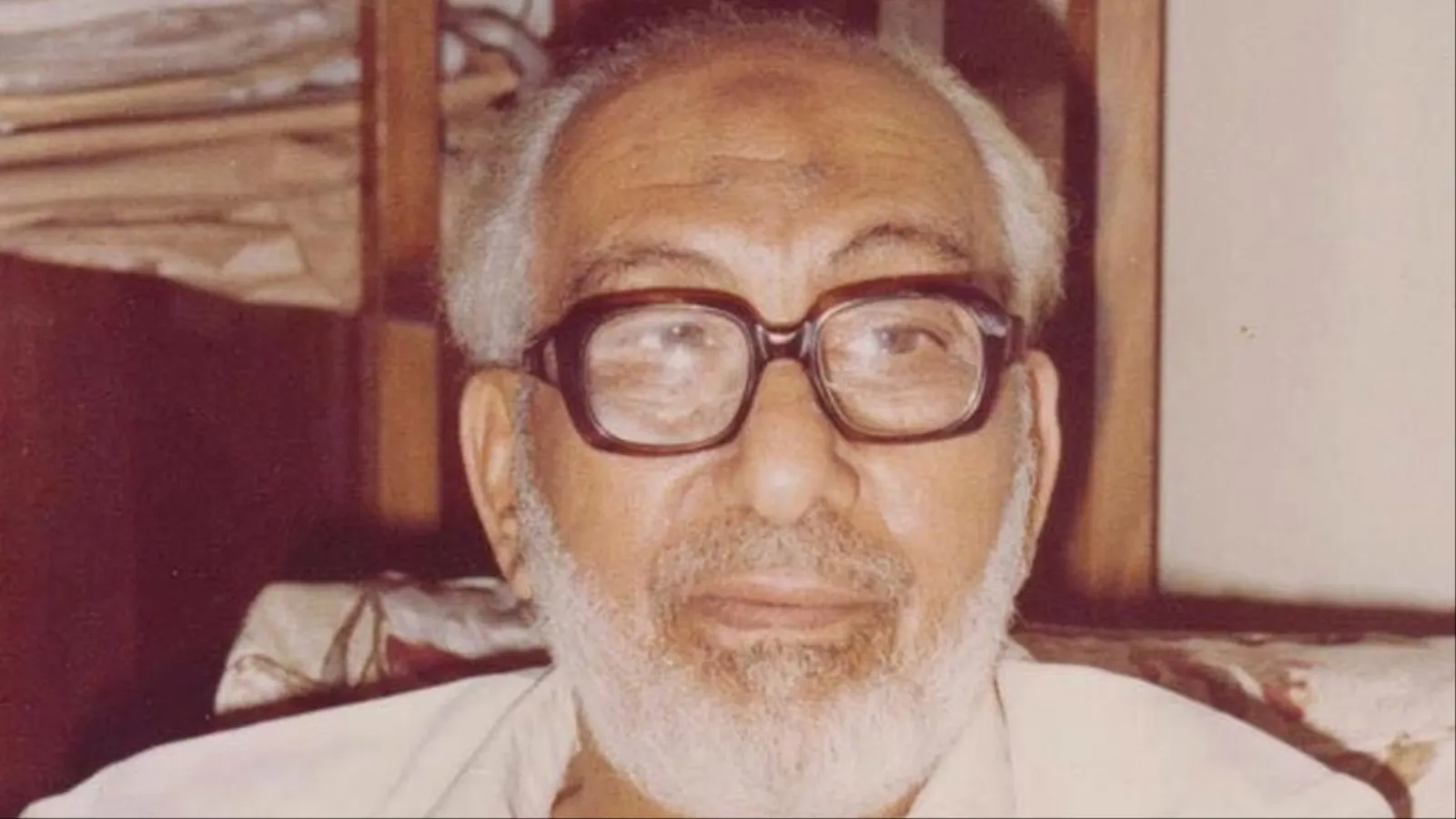
The Methodology of the Scholar Mahmud Shakir and the Methodology of the Muslim Brotherhood
The distinguished Professor Dr Muhammad Rashad Salim (d. 1407), may God have mercy on him, said in an address delivered at the home of the scholar Mahmud Shakir (d. 1418), may God have mercy on him:
In the name of God, the Most Merciful, the Especially Merciful. Praise be to God, and blessings and peace upon the Messenger of God and those who follow him in goodness until the Day of Judgement.
To proceed: I had not, in fact, prepared for this occasion, so I will confine myself to a few words. Perhaps what my brother Professor Abd al-Hamid al-Basyuni quoted from al-Aqqad prompts me to highlight one observation: he advised a philosophy student, or a teaching assistant in philosophy, to attend Professor Mahmud Shakir’s gatherings. I do not think this observation lacks profound significance. Professor Mahmud Shakir is not merely a scholar of language, poetry, and literature. He is distinguished by the greatest quality I have known in him: depth of understanding. His grasp of questions is penetrating and profound, going beyond appearances and superficial matters…
I have benefited greatly from him in Islamic studies, philosophy, the assessment of thought, and work and preaching for this religion and its creed, in ways many people may not notice. As Dr Mahmud al-Tanahi said, Professor Mahmud Shakir fought on many fronts, including work and preaching for this religion. People may not perceive or know his struggle in this sphere, but from what I know, it is among his greatest achievements and works…
Professor Mahmud Shakir had profound insights into the course of the Islamic movement and into what young people enthusiastic about Islam solely through emotion should undertake and cultivate, when they are unwilling to exert themselves and bear the burden of the real struggle: the struggle for religion!
We were a group of Brotherhood members, overflowing with enthusiasm to work for Islam. As was his habit, Professor Mahmud welcomed us warmly. He saw and hoped for good in us, but some of us disappointed him.
This imprisonment was in ’65. I remember that he and I were arrested on the same day and released on the same day, roughly two and a half years later. Professor Mahmud was counted among the Brotherhood despite his clear differences with them in thought and methodology. During that period many people of Islamic orientation were arrested, although many did not belong to the Brotherhood.
If I were to summarise very briefly the principal recurring differences between Professor Mahmud and Brotherhood thinking, I would say that, as I understand him, Professor Mahmud believes Islam is not served merely by empty emotional enthusiasm, nor merely by partisan political action in the manner of Western and modern political parties. Rather, we must work for Islam because it is a complete, comprehensive civilisation. A scholarly, social, intellectual, and civilisational edifice must be built for it. Hundreds of young people must dedicate themselves to understanding this religion correctly and serving it first through scholarship and thought. Once concepts and ideas become clear in Muslims’ minds, action follows.
There is no action before knowledge. Work for Islam cannot be sound without correct understanding and correct thought.
The Brotherhood’s preoccupation, however, was the state and the desire for power, with emotional Islamic notions, mere empty enthusiasm for the word Islam, and an impatient desire to rule. This brought governments into conflict with the Brotherhood and the Brotherhood into conflict with governments, causing disasters and ordeals that afflicted many young Muslims in this country.
Professor Mahmud’s insight was unquestionably correct. These extremist youths, such as those of Takfir wa-l-Hijrah and others, emerged from the Brotherhood’s mantle, leading many young people astray in their understanding of Islam. Yet I think, praise be to God, that the aware current and the understanding youth have increased, and interest in scholarship and correct Islamic understanding has grown over time. Undoubtedly this is among Professor Mahmud’s good deeds, which many people may not know, and which, God willing, are credited to him with God.
These are a few brief words. As I said, I am not skilled in speaking or in impromptu addresses. I ask God to prolong my teacher’s life, grant him health and well-being, and place goodness and blessing in his offspring, Fihr and Zulfa, God willing.
This is a brief observation or quick glimpse of an aspect of my teacher, shaykh, and friend Professor Mahmud Muhammad Shakir that may be hidden from many people.
Peace be upon you.
Source: Zill al-Nadim: Previously Unpublished Papers and Conversations of the Master of Arabic Abu Fihr Mahmud Muhammad Shakir, may God have mercy on him, Wijdan al-Ali, Alam al-Adab, first edition, Beirut, 2016, pp. 84-85.
“The distinguished Syrian writer Issam al-Attar came to Egypt. Some time after his arrival, Professor Abd al-Aziz Kamil accompanied him to the home of the master of Arabic. The professor, may God have mercy on him, received him with his familiar generosity and brotherliness. Then he turned and asked his guest al-Attar: How long have you been in Egypt?
He replied: About a month!
The professor began to thunder, raising his voice in denunciation of the Muslim Brotherhood, who had disliked the prospect of Issam visiting him and delayed his coming to his home all that time, and of Abd al-Aziz Kamil. His voice rose and cracked. Then, after a few seconds, he became calm again, with the remnants of a tear in his eyes.”
Source: Zill al-Nadim, p. 43.
The scholar Mahmud Shakir (d. 1418), may God have mercy on him, said:
“People who imagine civilisation is merely technology are mistaken. Civilisation rests on foundations greater than this, because civilisation is a product, and technology is a product of culture. Culture is belonging, and belonging to something means entering its depths and knowing its precise details.
Today, however, belonging is superficial, like someone saying, ‘I am a Muslim now’, then going off to issue religious rulings. We now have many muftis from the Muslim Brotherhood and Takfir wa-l-Hijrah. Each issues religious rulings while ignorant, not from knowledge grounded in understanding. No, it is belonging to something imaginary.”
Source: Zill al-Nadim, p. 73.
Ali Ashmawi said: “Professor Mahmud Shakir used to tell the Brotherhood: Before entering this room, leave the ideas in your heads outside the door along with your shoes.” More explicitly, he would say: “Leave the ideas you took from Hasan al-Banna outside the room’s door along with your shoes.”
Source: The Secret History of the Muslim Brotherhood, Ali Ashmawi, a member of the Muslim Brotherhood’s Special Organisation, p. 224.
Mahmud Muhammad al-Tanahi (d. 1419), while defending Mahmud Shakir and discussing ‘terrorist groups’, said: “What you do not know, Professor Samir, is that Mahmud Shakir was among the people most hostile to the groups you mentioned. Indeed, his angry, disapproving positions against the Muslim Brotherhood and all Islamic groups are well known. He proclaimed these positions and did not conceal them. The same was true of his elder brother, the hadith scholar of the age, Shaykh Ahmad Shakir. His article following the assassination of Mahmud Fahmi al-Nuqrashi is famous. He called it ‘Faith Restrains Assassination’ and published it in al-Asas newspaper [2 January 1949]. Read history, people!”
Source: Al-Tanahi’s article “Mahmud Muhammad Shakir and the Stray Arrows”, al-Jil magazine, 1998, also in Maqalat al-Tanahi: Pages on Heritage, Biographies, Language, and Literature, Dar al-Bashair al-Islamiyyah, Beirut, 1422, 2/608.