
The meaning of humanity’s succession on earth
Shaykh Muhammad Ibrahim Shaqrah (d. 1438 AH), may God have mercy on him, said:
I was aboard Saudi Airlines flight 265 returning to Amman on Monday, 27 Shawwal 1402 AH, when a crew member gave me issue 42 of Al-Muslimun magazine. I turned its pages, surveying topics to read, and paused at an article by Sahl Muhammad al-Qabbani entitled “Why Islam?” Its opening phrase caught my attention: “Because it is God’s guidance to His vicegerent on earth.”
The article also stated: “God made humanity His vicegerent on earth. Guidance in its counsels and obligations must therefore come directly from God to His vicegerent, for this vicegerency has no meaning if guidance comes from anyone other than God. Given humanity’s distinguished position as God’s vicegerent on earth, guidance must be an intended source of human happiness.”
I do not object to the beautiful meaning this paragraph conveys. My objection concerns some of its wording, indeed just one expression: “God’s vicegerent.”
This and many other expressions have spread as accepted terms, in past and present, until they are firmly established in the minds of ordinary and educated people, Muslims and non-Muslims. Someone who knows right from wrong may therefore hesitate to affirm the right and point out the error, less from fear of people than from self-doubt: perhaps what they think correct is wrong and what they think wrong is correct. They make themselves a target for pens that swiftly rise to answer them.
Given Al-Muslimun’s wide circulation, it should, as it does, God willing, present Islam to people pure and free from every blemish in its beliefs, rulings and laws. This is possible only by referring everything it presents to readers back to revelation’s two sources, the Book and Sunnah. If it falls into error, it should correct it and draw attention to it, preserving Islam’s substance from damage or admixture, and declaring that truth is truth wherever it comes from and falsehood falsehood wherever it comes from.
Accordingly, while appreciating Sahl’s article, I wish, to discharge my responsibility and fulfil scholarly trust, to explain an error that has spread until accepted as certain: the statement “Humanity is God’s vicegerent on earth.”
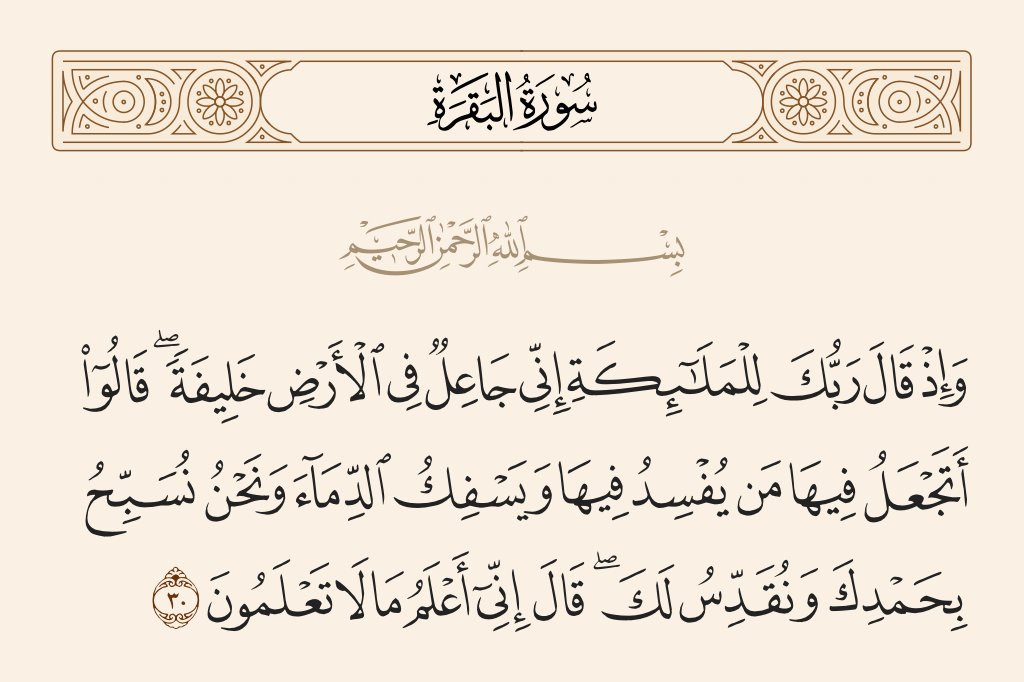
The word khalifah occurs in two Qur’anic places: al-Baqarah 2:30, “When your Lord said to the angels: ‘I am placing a successor on earth,’” and Sad 38:26, “David, We have made you a successor on earth.” Two plural forms also occur: khala’if in four places and khulafa’ in three. [1]
The word’s root is khalafa, a three-letter verb with a short a in its middle radical, and its verbal noun is khilafah. To say one person khalafa another means they came after them. Al-Sihah states: “One says someone succeeded another when he was his successor. One says he succeeded among his people, khilafah. Hence God’s words: ‘Moses said to his brother Aaron: Take my place among my people’ (al-A‘raf 7:142). ‘I succeeded him’ also means ‘I came after him.’” Al-Qamus al-Muhit says of “He made night and day successive”: “One succeeds the other, or one comes after the other.”
Khalifah has the pattern fa‘ilah and the active meaning khalif, one who succeeds. This requires that the successor act in the place of the one succeeded during that person’s absence for some reason necessitating a successor, to perform what the absent person performed. Their simultaneous presence, successor and person succeeded, is therefore impossible: succession occurs not while the person succeeded is present, but in their absence through death, travel, illness or similar causes, whether complete, as death, or relative, as travel.
This meaning certainly cannot apply between humanity and God. God is living and never absent. His attribute of life is everlasting like His being. If this is God’s condition, can succession in His place have any meaning? Does He need the human being He creates?
Were God to need a successor to carry out His command and apply His rulings on His behalf to other created beings, He would depend on His creation. Far exalted is God above that. He is the Self-Sufficient, as He describes Himself.
It is therefore the incapable who needs someone to succeed them. This does not apply to God but does apply to humanity. A person needs someone to take their place, whether an equal or someone superior. Someone inferior cannot be their successor, since what is below humanity is non-rational, and it is not reasonable for the non-rational to succeed the rational; otherwise humanity’s distinction through reason would be meaningless.
It is thus clear that a successor must be equivalent or superior to the person succeeded, not inferior in attributes.
No one among the righteous predecessors of the first three generations is known to have said humanity is God’s vicegerent on earth. It is a statement of some later people. We must, as Ibn Mas‘ud said, adhere to the ancient way. [2]
If evidence from the Book or Sunnah supported it, knowledge of that would have reached us from the predecessors. Indeed, what is authentically reported from the Messenger of God is the opposite: his travel supplication, which he taught his Companions, “God, You are the companion on the journey and the one who takes care of the family left behind.” [3] This hadith conclusively rules out God, far exalted is He, being the one replaced.
Moreover, khalifah in the al-Baqarah verse cannot convey that remote meaning. Were that intended, it would have been explicitly related to God’s majestic being, such as “I am placing a vicegerent for Myself on earth,” or “I am making Adam My vicegerent,” or similar wording that made the remote meaning reasonable, indeed the intended meaning.
Since God says instead, “I am placing a successor on earth,” the meaning is as Ibn Kathir explains in his commentary: “People succeeding one another, age after age and generation after generation, as God says: ‘He is the One who made you successors on earth.’” This is the correct interpretation, not the claim that Adam is God’s vicegerent based on this verse. Khalifah is thus a singular form intended collectively.
The author of al-Bahr al-Muhit mentions a fine interpretation: “Khalifah is a designation for anyone to whom management of the earth’s inhabitants and oversight of their interests passes, just as every ruler of the Romans is Caesar, of the Persians Chosroes, and of Yemen Tubba‘. There are two views concerning what Adam was appointed to succeed in: first, judging with truth and justice; second, developing the earth by planting, harvesting, building and directing rivers.” [4]
Some commentators hold that Adam succeeded creatures who preceded him but were destroyed before he encountered them. They cite the angels’ words, “Will You place there someone who causes corruption and sheds blood?” as referring to those earlier creatures. Al-Qurtubi says: “He succeeds angels previously on earth, or earlier beings other than angels, according to what is narrated.” [5] Interpreting “We have made you a successor on earth,” he also says: “We have granted you kingship to enjoin right and forbid wrong, succeeding earlier prophets and righteous leaders.” [6]
Someone may say that succession does not mean what Ibn Kathir’s cited opponents claimed, but carrying out God’s command on earth and implementing His laws and rulings in oneself and others. This too is not called succession, because God sustains the heavens and earth, and every affair is in His hand. When He wills something, He says “Be,” and it is. A person’s carrying out His command and applying His laws to themselves and others is obedience and response to His command, “Obey God.” Obedience is not replacing God. It is humility, willing submission, implementing His commands and avoiding His prohibitions as He wishes of His servants.
Those adopting this meaning may cite: “Spend from that over which He has made you successors” (al-Hadid 57:7). This is very remote from their claim. It means that an owner’s connection to wealth is temporary and ends when death removes it from their hands and it passes to heirs. These may be happier with it, or suffer its misery. If the former owner failed to fulfil its obligations while alive, they may share equally in that misery, exceed it or suffer less.
This verse therefore offers no support for their claim. Truth is most deserving of being followed, and God guides whom He wills to the straight path.
Perhaps this explanation suffices to clear uncertainty, remove doubt and establish certainty in a truth that is actually evident in itself, needing neither prolonged examination nor questioning those long past.
Shaykh Muhammad Ibrahim Shaqrah (d. 1438 AH), may God have mercy on him.
From Enlightening Understanding Concerning Some Concepts of Islam, p. 177.
For more, see:
Amr Khaled and the wisdom of creation
ISIS: a product of the political interpretation of Islam
Succession on earth means developing the earth
[1] The first plural occurs in: “He is the One who made you successors on earth and raised some above others in rank to test you in what He has given you. Your Lord is swift in punishment, and He is Forgiving, Merciful” (al-An‘am 6:165); “Then We made you successors on earth after them, to see how you would act” (Yunus 10:14); “They denied him, so We saved him and those with him in the ship, made them successors, and drowned those who denied Our signs. See the outcome of those warned” (Yunus 10:73–74); and “He is the One who made you successors on earth. Whoever disbelieves, their unbelief is against them. Unbelievers’ unbelief increases them only in abhorrence before their Lord and only in loss” (Fatir 35:39–40).
The second occurs in: “Do you wonder that a reminder has come from your Lord through a man among you to warn you? Remember when He made you successors after Noah’s people and increased you greatly in stature. Remember God’s favours so that you may prosper” (al-A‘raf 7:69–70); “Remember when He made you successors after ‘Ad and settled you on earth, building palaces on its plains…” (al-A‘raf 7:74); and “Who answers the distressed when they call upon Him, removes harm and makes you successors on earth? Is there a deity with God? Little do you remember” (al-Naml 27:62–63).
[2] Narrated by Abd al-Razzaq (20465), al-Darimi (145), al-Tabarani (8845) and al-Bayhaqi in al-Madkhal (387), through Abu Qilabah from Ibn Mas‘ud. It has corroboration in al-Bayhaqi’s al-Madkhal (388).
[3] Muslim (1342), from Ibn Umar, may God be pleased with him.
[4] Al-Bahr al-Muhit fi-l-Tafsir, 1/227.
[5] Al-Jami‘ li-Ahkam al-Qur’an, 1/263.
[6] Al-Jami‘ li-Ahkam al-Qur’an, 15/188.