
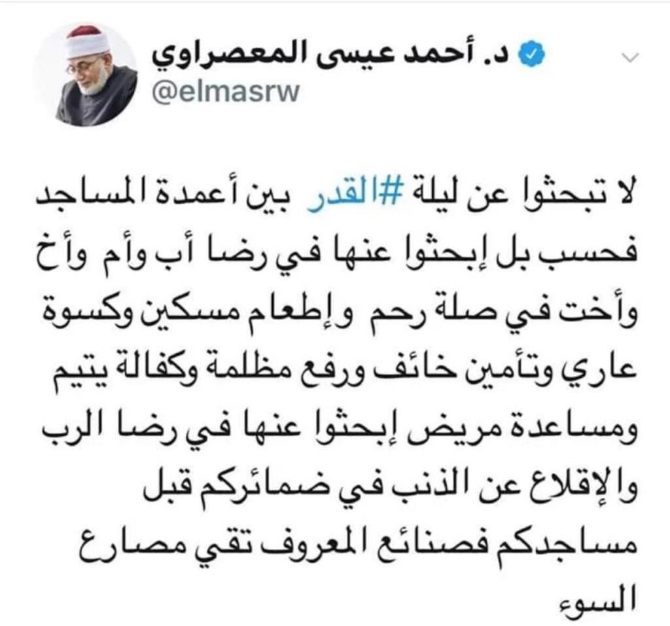
The post:
“Do not seek the Night of Decree only among the pillars of mosques. Seek it also in pleasing a father, mother, brother, or sister; maintaining family ties; feeding a poor person; clothing someone without clothes; reassuring the frightened; redressing a wrong; supporting an orphan; helping someone who is ill; and relieving distress. Seek it in pleasing the Lord and abandoning sin in your consciences before your mosques. Acts of kindness ward off evil deaths.”
Commentary:
This statement circulated on social media and was reposted by dozens of people on Twitter, each copying others out of imitation and approval, without recognising its departure from the methodology of the Sunnah and the objectives of Islamic law. Because this subject is important, we thought it appropriate to draw attention to the error and danger in this statement. We say:
1. God has assigned to every time and season its particular acts of worship and righteous deeds. The best and most appropriate deeds are those performed at the time, place, and in the manner specified by the wise Lawgiver. How excellent is the observation of some scholars, approvingly quoted by Ibn al-Qayyim:
“They said: The best worship is to act to please the Lord at every time in accordance with that time’s requirements and duties:
1. The best worship at the time of jihad is jihad, even if it means abandoning regular devotions of night prayer and daytime fasting, or even completing obligatory prayer in the manner used in safety.
2. The best action when a guest arrives, for example, is fulfilling his rights and attending to him instead of performing one’s recommended regular devotions. The same applies to fulfilling the rights of one’s wife and family.
3. The best action when a student seeks guidance or an ignorant person needs teaching is to devote oneself to teaching him and attend to that.
4. The best action in the hours before dawn is to engage in prayer, Qur’an recitation, supplication, and remembrance.
5. The best action at the call to prayer is to leave one’s current devotions and respond to the caller.
6. The best action at the times of the five prayers is to strive sincerely to perform them in the most complete manner and hasten to them at the beginning of their time. Going out to the congregational mosque, even if distant, is better.
7. The best action when someone urgently needs help through influence, physical effort, or money is to help him, relieve his distress, and prefer that over your devotions and seclusion.
8. The best action while reciting the Qur’an is to gather one’s heart and resolve to ponder and understand it, as though God were addressing you through it. Concentrate your heart on understanding and pondering it and resolving to carry out its commands more intently than someone receiving a letter from a ruler would concentrate on that letter.
9. The best action during the standing at Arafah is to strive in humble entreaty, supplication, and remembrance, rather than fasting in a way that weakens one’s ability to do so.
10. The best action during the ten days of Dhu al-Hijjah is abundant worship, especially declaring God’s greatness, His oneness, and His praise. This is better than jihad that is not an individual obligation.
11. The best action in the last ten days of Ramadan is to remain in the mosque, in seclusion and spiritual retreat, rather than deliberately mixing with people and attending to them. According to many scholars, this is even better than undertaking to teach them religious knowledge and Qur’an recitation.
12. The best action when your Muslim brother is ill or dies is to visit him, attend his funeral, and accompany it, giving this priority over your seclusion and concentration.
13. The best action when calamities occur and people harm you is to fulfil the duty of patience while mixing with them, rather than fleeing them. The believer who mixes with people and bears their harm patiently is better than one who does not mix with them and whom they do not harm. It is better to mix with them in good, rather than isolate oneself from them in it, and to isolate oneself from them in evil rather than mix with them in it. If he knows that mixing with them will remove or reduce the evil, that is better than isolation.
The best action in every time and circumstance is to prefer what pleases God in that time and circumstance and attend to its duty, function, and requirements…” (Madarij al-Salikin, Dar Ataat al-Ilm, Riyadh, 1441, 1/134-138).
I say: What Ibn al-Qayyim, may God have mercy on him, mentioned generally is known through detailed evidence from the Prophet’s words and practice. Citing it would take too long, so consult its relevant locations in works of Sunnah, including al-Mundhiri’s al-Targhib wa-l-Tarhib, may God have mercy on him.
2. Regarding Ibn al-Qayyim’s statement, “The best action in the last ten days of Ramadan is to remain in the mosque, in seclusion and spiritual retreat, rather than deliberately mixing with people and attending to them. According to many scholars, this is even better than undertaking to teach them religious knowledge and Qur’an recitation”: it is known from the multiply transmitted Sunnah that the last ten days generally, their nights particularly, and the Night of Decree most particularly, are blessed times specifically devoted to pure acts of worship: fasting, night prayer, spiritual retreat, Qur’an recitation, remembrance, and supplication. The Prophet, God’s blessings and peace be upon him, would observe retreat in these days, confining himself to the mosque and concentrating his resolve on pure worship. Aishah, may God be pleased with her, said: When the last ten days began, the Prophet would tighten his waist-wrapper, spend his nights in worship, and awaken his family. (Narrated by al-Bukhari.)
The noble Companions, scholars, and righteous people in every age and land followed this practice. Calling ordinary Muslims to occupy themselves during these days generally, and these excellent nights particularly, with maintaining family ties, checking on the needy, and so forth, actually departs from the wise Lawgiver’s purpose for these nights. It distracts Muslims with what is less excellent at this time from what is more excellent and important, contradicts the Prophet’s Sunnah, and introduces anxiety and confusion instead of encouraging them to concentrate their resolve on pure worship. Other righteous deeds have their own time, with ample opportunity throughout the year.
The Messenger of God, God’s blessings and peace be upon him, spoke truly: “Whoever stands in prayer on the Night of Decree with faith and seeking reward will have his previous sins forgiven.” (Narrated by al-Bukhari and Muslim.) On this blessed night he did not direct people to any of those righteous deeds urged today by some preachers.
When Aishah asked what she should say on that night, he directed her to the supplication now widely known: “O God, You are pardoning and love pardon, so pardon me.” (Narrated and authenticated by al-Tirmidhi.) He did not direct her to any other righteous deeds.
3. The purpose is to draw attention to the invalidity of this call circulating on social media, its contradiction of the Sunnah, and its harmful effect on Muslims’ devotion to pure acts of worship. These are intended primarily: for them God created creation, sent messengers, revealed books, and established Islamic law.
Other righteous deeds are intended secondarily in relation to pure worship. A Muslim can perform whatever of them is possible during Ramadan’s daytime, if not observing retreat; observing retreat is better and more excellent for him. He can also perform them throughout the rest of the year. In contrast, standing in prayer during the last ten nights, seeking the Night of Decree, its excellence, and its immense reward, has a narrow time that cannot be made up during the year’s other nights.
4. We conclude by drawing attention to a subtle matter that scholars and students must recognise and remain alert to. The spread of such statements and most people’s enthusiasm for them arise from the utilitarian and materialist tendency in interpreting religion and its objectives that has emerged strongly in modern times. Many Muslims have come to regard worldly happiness, social cooperation, and worldly human interests as the purpose behind prescribing acts of worship and righteous deeds. You therefore find them uncomfortable with ‘pure acts of worship’, which are exclusively God’s right and the primary purpose of religion and divine obligation. They cannot bear these acts remaining directed towards the original purpose God intended and commanded, and want them converted into ‘righteous deeds’ intended to bring people direct material benefits in this world.
Student of knowledge, do not be deceived by these advocates’ insistence on intention and sincerity towards God in performing those deeds. That is not the point of disagreement. Observe instead their primary aim of achieving direct benefit and advantage for creation through them, and their insistence on it even in ‘standing in prayer on the Night of Decree’. It is as though they resent servants turning to their Lord for one night or a few nights of limited hours, in worship devoted to Him out of love, fear, hope, veneration, and reverence. They intrude upon this by inventing the idea, ‘Do not seek the Night of Decree among the pillars of mosques.’ Whether or not they realise or intend it, this is a malicious and cunning idea whispered to them by Satan to divert people from sincerely worshipping their Lord in the manner He loves and approves. That is his habit, as God reports him saying: {Because You have led me astray, I will surely sit in wait for them on Your straight path (16). Then I will approach them from before and behind them, from their right and from their left; You will not find most of them grateful (17)} [al-Araf]. For this reason the Messenger of God said: “Satan has sat in wait for the son of Adam on all his paths.” (Narrated by Ahmad and al-Nasai.) Here he sits on his path to the Night of Decree, where God’s pleasure and forgiveness are found, scattering his heart and distracting him from it with what is less excellent. God is the One whose help is sought.
By Shaykh Abd al-Haqq al-Turkmani.
24 Ramadan 1442 AH, corresponding to 6 May 2021 CE.