
The Claim That “the Prophet Failed in His Mission”: From Khomeini to al-Dedew
Praise be to God, Lord of the worlds, and blessings and peace upon the Messenger of God, the seal of the prophets and messengers.
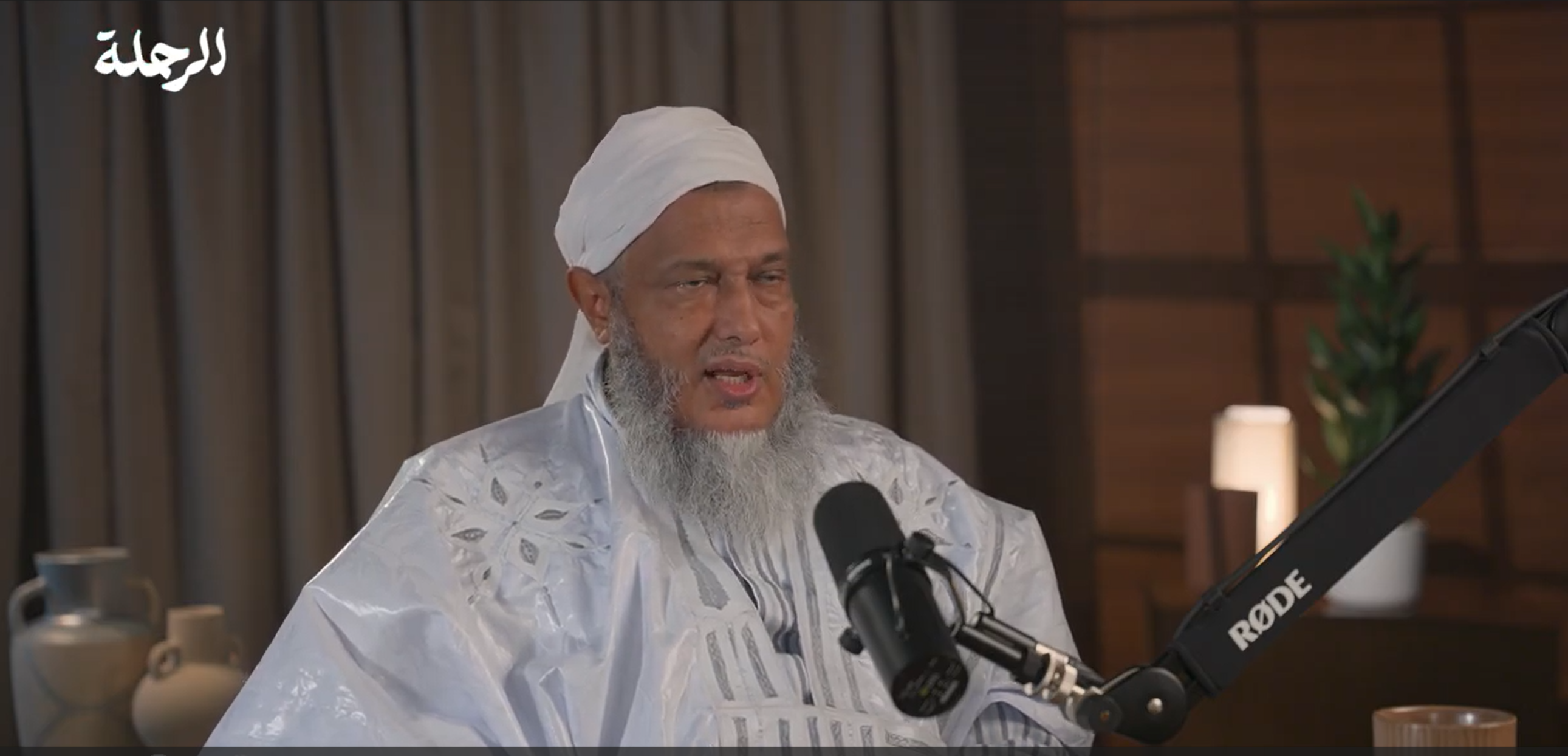
This is a clip of Shaykh Muhammad al-Hasan al-Dedew al-Shinqiti from an interview on the Al-Rihlah Podcast, published on YouTube on 29 August 2025. Discussing the reasons Islamic movements arose, he said:
“We must understand that these movements did not arise merely from independent judgment. They arose out of a necessity that occurred. This Muhammadan nation suffered calamities. I estimate that, up to our present time, six great calamities have diverted it from its orbit. The first calamity was the death of the Messenger, may God bless him and grant him peace, when revelation was coming in its most frequent succession and the Prophet, may God bless him and grant him peace, was at the height of his strength and activity, with fewer than twenty white hairs in his face and head. He had not written us a constitution, explained how to choose a ruler, hold him accountable, or remove him, or appointed a particular ruler for us. It was a crisis because of which the majority of Muslims apostatized from Islam.
“The men who faced this crisis were the Emigrants and the Helpers. They agreed upon pledging allegiance to Abu Bakr at the portico of Banu Sa‘idah, then agreed upon the general pledge of allegiance to him in the mosque. They could not restore prophethood to us, because it cannot be acquired and prophethood was sealed with Muhammad, may God bless him and grant him peace. But they were able to find us the best alternative after prophethood. They descended one degree below prophethood, but it is the best thing after prophethood: the rightly guided caliphate upon the prophetic method.”
Comment
Muhammad al-Hasan al-Dedew’s words are clear and explicit that the Prophet, may God bless him and grant him peace, left his nation with an immense deficiency: “He had not written us a constitution, explained how to choose a ruler, hold him accountable, or remove him, or appointed a particular ruler for us.” This immense deficiency in the Messenger’s work, may God bless him and grant him peace, was “the first calamity”, thus the greatest of Islam’s calamities. This “calamity” caused “a crisis because of which the majority of Muslims apostatized from Islam”.
Had al-Dedew meant by calamity simply “the Prophet’s death”, his words would have been acceptable. It was a tremendous affliction and the first of Muslims’ afflictions.
Had al-Dedew meant by crisis the trial of apostasy itself, his words would likewise have been acceptable. It was the greatest trial confronting the noble companions immediately after the Prophet’s death, may God bless him and grant him peace.
But by “calamity” al-Dedew meant the Messenger of God’s dying without writing his nation a constitution or establishing a political system for them. He then claimed that this “calamity” caused a “crisis” that began with apostasy and continued through all these ages, until Islamic movements in modern times were “compelled” to work to remedy the deficiency in which the Messenger of God, may God bless him and grant him peace, left us, having provided neither a constitution nor a political system.
This is his explicit statement. Moreover, every rational person acquainted with the meanings and purposes of Arabic discourse understands from his words that the Messenger of God’s death at the time he died was sudden, that is, unplanned, and that the Prophet had not prepared to leave his nation. On the contrary, he died while “revelation was coming in its most frequent succession and the Prophet, may God bless him and grant him peace, was at the height of his strength and activity, with fewer than twenty white hairs in his face and head”. Among the consequences of this sudden death was what he explicitly mentioned: the absence of a constitution and political system.
These are Shaykh Muhammad al-Hasan al-Dedew al-Shinqiti’s clear, explicit words. Whoever doubts this should return to the original recording of his interview and understand his words in their complete context. He will find that we have not fabricated anything against the man or attributed to him what he did not say. We believe al-Dedew to be a rational person legally accountable under Islamic law, understanding and intending what he says. We do not dare accuse him of senility or insanity, and there is no indication that he was coerced or compelled to say what he said.
For all these reasons, we say that these words express al-Dedew’s knowledge and understanding, belief and conviction. He is accountable for them before God Most High and then before all Muslims. We shall criticize them in light of the overarching legal principle: “We judge by what is outward, and God takes charge of inner secrets.”
These words of al-Dedew are among the greatest deviations and errors he has uttered thus far. They are extremely dangerous and liable to place him alongside the esoteric heretic, the sign of Satan, Khomeini, as we shall explain in this article, unless he repents sincerely, with reform and clarification, without evasion or changing colors as in his previous errors.
The following explains the error in al-Dedew’s words.
First
Al-Dedew claimed that the Prophet, may God bless him and grant him peace, died suddenly at the height of his activity while revelation was coming in succession. This is what his words indicate and convey through the language and manner of discourse, without strained interpretation or prejudice, as explained above.
We say: this is a false claim contradicted by the succession of reports in books of the Sunnah and prophetic biography concerning the signs that his death was approaching.
Among these is the authentic report concerning the revelation of Surat al-Nasr. Al-Bukhari (4970) reported from Ibn Abbas, may God be pleased with him and his father, that Umar ibn al-Khattab, may God be pleased with him, invited him together with the elders who had fought at Badr. Umar asked them about the Exalted’s words: “When God’s help and the conquest come.” Some said: “We are commanded to praise God and seek His forgiveness when we are helped and granted conquest.” Others remained silent. Ibn Abbas said: Umar asked me, “Do you say the same, Ibn Abbas?” I replied, “No.” He asked, “What do you say?” Ibn Abbas said: “It refers to the Messenger of God’s appointed death, which He made known to him. He said, ‘When God’s help and the conquest come’: that is the sign of your appointed end. ‘Then glorify your Lord with praise and seek His forgiveness; He is ever Accepting of repentance.’” Umar said: “I know no meaning for it other than what you say.”
Another is the report of al-Bukhari (6285) and Muslim (2450) from Aishah, may God be pleased with her: the Messenger of God, may God bless him and grant him peace, spoke privately to Fatimah, may God be pleased with her, telling her: “Gabriel used to review the Qur’an with me once each year, but this year he reviewed it with me twice. I can only think that my appointed end has drawn near. So fear God and be patient, for I am an excellent predecessor for you.”
The Messenger of God, may God bless him and grant him peace, hinted to his companions that his appointed end was approaching. At Jamrat al-Aqabah during the Farewell Pilgrimage, he told them: “Take your rites from me, for I do not know; perhaps I will not perform pilgrimage after this pilgrimage of mine.” Reported by Muslim (1297).
Al-Bukhari (466) and Muslim (2382) reported from Abu Sa‘id al-Khudri: the Prophet, may God bless him and grant him peace, delivered a sermon and said: “God gave a servant the choice between this world and what is with Him, and he chose what is with God.” Abu Bakr, may God be pleased with him, wept. I said to myself: “What makes this old man weep, if God gave a servant the choice between this world and what is with Him, and he chose what is with God?” The Messenger of God himself was that servant, and Abu Bakr was the most knowledgeable among us.
This sermon occurred during his final illness (Fath al-Bari, 7/12). His illness lasted thirteen days according to most scholars (Fath al-Bari, 8/129). He remained in Aishah’s house during it and stopped leading prayer in his mosque several days before his death. All this is well known in books of the Sunnah and prophetic biography. How, then, can it be said that his death, may my father and mother be his ransom, was sudden and thereby prevented him from establishing a political system like Islamic and non-Islamic parties and movements, making this a cause of those movements’ emergence?
The reports that some companions were shaken by his death and initially refused to believe it do not mean that he died suddenly at the height of activity. Rather, the shock overwhelmed them. Even if the companions were surprised, he, peace and blessings be upon him, would not have been surprised and left them without establishing or indicating a political system if that had been his intention or one of religion’s fundamental requirements.
Second
Al-Dedew said: “The Messenger died, may God bless him and grant him peace, when revelation was coming in its most frequent succession.”
We say: al-Dedew mentioned the succession of revelation to reinforce in the listener’s mind the meaning conveyed by his words: that the Prophet died suddenly. This is false. The truth is that revelation was coming in succession to prepare the Messenger of God and his nation for completing the mission and parting. Al-Dedew certainly knows the report in the two Sahih collections about the revelation of the verse of al-Ma’idah during the Farewell Pilgrimage.
Al-Bukhari (45 and 4407) and Muslim (3017) reported from Tariq ibn Shihab that a Jewish man said to Umar ibn al-Khattab: “Commander of the Faithful, there is a verse in your Book that you recite. Had it been revealed to us Jews, we would have made that day a festival.” Umar asked: “Which verse?” He said: “‘Today I have perfected your religion for you, completed My favor upon you, and approved Islam as your religion.’” Umar replied: “We know the day and place where it was revealed to the Prophet, may God bless him and grant him peace: he was standing at Arafah on a Friday.”
Ibn Kathir, may God have mercy on him, said in his exegesis of the verse:
“The correct position, admitting neither doubt nor uncertainty, is that it was revealed on the Day of Arafah, which was a Friday, as reported by the Commander of the Faithful Umar ibn al-Khattab, Ali ibn Abi Talib, the first of Islam’s kings Muawiyah ibn Abi Sufyan, the interpreter of the Qur’an Abd Allah ibn Abbas, and Samurah ibn Jundub, may God be pleased with them. Al-Sha‘bi, Qatadah ibn Di‘amah, Shahr ibn Hawshab, and several other imams and scholars transmitted it without a complete chain. Ibn Jarir al-Tabari, may God have mercy on him, adopted this view.”
The great divine announcement of the perfection of religion and completion of the blessing of revelation, prophethood, and the prophetic mission therefore occurred during the Prophet’s pilgrimage, universally called the “Farewell Pilgrimage”. He lived only a limited number of days after it: the remainder of Dhu al-Hijjah and the full months of Muharram and Safar. According to the correct, relied-upon view, he died on the first of Rabi‘ al-Awwal. He lived seventy-nine days after the day he stood at Arafah and died in the forenoon of the eightieth day, may God bless him and grant him peace.
Scholars differed about the number of verses revealed after the verse of al-Ma’idah. The reports and views taken together indicate decisively that these were only a small, limited number of verses, perhaps no more than ten.
Third
Al-Dedew’s claim that the Prophet died suddenly and “had not explained how to choose a ruler, hold him accountable, or remove him, or appointed a particular ruler for us, and it was a crisis because of which the majority of Muslims apostatized from Islam” is not a statement a Muslim would make at all. It is the position of esoteric heretics, extreme philosophers such as Ibn Sina, atheistic Orientalists, and others who see “Muhammad ibn Abd Allah” as a national leader and great reformer who wanted to improve his people’s condition through the acts of worship and laws he established for them. If he died before founding a political system of government for them to follow after him, that would undoubtedly be an immense deficiency and a major failure in his project.
People of faith and Islam, however, believe that prophethood and the prophetic mission, from beginning to end and in every particular and detail, did not arise from this chosen Messenger’s knowledge, choice, desire, or planning. They were pure revelation from his Lord, through His knowledge, command, wisdom, will, and ordering.
God Most High says: “You did not expect the Book to be imparted to you, except as a mercy from your Lord” [al-Qasas: 86].
He, exalted is He, says: “Thus We revealed to you a spirit by Our command. You did not know what the Book was or what faith was, but We made it a light by which We guide whomever We will of Our servants. Indeed, you guide to a straight path” [al-Shura: 52].
The Mighty and Majestic says: “You have no part in the matter: whether He turns to them in mercy or punishes them, for they are wrongdoers” [Al Imran: 128].
He, blessed and exalted, says: “He does not speak from desire. It is only revelation revealed” [al-Najm: 3–4].
He says, and His word is truth: “O Messenger, convey what has been sent down to you from your Lord. If you do not, you will not have conveyed His message. God will protect you from people. God does not guide the unbelieving people” [al-Ma’idah: 67].
Al-Bukhari (4612) and Muslim (177) reported from Aishah, may God be pleased with her: “Whoever tells you that Muhammad, may God bless him and grant him peace, concealed anything revealed to him has lied. God says: ‘O Messenger, convey what has been sent down to you…’”
Therefore, one foundation of faith in him, may God bless him and grant him peace, is the firm belief that he fulfilled the trust, conveyed the message, sincerely advised the nation, strove for God with the striving due to Him, and worshipped his Lord until certainty came to him from his Lord. May God grant him blessings and abundant peace.
A necessary consequence of this great foundation is believing with undoubted certainty that whatever the Messenger of God did not explain to us in any matter of religion, worldly life, government, or politics was not due to deficiency, inability, betrayal, or forgetfulness. Rather, his leaving unexplained what he left unexplained was knowing and deliberate, by God’s knowledge and revelation. God Most High says: “We descend only by your Lord’s command. To Him belongs what is before us, what is behind us, and what is between them. Your Lord is never forgetful” [Maryam: 64].
Fourth
If we know and believe that God Most High perfected our religion and that the Prophet conveyed the message and fulfilled the trust without deficiency or shortcoming, then we know with certainty that when, as al-Dedew says, he “had not written us a constitution, explained how to choose a ruler, hold him accountable, or remove him, or appointed a particular ruler for us”, he left all these matters deliberately and intentionally, by God Most High’s knowledge and command.
Since we know, as a necessity of faith and religion, that the Prophet concealed nothing of his message and neglected none of his Lord’s commands, and that he left us upon the straight path and the clear white road whose night is like its day, from which none deviates except one doomed to destruction, we know with certainty that the matters he left unwritten, unexplained, and uncommanded are neither foundations nor rulings of his religion, nor purposes nor ends of his mission.
We also know thereby, as a necessity of religion and reason, that these matters possess no importance measured against the end for which God created His servants. They are not included in what God, mighty and majestic, intends, and are not foundations, rulings, or ordinances of religion. What is required in them as worship and religious adherence is what the texts of the Qur’an and the Sunnah brought and what the practice of the rightly guided caliphs followed in government, leadership, adjudication, treatment of rulers, and other questions of governance in Islamic law. Where the wise Lawgiver remained silent, Muslims may exercise judgment to improve their worldly affairs in ways that do not contradict their religion’s rulings.
Fifth
Al-Dedew’s claim that the Prophet’s failure to explain the system of government after him was “the first calamity in Islamic history” and “a crisis because of which the majority of Muslims apostatized from Islam” is false and has no connection with historical reality. Reports, accounts, and historians’ statements indicate that apostasy arose from two causes, with no third:
First: explicit apostasy through abandoning Islam by those who had embraced it late and into whose hearts faith had not entered.
Second: refusing to pay zakat.
Imam Ibn Kathir summarized this:
“When the Messenger of God, may God bless him and grant him peace, died, many Bedouin tribes apostatized, hypocrisy emerged in Madinah, Banu Hanifah and many people in al-Yamamah sided with Musaylimah the Liar, and Banu Asad, Tayy’, and many others rallied around Tulayhah al-Asadi, who also claimed prophethood as Musaylimah the Liar had done. The situation became grave and severe. Al-Siddiq dispatched Usamah’s army, leaving few soldiers with him. Many Bedouins coveted Madinah and sought to attack it, so al-Siddiq stationed guards at the city’s approaches, spending the nights with troops around it. Arab delegations began arriving in Madinah, affirming prayer but refusing to pay zakat.” (Al-Bidayah wa-l-Nihayah, 9/438.)
Al-Dedew built this second claim upon his first, thus building falsehood upon falsehood and giving the event a political interpretation. This is the root of deviation in his creed and thought and what emboldened him to utter these dangerous words impugning the Muhammadan mission. We explain this in the next point.
Sixth
One of the fundamental, central ideas in the thought of contemporary Islamic activist groups is that the purpose of the Muhammadan mission is to bring about political revolution, establish an ideal system of government, and realize social justice.
The best-known activist theorist to state and explain this in detail is al-Mawdudi. Among his statements are:
“By sending them, God intended to establish in the world a system of social justice based on the clear proofs He revealed to them and the balance He bestowed on them in His Book, that is, the just system of human life.”
“This is the purpose for which prayer, fasting, zakat, and pilgrimage were made obligatory in Islam. Calling them acts of worship does not mean that they are themselves the acts of worship. It means that they prepare the human being for the original worship and constitute an indispensable training course for it.”
See An Introduction to the Interpretation of Islam, by Shaykh Abd al-Haqq al-Turkmani.
This central idea dominates the thought of all Islamist activists, such as Hasan al-Banna, Sayyid Qutb, and Muhammad Qutb, though with varying degrees of frankness and clarity. It is known that Shaykh Muhammad al-Hasan al-Dedew was raised from his youth within the Muslim Brotherhood’s institutions, where this vision and belief were instilled in him.
Activists faced a great difficulty when they examined the messengers’ call generally and the call of their leader and seal specifically, may God bless and grant peace to them all. They found that this central idea represents no foundation of the messengers’ call, nor does it possess great importance in their religion and law. They also found that the Prophet, may God bless him and grant him peace, had not provided the nation with a political constitution or specified a system of government like, for example, that established by “the founding fathers of the United States”, who wrote the constitution and established the Senate, House of Representatives (Congress), electoral system, and transfer of power.
Faced with this difficulty, activists dodged like a fox. They found no solution except reinterpreting, distorting, or rejecting texts and inventing explanations and interpretations for which God sent down no authority. Very few were as frank and bold as al-Mawdudi. Al-Dedew’s compatriot and fellow Muslim Brotherhood affiliate Muhammad al-Mukhtar al-Shinqiti wrote The Constitutional Crisis in Islamic Civilization: From the Great Civil Strife to the Arab Spring, with a foreword by Rashid al-Ghannushi. It is clear that al-Dedew took this idea from his compatriot, but dared state it in a way that impugned the perfection of the Muhammadan mission.
Al-Dedew invented this extraordinary explanation, the Prophet’s sudden death. Were it not for that, the Messenger of God would not have left us without a political system and a precise constitution. How could he, if his call and religion existed only for divine government?
We know of no one whose audacity and insolence reached this point except the esoteric heretic Khomeini. His words concerning the Prophet’s failure in his mission are even uglier and more atrocious than al-Dedew’s.
Khomeini accepted the necessary consequence of their central idea, which contradicts the reality of the messengers’ call, peace be upon them, and was more daring and explicit. He cast off the cloak of dissimulation and, intoxicated by his revolution’s victory, dared what no one else dared. He stated explicitly:
“Every prophet came only to establish justice, and his goal was to apply it throughout the world, but he did not succeed. Even the seal of the prophets, who came to reform and refine humanity and implement justice, was likewise unsuccessful. The one who will succeed in every sense and implement justice in every part of the world is the awaited Mahdi.”
[From his address to the Iranian people on the occasion of 15 Sha‘ban 1400 AH, corresponding to 28 June 1980, broadcast on radio and television, as reproduced in Selections from Imam Khomeini’s Talks and Speeches, published by the Institute for the Compilation and Publication of Imam Khomeini’s Works, International Affairs Department, Tehran, 2/42.]
Anyone wishing to understand al-Dedew’s words correctly should use these words of Khomeini and the statements we quoted from al-Mawdudi. Al-Mawdudi has other passages close to Khomeini’s statement, including this in Jihad in Islam, original Urdu edition, p. 174:
“But after failing in preaching and instruction, the preacher of Islam took the sword in his hand.”
Seventh
What demolishes all this activist falsehood, and refutes al-Dedew’s claim that “Islamic movements” necessarily arose to remedy the deficiency in which the Messenger of God left us, is refuting the theory of “the political interpretation of religion” at its root. It is the root of activists’ error and the knot of their deviation that has brought them into these straits and destructive paths. Islam, which God Most High revealed to His Prophet Muhammad, may God bless him and grant him peace, has neither a political nor a utilitarian end. Its end is worship of God alone: “I did not create jinn and humankind except that they should worship Me” [al-Dhariyat: 56]; “They were commanded only to worship God, devoting religion sincerely to Him, inclining to truth, and to establish prayer and give zakat. That is the upright religion” [al-Bayyinah: 5]. The Prophet did not die until religion had been completed for us in everything that benefits us in this world and the Hereafter. Religion is sound and reforming for every place and time. People’s worldly conditions and political and social systems, however, differ and change with different ages and lands.
The eminent scholar Ibn al-Qayyim, may God have mercy on him, has a comprehensive and precise statement answering anyone who imagines that religion contains a deficiency and that the Prophet did not explain what we need until movements of political Islam arose to fill this gap, as al-Dedew said. We quote it at length because of its importance.
Ibn al-Qayyim said:
“Some people’s division of methods of governance into religious law and politics resembles others’ division of religion into law and reality, and still others’ division of religion into transmission and reason. All such divisions are false. Rather, politics, reality, spiritual method, and reason are each divided into two categories: sound and corrupt. The sound is a part of Islamic law, not a counterpart to it; the false opposes and contradicts it.
“This principle is among the most important and beneficial. It rests on a single point: the universality of the Prophet’s mission, may God bless him and grant him peace, with regard to everything servants need in their understanding, knowledge, and actions. He did not leave his nation needing anyone after him. They need only someone to convey to them what he brought. His mission has two preserved universalities admitting no restriction: universality with regard to those to whom he was sent, and universality with regard to everything those to whom he was sent need in the foundations and branches of religion. His mission is sufficient, healing, and universal, leaving no need for anything besides it. Faith in him is incomplete without affirming the universality of his mission in both respects. No legally accountable person falls outside his mission, and no kind of truth the nation needs in its knowledge and actions lies outside what he brought.
“The Messenger of God, may God bless him and grant him peace, died leaving no bird beating its wings in the sky without having given the nation knowledge concerning it. He taught them everything, even the manners of relieving oneself, sexual relations, sleeping, rising, sitting, eating, drinking, mounting and dismounting, traveling and staying, silence and speech, seclusion and association, wealth and poverty, health and illness, and all the rulings of life and death. He described the Throne and the Footstool, angels and jinn, Hell and Paradise, the Day of Resurrection and what it contains, as though seen with their own eyes.
“He made their worshipped One and God known to them in the fullest way, as though they saw and witnessed Him through His attributes of perfection and qualities of majesty.
“He acquainted them with the prophets and their peoples, what happened to them and what they experienced with their peoples, as though they had lived among them.
“He acquainted them with the paths of good and evil, their subtle and great aspects, as no prophet before him had acquainted his nation.
“He, may God bless him and grant him peace, acquainted them with the states of death, what comes afterward in the intermediate realm, and the bliss and punishment experienced there by soul and body, as no other prophet had.
“Likewise, he acquainted them with the proofs of monotheism, prophethood, and resurrection and the refutation of every group of unbelief and error, such that whoever knows them needs no one after him except someone to convey them, explain them, and clarify what was obscure to him.
“Likewise, he acquainted them with the stratagems of war, meeting the enemy, and the paths to victory and triumph. Had they known these, acted upon them, and observed them properly, no enemy would ever have stood against them.
“Likewise, he acquainted them with Iblis’s schemes, the paths by which he approaches them, how to guard against his plotting and cunning, and how to repel his evil, leaving nothing to add.
“Likewise, he acquainted them with the conditions, qualities, hidden intrigues, and concealed snares of their own souls, leaving them no need for anything besides it.
“Likewise, he acquainted them with matters of their livelihood which, had they known and acted upon them, would have set their worldly affairs right in the fullest way.
“In sum, he brought them the entirety of good in this world and the Hereafter, and God left them needing no one besides him. How, then, could anyone suppose that his perfect law, than which no more perfect law has ever entered the world, is deficient and needs an external politics to complete it, or external analogy, reality, or rational teaching? Whoever thinks this is like someone who thinks people need another messenger after him.
“All this arises because what he brought is hidden from those who think so and because they possess little of the understanding God granted His Prophet’s companions. They found what he brought sufficient, dispensed through it with everything else, conquered hearts and lands through it, and said: ‘This is our Prophet’s covenant with us, and it is our covenant with you.’
“Umar, may God be pleased with him, used to restrain narration from the Messenger of God for fear that people would become occupied with it to the neglect of the Qur’an. How, then, if he saw people occupied with their opinions, the froth of their thoughts, and the refuse of their minds to the neglect of the Qur’an and hadith? God’s help is sought.
“The Exalted says: ‘Is it not sufficient for them that We sent down to you the Book, which is recited to them? In this there is mercy and a reminder for people who believe’ [al-Ankabut: 51].
“He says: ‘We sent down to you the Book as an explanation of everything, a guidance, mercy, and glad tidings for Muslims’ [al-Nahl: 89].
“The Exalted says: ‘O humankind, there has come to you an admonition from your Lord, a healing for what is in the hearts, and a guidance and mercy for believers’ [Yunus: 57].
“How can a book heal what is in the hearts if it and the Sunnah that explains it do not suffice for a hundredth of the law? Or how can a book heal what is in the hearts if certainty cannot be derived from it in even one question concerning knowledge of God, His names, attributes, and acts, or if most of it consists of verbal appearances whose meaning depends upon the absence of ten things whose absence cannot be known? Glory be to You! This is an immense slander.
“How astonishing! What was the condition of the companions and Successors before these rules were established, whose structure God has undermined from the foundations, and before these opinions, analogies, and conventions were extracted? Were they guided and content with the texts, or were they otherwise until later scholars came and became more knowledgeable, better guided, more accurate in grasping the law, and more knowledgeable about God, His names and attributes, and what is necessary or impossible for Him? By God, meeting God with every sin except associating partners with Him would be better than meeting Him with this corrupt assumption and false belief.” (A‘lam al-Muwaqqi‘in, 5/411.)
Eighth
From everything we have said, we conclude that one of Islam’s purposes was not to establish systems of this kind that make political activity the Muslim’s overriding occupation. That is not its objective, and competition for power is not its end. It sufficed with general rules of government: requiring rule by Islamic law, justice among people, redress for the oppressed, restoration of rights, and organization of people’s lives. It guarded against turmoil by prohibiting rebellion against Muslim rulers and commanding patience with their injustice and monopolizing of benefits.
The texts and reports brought a method for “dealing with rulers”, holding them accountable, removing them, and the rulings on rebellion and those who rebel. These are set out in books on governance in Islamic law, including Dealing with Rulers in the Light of the Book and the Sunnah, by Shaykh Abd al-Salam ibn Barjis Al Abd al-Karim, may God Most High have mercy on him. The theorists of the political interpretation of Islam came and reversed this matter. Means acquired the rank of ends. Political activity became the arena of conflict between Islam and unbelief. Acts of worship became training and military methods whose aim was to prepare the Muslim to take control of the world and form divine government. They thus collided with the Prophet’s biography, Islamic history before those movements and groups arose, and even the lives of most messengers, peace be upon them, who died without governing at all. [See An Introduction to the Interpretation of Islam, pp. 229–242.]
We ask God Most High to guide Shaykh Muhammad al-Hasan al-Dedew to truth and correctness and enable him to repent sincerely, clarify, and reform. Amen. Praise be to God, Lord of the worlds.
Center for Studies in the Interpretation of Islam
Thursday, 26 Rabi‘ al-Awwal 1447 AH, corresponding to 18 September 2025