Text of the publication
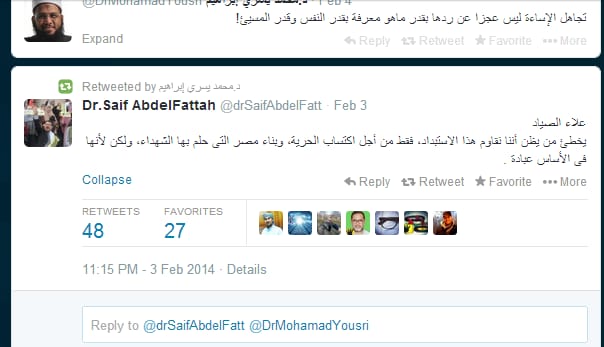
A tweet on Twitter dated 3 February 2014 reads:
“Alaa Sayyad: Anyone who thinks we resist tyranny only to gain freedom and build the Egypt of which the martyrs dreamed is mistaken. We do so because it is, fundamentally, worship.”
It is unfortunate that this tweet was reposted by someone who claims affiliation with Islamic scholarship and wears the Azhar turban.
Comment
- The author of this tweet has transformed the concept of worship, whose greatest purpose and highest distinction are glorifying the Lord and humbling oneself before Him through outward and inward acts to gain His pleasure and avoid His anger and displeasure, into barbaric actions arising from worldly ambitions to acquire power and rule.
- The author’s words arise from a deeply rooted belief among advocates of the political interpretation of Islam. This transfers questions of authority, government, politics and power from their subsidiary place in religion, discussed by scholars in the familiar branches of jurisprudence called governance in Islamic law or the chapters on rulership, into a central issue around which all the rulings of Islamic law revolve, in creed and practice alike. It is therefore unsurprising that revolutions against rulers are regarded as worship! These people consider the original acts of worship to have been prescribed primarily to reform society and establish justice. Resisting rulers by rebelling against them and provoking turmoil would, a fortiori, be worship. On their logic, this issue is more closely connected with their cause than prayer, fasting and other original acts of worship.
- The fruit and objective of forbidding wrongdoing are to fulfil servitude to God by forbidding beliefs and actions that anger Him. When such prohibition itself obstructs this servitude because it brings about greater wrongdoing, the prohibition becomes itself forbidden and wrong, since it fails to achieve its intended benefit. For this reason, the Lawgiver prohibited rebellion against rulers because of the harms it brings, which do not fulfil the purpose of creation. Ibn al-Qayyim, may God have mercy on him, said: “The Prophet, may God bless him and grant him peace, prescribed for his community the obligation of opposing wrongdoing so that its opposition would produce the good loved by God and His Messenger. If opposing wrongdoing entails something still more wrong and more hateful to God and His Messenger, it is not permissible to oppose it, even though God hates it and detests its perpetrators. This includes opposing kings and governors by rebelling against them, for that is the basis of every evil and turmoil until the end of time.” [1]
The advocates of this distorted interpretation, however, have reversed and overturned the objective. Everything can be sacrificed; indeed, they claim worshipping God and affirming His oneness have no value under tyrannical rule! It is therefore unsurprising that revolutions, despite their harms and wrongs, become among the finest acts of worship. Government is an end for which every loss is insignificant!
- The Prophet did not permit rebellion against an unjust Muslim ruler. When he told his Companions about unjust rulers who monopolise worldly goods at their subjects’ expense, demand obedience and withhold their rights, he answered: “Give them their rights and ask God for your rights.” [2] Worshipping God through what He has not prescribed is rejected and unacceptable; it constitutes legislation God has not authorised. God says: “Or do they have partners who have prescribed for them in religion what God has not authorised?” [al-Shura: 21.] What, then, of someone who makes opposing the Prophet’s guidance into worship?
- Regarding rebellion against an unjust ruler as worship is precisely the creed of the Kharijites. Shaykh al-Islam, may God have mercy on him, said of the Kharijites and those who agree with them among the people of doctrinal deviation: “The religious among them intend to attain what they consider religion. They may, however, err in two ways. One is that what they consider religion is not religion, as in the views of the Kharijites and other people of doctrinal deviation. They hold a mistaken and innovated view and fight people over it; indeed, they declare those who disagree with them unbelievers. They thus err both in their opinion and in fighting, declaring unbelief against or cursing those who disagree. This is the condition of people of doctrinal deviation generally…” [3]
See also
- Scholarly Efforts to Refute the Political Interpretation of Islam
- Rather, the Political Interpretation Is a Bridge to Secularism
- ISIS: A Product of the Political Interpretation
Notes
[1] I‘lam al-Muwaqqi‘in ‘an Rabb al-‘Alamin, 3/12.
[3] Minhaj al-Sunnah al-Nabawiyyah, 4/536.