
Rashid al-Ghannushi’s Islamization of Liberal Freedom
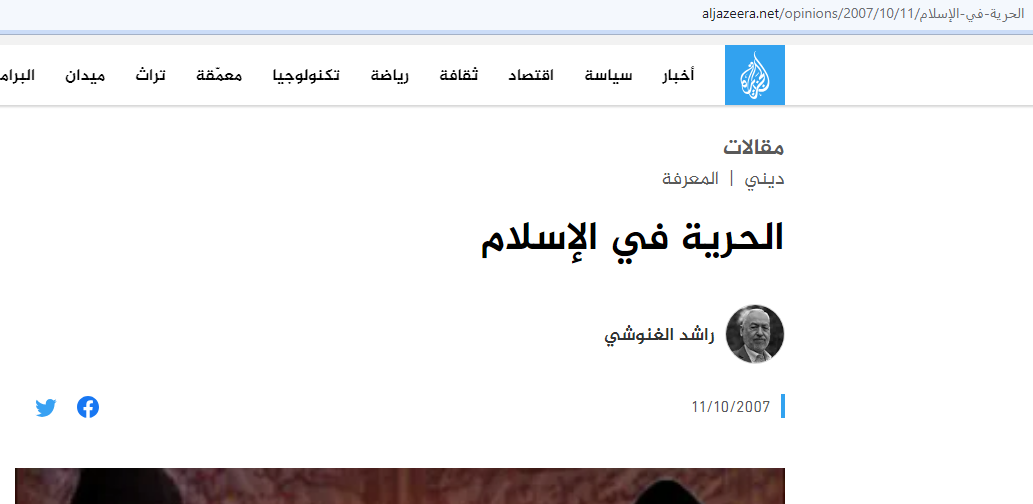
Rashid al-Ghannushi, leader of Tunisia’s Ennahda Party, wrote an article entitled “Freedom in Islam”, published on Al Jazeera’s website on 11 October 2007. It revolves around distorting the concept of freedom in Islam, importing the liberal concept in its place, and attempting to bend religious texts and some scholars’ words to fit this deviant concept. It turns the principle of free choice, with which God endowed human beings, into an objective and end that Islam seeks to realize and establish. It even makes all acts of worship in Islamic law serve this desired objective.
Freedom in the liberal conception does not mean freedom of choice through intention and will, with the knowledge and action that follow and the resulting reward and punishment. Rather, it means freedom in the general sense: unrestricted freedom to speak, act, or refrain. This unrestricted character undoubtedly conflicts with the principle of commanding what is right and forbidding what is wrong in all its details and ramifications. Since society must have an order governing it, and absolute freedom conflicts with the indispensable public order, liberals restricted the principle of freedom they advocate to what does not inflict purely physical, material harm or coercion on others. They disregard the destruction of values and morals and the spread of unbelief and atheism that this freedom causes. This accords with their outlook, in which religion is intended merely to fill a spiritual and psychological void. But that religion and worship should be the end for which God created creation, that all people should be commanded to come within it, and that some of its adherents should prevent deviants and their ideas from infiltrating its people, by hand, tongue, and heart: to them this is wholly unacceptable despotism and enslavement.
When Islamists appeared and were overwhelmed by the objections liberals raised against them concerning freedom, their belief about the purpose of human creation and the sending of messengers was already distorted, to the point that they made acts of worship means rather than ends. Having absorbed the materialist meaning of freedom, they proceeded to distort Islamic texts, deny the religious attribution of some, and bend whichever scholars’ statements they wished to serve this deviant concept. They did not sense the danger this posed to religion and worship or to the Muslim society they claimed to call for reforming and protecting from intellectual invasion. They became among the greatest instruments for demolishing religion and its values through this alleged freedom. All of this was in pursuit of material progress, whose cause, they claim, is a freedom absent from Islam in the correct understanding held by those who adhere religiously to God Most High’s law and judgment.
One leader of this call was Rashid al-Ghannushi, who has numerous books and articles on the subject. The article mentioned above is an important example of his thought and advocacy. We have therefore chosen to present and criticize it. Success is from God Most High.
1. After discussing freedom among jurists and theologians, saying that it falls within two concepts, first freedom as opposed to slavery and bondage, and second the question of the servant’s action, the Lord’s will, and theologians’ disagreement over them, al-Ghannushi says: “However, if we set theological quibbling aside and examine closely the nature of Islam’s message and its highest purposes, this artificial contradiction will disappear.” He means the contradiction liberals manufactured by saying that Islam opposes freedom. He then says:
“Although the human being is a vicegerent rather than a god, and this vicegerency presupposes one who commands, God mighty and majestic, and one commanded, the human being, it is conditional upon two qualities in the vicegerent: reason and freedom. These are the essence of the trust with which the human being was honored and which all other creatures feared. ‘We offered the trust to the heavens, the earth, and the mountains, but they refused to bear it and feared it, while the human being bore it…’ [al-Ahzab: 72].”
Al-Ghannushi claims that the human being is God’s deputy on earth, not by possessing divinity but through the freedom of choice and discernment God gave him. He is therefore God’s deputy in executing His commands through his own freedom, choice, and discernment. The very basis of this claim is contested. Interpreting succession in this sense is incorrect. The correct meaning, held by most commentators, is that “some succeed others”. But because the concept of deputizing for God serves many Islamists’ deviant concept of freedom, they are enamored of this interpretation and completely disregard the correct interpretation of succession, because it does not serve their method.
2. He says: “Freedom and reason are the basis of responsibility and religious obligation, as scholars of legal theory say. This follows from God’s honoring the human being. This honor gives human action an intention based on the choice between worshipping God consciously and willingly and rebelling.”
This invocation of legal theorists as saying that reason and freedom are conditions of religious obligation distorts their meaning and falsely attributes a position to them. Legal theorists certainly establish reason as a condition of obligation. Freedom, however, cannot correctly be described as an unrestricted condition according to them. They discuss the conditions of obligation and address coercion in detail. Some coercion is rightful and does not conflict with obligation; some is wrongful and removes obligation, alongside other distinctions. Freedom in the sense of the obligated person not being an enslaved person lies outside this discussion.
One of his contradictions is that at the beginning of his article he says the principle of freedom remained, until two centuries ago, confined to two concepts: freedom as opposed to slavery and bondage, and the question of the creation of servants’ acts and the relationship between a servant’s act and the Lord’s will. What connection, then, does what he says have with the legal theorists’ statements? They certainly belonged to earlier centuries.
Al-Ghannushi’s making freedom of choice an absolute condition of religious obligation is a corrupt notion. It implies that someone forced to pray or give zakat, for example, is in that situation no longer obliged to pray or give zakat because he lacks freedom of choice. This is a major contradiction and error that the legal theorists themselves do not endorse. How could they, when some coercion, according to them, is rightful and does not conflict with obligation? Moreover, someone compelled to perform worship, obey religious commands, or fulfill rights is compelled only outwardly. No one can exercise power over his heart except God. A person compelled to pray who prays unwillingly remains free in choosing prayer through the inward will with which God endowed human beings. He is accountable for this choice. This is what those whose hearts have absorbed material freedom overlook.
3. He says:
“The Exalted said, explaining to His servants the path of guidance as distinct from error: ‘Whoever wills, let him believe; whoever wills, let him disbelieve’ [al-Kahf: 29]. He said, objecting to His Prophet’s grief over his people’s rejection: ‘Would you compel people until they become believers?’ [verse 99]. This deprives ‘Islamic’ acts such as prayer, zakat, jihad, and, for women, veiling, of all value before God unless they proceed from a conscious, free, responsible will seeking God’s pleasure. ‘We shall turn to whatever deeds they performed and make them scattered dust’ [verse 23].”
These words of al-Ghannushi distort the verses and remove them from their context. The first came as a threat and warning. The second concerns coercion of the heart, which he, may God bless him and grant him peace, does not possess. Otherwise there would necessarily be a contradiction between this and implementing prescribed punishments, disciplining offenders, even jihad in God’s cause, and everything connected with commanding right and forbidding wrong. Islamists sensed the contradiction between freedom in its materialist liberal meaning and what Islamic law brought. Instead of supporting the law and explaining its correct meaning, their hearts absorbed the distorted concept of freedom, and they began reinterpreting and distorting religious texts to suit their desires.
As for his statement that “compulsion to perform worship and religious commands deprives deeds of their value before God”, undoubtedly this is so if a servant performs them with aversion. But he has not noticed the more important aspect: although that particular person receives no reward, these acts remain intended by Islamic law to preserve religion and society against the infiltration of sources of deviation and the spread of the immoral, the wicked, and even atheists among believers and the God-fearing. Wise Islamic law took this into account through the principle of commanding right and forbidding wrong, which works to dry up the sources of evil wherever possible. It is among the most important means of realizing servitude to God within Muslim society.
The eminent scholar Muhammad al-Khidr Husayn (d. 1377 AH), may God have mercy on him, said:
“Allowing a person unrestricted action to do whatever he wishes, leaving him free to believe whatever occurs to him, and not binding him in this to religious ordinances is an immense evil affecting individuals personally and nations collectively. Consider the Arabs’ condition in the age of pagan ignorance, when they were scattered in their doctrines and divergent in their directions, each acting to fulfill his own impulse, with no religious restraint to curb their fierceness and no dominant authority capable of reining them in. You will see that absolute freedom and disturbing barbarism are inseparable brothers. Then turn your gaze to the time of the prophetic mission and the rightly guided caliphs. You will find no cause for Islam’s expansion to the earth’s far reaches and the consolidation of firmly bonded dominion other than their implementation of those principles that revelation planted in their minds.” [Encyclopedia of the Complete Works of Imam Muhammad al-Khidr Husayn, 12/2/100.]
Consequently, such public, collective rulings are implemented only by the ruler who possesses authority and power. Individual people may not implement the rulings of governance in Islamic law that are specific to the ruler and his deputies, because doing so will fail to achieve their purpose and will produce greater harm.
Attributing his words to Imam Ibn Taymiyyah and his student Ibn al-Qayyim, al-Ghannushi says:
“All His acts, exalted is He, are wisdom, justice, and mercy. Everything of this kind belongs to Islam even if no specific text addresses it, while everything contrary to it has no part in Islam. (Ibn al-Qayyim, Al-Turuq al-Hukmiyyah.) Agreement between authentic transmission and sound reason is the foundation of Islamic thought. (Ibn Taymiyyah.)”
This quotation is found in none of the two imams’ books. Rather, it reflects his understanding of what serves his Islamization of liberal freedom. It exploits their words, may God have mercy on them, and gives the reader the impression that freedom in the liberal activist conception belongs to sound reason consonant with wisdom and justice, for whose sake texts are rejected and reinterpreted to create agreement between reason and transmission, as they claim!
This is the opposite of what the two imams advocate throughout their works: reverence for religious commands and commanding right and forbidding wrong. Deviants exploited their explanations exposing the error of those who claim Islamic law conflicts with reason and wisdom, and showing that it accords with them, commands only what contains pure or predominant good and benefit, and prohibits only pure or predominant harm; and that sound reason contains nothing contrary to an authentic text. Activists such as al-Ghannushi reversed the issue, making wisdom and justice imagined by their own minds the criterion by which Islamic law is accepted, rejected, and reinterpreted.
Read Shaykh al-Islam’s words, may God have mercy on him, and you will find him as though addressing al-Ghannushi and his like:
“How many things many people believe to be wisdom and benefit that must be obtained, or foolishness and harm that must be averted, are not so in the Lawgiver’s view! The realities of what benefits people and harms them in the affairs of the Hereafter, indeed even in worldly affairs, are known only through revelation sent down by God.” [Alerting the Reasonable Person to the Deceptions of False Disputation, 1/116.]
Al-Ghannushi then turns to Ibn Rushd the grandson, celebrating him:
“The philosopher and jurist Ibn Rushd, who taught the West the Greek heritage, was not mistaken when he entitled one of his epistles The Decisive Treatise on the Connection between Philosophy and Religious Law, affirming that knowledge of the universe is the way to knowledge of its Creator: ‘Increasing knowledge of the workmanship increases knowledge of the Maker.’”
It is unsurprising that someone like al-Ghannushi celebrates Ibn Rushd the grandson. He is among the major philosophers who believe that religion came only to regulate worldly interests, that religious law contradicts reality and came only to govern the masses, and that correct belief is neither explained nor indicated by religious law, because ordinary people’s minds, meaning those of most people, cannot bear it. Ibn Rushd therefore sought to bring the statements of philosophers who were not guided by the prophets’ guidance closer to religious law, to prove that it came only for the meanings of reform and lofty values advocated by ancient philosophers. As for the Hereafter and the return after death, they and he are apart from them. Because of this deviant foundation, he favored practitioners of philosophy and Greek logic over people of religious law and faith.
Hence Shaykh al-Islam Ibn Taymiyyah, may God have mercy on him, said:
“Then it is said to him: Glory be to God! Who made this group of Greeks and their followers the scholars, excluding all other nations and the followers of the prophets, whom no one possessing reason and religion doubts to be more knowledgeable than them? What demonstration do they possess by which this reality becomes evident? … Who singled them out as the people of demonstration, when the utmost of what they say in theology is unfit even to count as rhetorical and dialectical syllogisms, let alone demonstrative ones? … These people did not distinguish themselves in divine knowledge, nor did anyone become eminent by following them in it. Rather, the nations agree on their error in it, except those who imitate them. What is transmitted from them concerning natural and mathematical matters is what made them famous. Without it they would not be mentioned among the nations.
“How can a Muslim permit himself to say that the scholars God praised in His Book are the people of logic, when he knows that the leading companions, the Successors, and their successors were certainly intended by this address, indeed that they were the best of those intended after the prophets, and that they died before the Greek books were translated into Arabic at all? … Moreover, the scholars God praised are those who testified that there is no god but Him. Anyone acquainted with the conditions of nations knows that adherents of revealed religions have a stronger claim to this monotheism than the Sabians, who belong to the philosophers’ refuse heaps, and than the polytheists, among whom are many philosophers. … Even if someone claims superiority to them in philosophy, he cannot claim superiority to them in knowing what the Qur’an intended. They learned its wording and meaning from the Messenger and conveyed them to those after them. … How can these philosophers be the people knowledgeable in testifying that there is no god but God? Rather, saying that these and their like are the root of all polytheism, the rot within religions, and the enemies of messengers would be closer to truth than the testimony he gives them.” [Bayan Talbis al-Jahmiyyah fi Ta’sis Bida‘ihim al-Kalamiyyah, 2/60–67.]
Al-Ghannushi then says:
“Despite the importance of predestination, restricting the discussion of freedom in Islam’s heritage to the two contexts mentioned is incorrect. Freedom, like consultation, is not derived merely from an individual text, since it is an overarching purpose among Islamic law’s five purposes: preserving religion, life, reason, lineage, and property. The great jurist and legal theorist Ibn Ashur added the purposes of freedom and justice (The Objectives of Islamic Law). This requires that the nation be free, not partially but in every aspect of its life, since all religious obligations lapse in the absence of reason, freedom, and knowledge. A hadith states: ‘God has pardoned my nation for three things: error, forgetfulness, and coercion.’ Reported and authenticated by Ibn Hibban.”
These words of al-Ghannushi contain many fallacies and claims. He misleads the reader into thinking consultation is one of religion’s overarching rites, although it is a particular ruling. This exaggeration arises from magnifying the question of leadership and making it the foundation of foundations. Such exaggeration predominates among Islamist activists like him. The origin of all this lies with the Rafidah. We do not wish to pursue this here, as it has its proper place. Our purpose is to explain that his claim and insinuation concerning consultation are not conceded. Consultation is only one of religion’s particulars and detailed rulings, no more.
As for freedom, his claim that it is among religion’s overarching purposes, and his citation of Ibn Ashur, the same applies. The least that can be said is that this necessarily imputes ignorance to the nation for failing to discover a purpose that, they claim, is plain and evident. One of three conclusions is necessary: either the nation went astray by failing to discover this consequential purpose despite its alleged clarity and obviousness; or Ibn Ashur exaggerated and erred in counting as a purpose something that is not among religion’s purposes; or it is not a purpose at all and cannot rightly be included, let alone placed ahead of all the purposes on which scholars agreed. It is simply desirable within certain limits that ultimately return to the two kinds of coercion, rightful and wrongful, which scholars discussed and did not neglect.
It must also be said that generalization and obscurity in speech are among the greatest methods of attacking and distorting religion. Making freedom one of religion’s purposes in reality does nothing but invalidate commanding right and forbidding wrong and abolish prescribed punishments. Otherwise there is no practical matter approved by the law that derives from this alleged freedom so as to make it a purpose of religion, unlike all the other purposes whose preservation the law brought. As noted earlier, freedom of choice arises fundamentally from the heart, which no one can control or compel except its Creator.
After these preparations and foundations, al-Ghannushi moves to establish the principal aim around which most Islamist activists revolve: making leadership and sovereignty the foremost objective and greatest pillar, which everyone working in religious outreach must adopt as a goal and an end to pursue, and for which God created creation and sent down the books. He says:
“Islam is a call to freedom and liberation. The greatest theorists of contemporary Islam, Abu al-A‘la al-Mawdudi and Sayyid Qutb, were not mistaken when they defined Islam as a comprehensive revolution of liberation, beginning in the depths of the soul, reason, and will and extending into every corner of social and economic life.”
This is a clear statement revealing these people’s view of Islam and religious commitment generally. They have no definition of Islam other than “a comprehensive revolution of liberation”! Submission, love, and reverence toward God, acts of worship, and all religious rites are merely means and training to bring about this revolution. They were prescribed only to realize “lofty human values”. This is precisely what atheist philosophers such as Ibn Sina and al-Farabi advocated. The difference is that the philosophers did not affirm the return after death and recompense, whereas Islamist activists affirmed them and made “developing the earth and realizing human values” an end through which God’s pleasure and entry into Paradise are attained.
Acts of worship, in their view, are not ends intended for their own sake. Even if intended for their meanings of love, fear, and hope, they do not rank alongside realizing freedom and human values. These are the original purposes; everything else is subordinate! Unsurprisingly, al-Mawdudi and Sayyid Qutb are among the greatest authorities for this deviant interpretation of religion that they brought forth. To make the picture clearer, listen to al-Ghannushi confirm what we said:
“They also highlighted the human values contained in these acts of worship, such as brotherhood, forbearance, justice, order, freedom, and solidarity. All Islamic acts of worship are exercises in realizing these things. This is what explains the scene of a family gathered around a table laden with delicious food, resisting the pressure of hunger while awaiting divine permission to break the fast; the scene of believers rising from their beds at dawn in response to the divine call to congregational prayer; the scene of pilgrims to God’s Sacred House gathering on one plain and responding in one voice, having left family and homeland behind; and the scene of those who give zakat, having overcome the desire to hoard, generously paying the zakat on their wealth with no watcher over them except God. All these are scenes of human liberation par excellence and of solidarity.”
This is the reality of the distorted concept of religion in activist thought. They exaggerated religion’s worldly, material benefits and effects at the expense of its original religious and otherworldly foundations and purposes. The proverb applies to them: “He came to build a palace and demolished a city.” Islam undoubtedly contains abundant rulings of brotherhood, forbearance, and justice. But these people’s vision narrowed and a veil covered their hearts, so they saw no “justification” for worship and devotion through Islam’s original pillars other than the distorted understanding of religion entrenched within them: as he previously established, “a call to liberation and freedom and a comprehensive revolution”. Developing the earth, reforming society, and human values are, in this view, ends in themselves for which creation was created.
When they did not find these effects and immediate benefits appearing among Muslims despite their observance of religious rites, they began magnifying the benefits and fruits of worship. They did not stop there, but made these benefits the ends and worship exercises to realize them. We do not know how they escape the necessary consequence of this statement: if someone realizes these human values and experiences this alleged liberation, what need does he then have for devotion and worship? Because of this dangerous deviation, many deviant sects consistently applied this principle and accepted its implication. Some claimed that religious obligation is lifted from one who witnesses the end and realizes the immediate objective, as the extreme Sufis say. Others denied resurrection, recompense, and reckoning, as atheistic philosophizers say.
Al-Ghannushi then moves to a remarkable contradiction. While seeing no value in someone who performs worship or refrains from forbidden acts under compulsion, he deplores those who try to turn Ramadan from a month of competing in obedience into one of competing in forbidden and permissible pursuits. He says:
“It is no coincidence that occupying powers make special preparations to confront the escalation of resistance in Ramadan, when Islam’s acts of worship intensify: fasting, prayer, recitation, and charity. Truly, whoever defined Islam as a comprehensive method of liberation was not mistaken, if all its mechanisms were activated free from the processes of secularization and emptying of content proceeding at full pace, which turn fasting from a season of competing in acts of obedience into competition over consumer goods, television serials, and ingenious stimulation of desires.”
These words accord with what we previously cited of his view of acts of worship as exercises rather than ends in themselves. Here he makes them, specifically in Ramadan, a force of resistance against the challenges of temptation and seduction practiced by religion’s enemies during Ramadan. Quite apart from the error of making this the foremost purpose of intensified worship in Ramadan, it would, if true, be a natural consequence of the freedom al-Ghannushi and his like advocate. These people understand the principle of commanding right and forbidding wrong, and the means of condemnation by hand, tongue, force, and authority, only as destroying freedom, which they regard as among religion’s most important purposes! Then they wail over religion’s enemies distorting religion and spreading immorality within it. They do not realize that they opened this door themselves through the Islamization of liberal freedom.
If the devils among jinn and the soul that commands evil can be resisted only by inner religious restraint, then resisting human devils has been prescribed through the restraint of authority and commanding right and forbidding wrong alongside religious restraint, with their conditions, controls, and ranks known from books of Islamic manners. If they understood it, this would be recognized as God’s mercy toward His servants. This fundamental principle is mercy, compassion, and assistance to the Muslim against his enemies. Shaykh al-Islam Ibn Taymiyyah, may God have mercy on him, said:
“This makes clear to you that all prescribed punishments are beneficial medicines through which God remedies diseases of the heart. They belong to God’s mercy and compassion toward His servants, included in His saying, exalted is He: ‘We sent you only as a mercy to all worlds’ [verse 107]. Whoever abandons this beneficial mercy out of compassion he feels for the sick person is the very one who assists in that person’s torment and destruction, even if he intends only good. In this he is ignorant and foolish, like some ignorant women and men with their sick relatives or with the children, servants, and others they raise. Out of compassion they refrain from disciplining and punishing them for the evil they do and the good they neglect, thereby causing their corruption, hostility, and destruction.” [Majmu‘ al-Fatawa, 15/290.]
Liberal freedom is in reality nothing but assistance to a person’s enemies against himself, even when they clothe it in Islamic dress. God’s help is sought.