
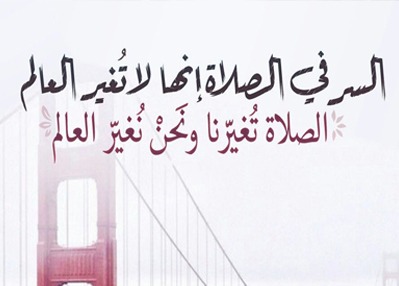
The story of “The Day I Stopped Praying”
“The Day I Stopped Praying,” first published in the Saudi newspaper Al-Eqtisadiah on Monday, 17 September 2007, issue 5089, is the best-known article of Saudi writer, media figure and charitable worker Najeeb al-Zamil.
Al-Zamil began: “The secret of prayer is that it does not change the world. Prayer changes us, and we change the world.” He then told of his youth and his interest in varied reading: “Until existentialist ideas swept me away, my first slip towards all the philosophies.” He described a religious secondary-school teacher who regularly advised and guided him. One day: “‘Why do you no longer pray?’ my teacher asked with profound sharpness. I answered: ‘Does prayer change the world?’ He gave an answer that blew my mind and shook the foundations of a self I thought secure: ‘Yes, prayer does not change the world, but it changes us, and we change the world.’ Yet I fought the effect of that dreadful sentence and continued in my error.”
Al-Zamil then described returning to God when seriously ill: “Years passed. I returned home. Our household admitted no compromise concerning prayer in the mosque. My father made leaving for the mosque a luminous ritual, and my mother woke us before the call to prayer rang out. I dragged myself back to prayer, but my stubborn resistance remained inside. One day I became ill. The doctor said: ‘I am sorry, Najeeb. You will certainly die in nine months.’ I was in the American coastal city of Tacoma. I went alone to a green hill and saw the mighty ocean stretching before me. Nothing but myself, sky, water, death and life. I asked myself: can I change anything? I reflected, tears welling up and covering the ocean’s breadth with an immense, mysterious mirage. Suddenly the phrase sprang into my mind: ‘Prayer changes us, and we change the world.’ I hurried back to where I was staying and sent my teacher that sentence by telegram, without introduction or conclusion. He replied: ‘God has reclaimed you. Live in peace.’ The most overwhelming prayer I experienced was on the Atlantic coast in Tacoma, America. I knew God was real, knew what truth meant, and that its ultimate meaning lay in heaven, not on earth. And I did not die, not yet.”
Najeeb al-Zamil died on Saturday, 4 January 2020, after a long struggle with kidney disease. May God have mercy on him, forgive him and grant him spacious gardens.
Criticism of “Prayer does not change the world, but changes us, and we change the world”
1. This comment and criticism concern neither al-Zamil’s personal experience nor his teacher’s guidance, but the article’s spread across many Islamic websites, including Sayd al-Fawa’id, until the sentence became a slogan circulating on social media. Many intellectuals praised the article: Islamists such as Dr Umar ibn Abd Allah al-Muqbil, professor at Qassim University’s College of Islamic Law, who tweeted on 22 January 2011, “This is among the finest articles I have read by Najeeb al-Zamil,” and Dr Abd al-Aziz al-Shayi‘, associate professor in Imam University’s Sunnah department, who tweeted on 4 January 2020, “Enduring words of the departed writer Najeeb al-Zamil.” Liberals also praised it, such as Dr Abd Allah al-Ghadhdhami, who referred to it on 4 January 2020: “The secret of prayer is that it does not change the world, but changes us, and we change the world. Najeeb al-Zamil’s article: The Day I Stopped Praying. May God have mercy on him and honour his abode.” The renowned Egyptian lawyer Montasser al-Zayyat praised the phrase in “Prayer First,” published in Al-Masry Al-Youm on 8 November 2011. It is unsurprising that al-Zamil himself tweeted on 23 March 2018: “This article has become the icon of my articles.”
We therefore face a profound philosophical idea interpreting prayer, widely disseminated, admired by liberals and whose danger specialists in religious studies failed to notice. That deserves attention and criticism. Private experiences, however, should be treated tolerantly and left undiscussed so they do not become public and widespread.
2. Perhaps the teacher, may God reward him, thought on a personal level that such language suited this young man’s mind, swept away by prevailing philosophical ideas. He gave a dialectical answer that achieved a powerful shock. Philosophers count this among dialectic’s benefits: training the resistant mind to accept truth and submit to proof. Al-Farabi (d. 339 AH) says in “Dialectic,” Logic according to al-Farabi, Dar al-Mashriq, Beirut, 1986, 3/39: “Dialectic is a kind of training. Its craft is an exercise, like other arts that train and prepare for other things, such as wrestling, running, fencing and the other exercise arts.”
Abu Hamid al-Ghazali (d. 505 AH) says in Maqasid al-Falasifah, edited by Sulayman Dunya, Dar al-Ma‘arif, Egypt, 1961, p. 110: “Dialectic has benefits. First, silencing every meddler and innovator who follows a path other than truth and whose understanding cannot grasp truth through demonstration. One turns with him to commonly accepted premises which he thinks must be accepted as truth, and thereby refutes his corrupt opinion…”
3. This dialectical method offered no decisive proof against the young man’s doubt, although it affected him psychologically. It did not lead him to pray immediately; “doubt remained inside,” as he said. Reflection shows that his return to God and prayer occurred not when he could “change the world,” but in complete helplessness, when the doctor said he would die within months. Consider the effect of such words on someone confronting helplessness, despair, inevitable destiny and the death long ignored and evaded. Al-Zamil’s guidance came first through God’s enabling, then through faith planted within him by upbringing and environment, and then through feeling total helplessness and need before the Lord of the worlds. His philosophical and literary inclination clothed this natural response in his teacher’s words. In weakness, despair, estrangement and loneliness, people understandably long for earlier memories and cling to their remnants. At that moment he recalled his teacher’s image and voice.
4. The correct answer required by religion is explicit: “We do not pray to change the world. We pray to fulfil God’s right over us because He is our Lord, Creator and Provider, and our life and death are in His hand. His right is that we worship Him, associate nothing with Him and devote reverence, love, fear, hope and gratitude sincerely to Him.” This is our motive for prayer, its reality, purpose and end. God says: “I am God. There is no deity but Me, so worship Me and establish prayer for My remembrance. The Hour is coming, which I almost conceal, so that every soul may be recompensed for its striving. Let not one who disbelieves in it and follows desire turn you from it, lest you perish” (Ta Ha 20:14–16).
He says: “Recite what has been revealed to you of the Book and establish prayer. Prayer restrains indecency and wrongdoing, and the remembrance of God is greater. God knows what you do” (al-‘Ankabut 29:45). And: “Those given knowledge before it, when it is recited to them, fall upon their faces in prostration, saying: ‘Glory be to our Lord. Our Lord’s promise is certainly fulfilled.’ They fall upon their faces weeping, and it increases their humility” (al-Isra’ 17:107–109).
5. “Prayer changes us and we change the world” is an imprecise statement unsupported in wording or meaning by God’s Book, His Messenger’s Sunnah or Islamic scholars’ words. What change is intended? What are its limits and fields? We know with certainty from God’s Book that this life is a place of trial and testing. In His wisdom, God decreed corruption, injustices, afflictions, troubles, pain, toil and illness within it so that the intended test occurs. Reward and recompense follow on the Day of Resurrection, one group in Paradise and another in the Blaze. He says: “But that He may test you in what He has given you. Race to good deeds. To God you will all return, and He will inform you concerning your differences” (al-Ma’idah 5:48).
Concerning the wisdom of differences in rank, He says: “He is the One who made you successors on earth and raised some above others in rank to test you in what He has given you. Your Lord is swift in punishment, and He is Forgiving, Merciful” (al-An‘am 6:165). God makes creation, testing and resurrection one coherent, integrated sequence: “He created the heavens and earth in six days, while His Throne was over the water, to test which of you is best in deed. If you say, ‘You will be raised after death,’ those who disbelieve will surely say, ‘This is nothing but manifest magic’” (Hud 11:7).
He says: “Blessed is He in whose hand is dominion, who has power over everything; who created death and life to test which of you is best in deed. He is the Mighty, the Forgiving” (al-Mulk 67:1–2). And: “Do people think they will be left to say ‘We believe’ without being tested? We tested those before them, so God will surely distinguish the truthful and the liars. Or do those who do evil think they can escape Us? How badly they judge! Whoever hopes to meet God, God’s appointed time is surely coming. He is the Hearing, the Knowing” (al-‘Ankabut 29:2–5).
6. Change in the modern material sense, a liberal concept making humanity its starting point, endpoint, axis and purpose, is neither commanded by God’s law nor possible within creation and decree. It is an unattainable idealistic fantasy, known as utopianism.
The great Qur’anic rule, however, is: “God does not burden a soul beyond its capacity” (al-Baqarah). God states that faith and righteous deeds, whose condition and foremost element are acts of worship, suffice for salvation without overwhelming hardship or destructive idealism: “Those who believe and do righteous deeds, We burden no soul beyond its capacity, are the people of Paradise, remaining therein forever” (al-A‘raf 7:42). Reflect, Muslim, on the parenthetical sentence within these great glad tidings: “We burden no soul beyond its capacity.” Praise God for His vast mercy, His law’s forbearance and the possibility of entering Paradise and attaining eternal bliss through specified, known and easy religious means: “Race towards forgiveness from your Lord and a Garden as broad as heaven and earth, prepared for those who believe in God and His messengers. That is God’s favour, which He gives to whom He wills. God possesses immense favour” (al-Hadid 57:21).
7. The change religion commands is within our capacity. It includes changing hearts from unbelief, denial, arrogance and aversion to faith, acceptance, submission and turning towards God; changing speech from obscenity, lies, backbiting, tale-bearing and neglect of remembrance to truthfulness, good words, remembrance, glorification and intimate supplication; and changing conduct from injustice, oppression, aggression, evil and other sins to obedience to God and kindness towards creation through justice, pardon, forbearance, fulfilling rights and meeting people’s needs.
Prayer undoubtedly has the greatest effect on this change in faith, morals and conduct: “Prayer restrains indecency and wrongdoing” (al-‘Ankabut 29:45). God says: “Humanity was created anxious: when harm touches them, impatient; when good touches them, withholding, except those who pray, constant in their prayer; those in whose wealth there is a known share for the beggar and the deprived; those who affirm the Day of Judgement; those fearful of their Lord’s punishment, for none is secure from their Lord’s punishment; those who guard their chastity except with their spouses or those their right hands possess, for then they are blameless, but whoever seeks beyond that is transgressing; those who honour their trusts and covenants; those who stand firm in their testimony; and those who preserve their prayer. These will be honoured in gardens” (al-Ma‘arij 70:19–35).
He says: “Every soul is held in pledge for what it has earned, except the companions of the right, in gardens, asking about the guilty: ‘What brought you into Saqar?’ They say: ‘We were not among those who prayed, nor did we feed the poor. We joined those indulging in vain discourse, and denied the Day of Judgement until certainty came to us’” (al-Muddaththir 74:38–47). Read Surat al-Ma‘un as well.
8. This remains individual change, whose effect on the worldly “world,” in the term’s broad sense, remains limited. In His wisdom, God willed this world to be a place of corruption, deficiency and affliction: “Corruption has appeared on land and sea because of what people’s hands have earned, so that He may make them taste some of what they have done, that they might return” (al-Rum 30:41).
True change comes on the Day of Resurrection: absolute truth, good, justice and change, or replacement. “Do not think God will fail His promise to His messengers. God is Mighty, Possessor of retribution. On the day the earth is replaced by another earth, and the heavens likewise, they will appear before God, the One, the Overpowering. You will see the guilty that day bound together in fetters, their garments of pitch and fire covering their faces, so that God may recompense every soul for what it earned. God is swift in reckoning. This is a proclamation to people, so that they may be warned by it, know that He is one God, and those of understanding may take heed” (Ibrahim 14:47–52). Praise belongs to God, Lord of the worlds.
Najeeb al-Zamil departed without being able to “change the world.” But he changed himself through faith in God, establishing prayer and giving zakat. He contributed to charity, founded charitable associations and pursued good and people’s benefit. This will benefit him, God willing, on the Day of Resurrection: “The day neither wealth nor children benefit, except one who comes to God with a sound heart” (88–89).
Written by Abd al-Haqq al-Turkmani
Sunday, 27 Rajab 1441 AH, corresponding to 22 March 2020