
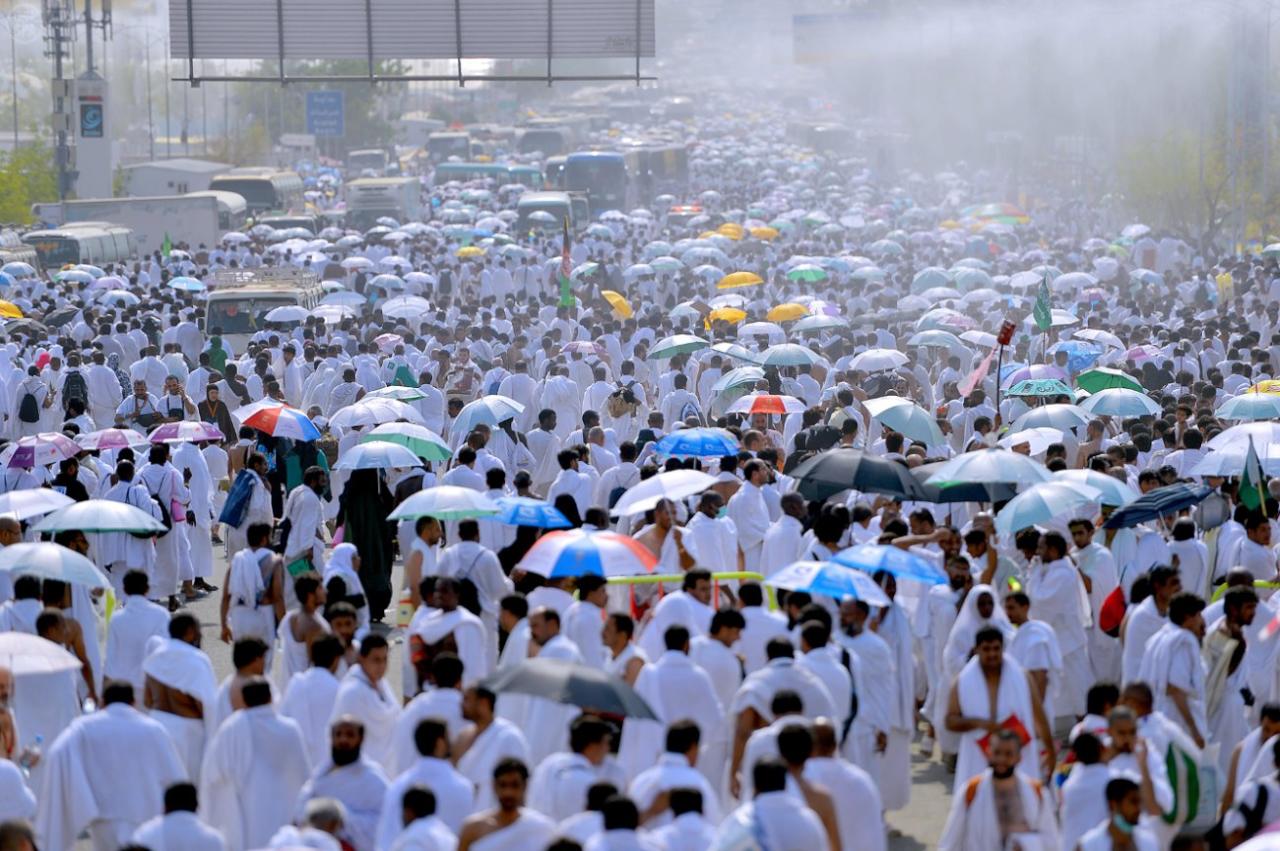
Political Hajj
In the name of God, the Most Merciful, the Especially Merciful.
Praise belongs to God, Lord of the worlds. I bear witness that there is no deity but God alone, with no partner, and that Muhammad is His servant and Messenger. May God bless him, his family and his Companions and grant them abundant peace.
Brothers and sisters,
During the Hajj of 1407 AH, the holy lands witnessed marches, demonstrations and riots by Iranian pilgrims, answering their imam Khomeini’s call for what he termed “political Hajj”. Most people thought this was a political position connected with the Iran–Iraq War. In fact, however, it was connected with an integrated outlook and a philosophical perspective on the interpretation of religion and the nature of worship in Khomeini’s thought.
He interprets religion and worship philosophically, making the end and objective of prophethood, the prophetic message, worship and Islamic law the establishment of justice and Islamic government. Khomeini himself said in his famous address on the eve of the middle of Sha‘ban in 1400 AH: every prophet came only to establish justice and aimed to implement it in the world, but did not succeed; even the Seal of the Prophets, who came to reform and refine humanity and implement justice, likewise did not succeed. Such were Khomeini’s words. God is the One whose help is sought.
Under this false interpretation of Muhammad’s message, prayer, zakat, fasting, Hajj and all other acts of worship are merely means and tools to accomplish that end: establishing government and achieving justice.
This is how we should understand the slogans, sayings, articles and lectures put forward whenever the Hajj season arrives. They circulate concepts that distort the image and reality of Hajj: Hajj is a “political conference”; an “Islamic demonstration”; “development through Hajj” – some have even launched a project for “building life through development through Hajj”; a “forum for declaring political positions”; “equality and socialism” and the “abolition of class distinctions”; or the “consultative council of Muslims”. These are among the many slogans circulating through different media.
Every Muslim who affirms God’s oneness, and whose natural disposition and religious practice have not been contaminated by such ideas about interpreting religion, recognises the falsity of this interpretation of Hajj. If Hajj were a political conference, why would ordinary, poor and vulnerable people be called to it? If Hajj abolished class distinctions and proclaimed socialism, why did Islam not command the wealthy to relinquish their property? Why does a wealthy pilgrim return wealthy, just as a poor pilgrim returns poor? We do not deny that Hajj has psychological, social and economic benefits. That is beyond doubt, just as everything God has prescribed contains goodness, guidance and right direction.
The end, objective and original basis for prescribing the worship of Hajj are, however, another matter.
Hajj fulfils servitude to God, the One and Only. Hajj proclaims pure monotheism, free of every form of association and distortion. Hajj answers the great divine call.
That is why most of those who repeat each year, “What have Muslims gained from Hajj? What change has Hajj brought about in the Muslim community?”, start from this philosophical interpretation, political interpretation and utilitarian interpretation, whose roots and foundations are found in Khomeini and others like him.
Is it not enough for them that Hajj establishes the fifth pillar of Islam? Is it not enough that Hajj renews the proclamation of God’s oneness: “Here I am, O God, here I am. Here I am; You have no partner, here I am. All praise, blessing and sovereignty are Yours. You have no partner”?