
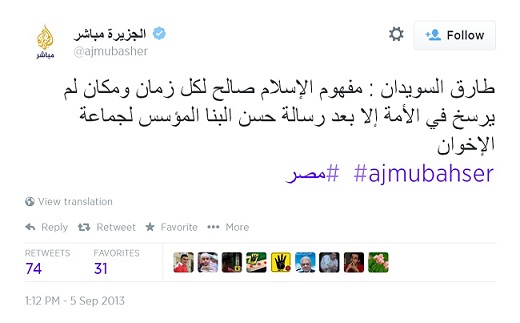
On 5 September 2013, Al Jazeera television published a tweet quoting Tariq Suwaidan:
Text of the post:
“Tariq Suwaidan: The concept that Islam is suitable for every time and place did not take root in the community until the message of Hasan al-Banna, founder of the Muslim Brotherhood.”
Comment:
These words distort the meaning of soundness and reform in Islam in several ways:
1. It must be explained that true reform, as the Qur’an establishes, consists in rooting monotheism in people’s souls and rejecting association of partners with God, its manifestations and its means, by glorifying God and His right. This was the first work of the messengers and prophets, may God’s peace and blessings be upon them, who were sent primarily to reform and guide creation. Any efforts at reform that disregard this are incomplete and deviate from the straight path. God says: “We never sent a messenger before you without revealing to him: ‘There is no deity but Me, so worship Me’” (al-Anbiya’ 21:25). He says: “We sent a messenger to every community: ‘Worship God and shun false objects of worship’” (al-Nahl 16:36). Every messenger God sent told his people: “Worship God; you have no deity other than Him” (al-A‘raf 7:59, 65, 73, 85; Hud 11:50, 61, 84; al-Mu’minun 23:23, 32). Reform follows this. God says: “They said, ‘Shu‘ayb, does your prayer command you that we should abandon what our fathers worshipped, or cease doing what we please with our wealth? You are indeed the forbearing, the discerning!’ He said, ‘My people, consider: if I stand upon clear evidence from my Lord and He has granted me good provision from Him, I do not wish to oppose you by doing what I forbid you. I desire only reform as far as I can. My success comes only through God. Upon Him I rely and to Him I turn’” (Hud 11:87–88).
2. This alleged “reform” springs from a distorted understanding of Islam’s reality and the purpose of creation. When we make political and utilitarian activity and contention with the ruler the purpose for which religious laws were prescribed and messengers sent, this is undoubtedly corruption, not reform. The Muslim Brotherhood adopted this distorted understanding of Islam, and its senior leaders advocated it. On this basis we understand the writer’s claim that reform “did not take root in the community until the message of Hasan al-Banna.”
3. These words invert and misrepresent the facts. It would not be far-fetched to say instead that the community’s conviction that Islam is suitable for every time and place has declined because of the Brotherhood and its founder. One of the Brotherhood’s senior leaders states in his book The Secret History of the Muslim Brotherhood, pp. 61–62, that most extremist groups emerged from the Brotherhood and carried its thought and creed. One of its own has testified. What soundness and reform can there be after this?
4. Islam’s suitability and capacity to reform every time and place, in the correct religious sense, is a truth that can take root in people’s hearts only by understanding the call of the final Messenger, peace and blessings be upon him, according to the understanding of his noble Companions, through a sound chain of transmission to him, at the hands of godly scholars. These scholars have a standing of truthfulness and sincerity in Islam, have made great efforts in the service of learning and religious teaching, and understand both true corruption and the reform sought. This is the religious criterion for understanding Islam as suitable and reformative for every time and place. This should be present in the community’s minds, rather than “the message of Hasan al-Banna, founder of the Muslim Brotherhood.” God knows best.
For more, see: