
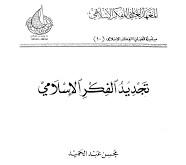
Book Reading: Renewing Islamic Thought, by Dr Muhsin Abd al-Hamid
Renewing Islamic Thought, by Dr Muhsin Abd al-Hamid [1], International Institute of Islamic Thought.
This book matters not only because its author is a professor specialising in the field, but also because he is among the leading figures of the Islamic movement in Iraq. [2] It enables us to examine views and theories adopted by that group and spread through various means. Saying that the author expresses his personal viewpoint does not invalidate this observation. He formulated his views from the group’s principles and concluded by affirming those principles. The relationship between his research’s aims and his group’s method is like that between a thing and itself.
What is the book’s concise substance?
There are three approaches to analysing and interpreting the relationship between Islamic sects and schools and the true Islam God chose for His servants:
First, the Marxist approach. It does not distinguish in its view of Islam between divine revelation, the Book and Sunnah, and human reasoning and opinion, such as Islamic sects’ theories. It treats them all as one thing and interprets them alike as a social phenomenon subject to historical necessities and changes. It is an atheistic interpretation of religion as national heritage and a human product. The author rejects this approach entirely, pp. 26–31, and is undoubtedly correct to do so.
Second, the author’s approach, shared by a group of Islamist intellectuals. In brief, it distinguishes divine revelation from human reasoning. It regards all Islamic sects and schools as human efforts subject to historical and civilisational influences, but grounded generally in one source: the definitive and universal principles of preserved divine revelation.
Third, the approach of the Sunnis, the Companions, Successors, their successors and later imams of learning and Sunnah. In brief, divine revelation represented by the noble Qur’an and authentic prophetic Sunnah is preserved, but does not exist in an ideal state abstracted from Muslims’ reality. It has clear beliefs, universal foundations and detailed rulings, whose true embodiment in life and history is the saved sect, the manifest, victorious group. [3] Other sects’ views become human products to the extent that they depart from this saved sect’s concepts and foundations, making them explicable through historical dialectics.
What, then, distinguishes the latter two approaches?
The difference is like that between guidance and error, truth and falsehood. The intellectuals’ approach in reality isolates the Book and Sunnah from Muslim life, then opens the door to anyone holding opinions and grave, objectionable innovations, provided they broadly rest on divine revelation, this religion’s universals and its doctrinal framework. The author summarises that framework in general paragraphs, p. 146, discussing the material nature of the cosmos, God, prophethood, the finality of prophethood and the Last Day. On this basis, all Islamic sects that do not directly negate these universal foundations are broadly acceptable and praised for serving Islam, at least at a particular historical stage.
The author therefore condemns only destructive movements that attacked all or some of these foundations, such as the Zanj, Khurramiyyah, Qarmatians and esotericist Isma‘ilis. He overlooks that these groups were not Islamic in the first place; most were Persian, Shu‘ubi and esotericist rebellions against the Arab Islamic state.
We also find him exaggerating praise for great leaders of error who led major movements of distortion in Islamic history. Among them is Ma‘bad ibn Khalid al-Juhani, who introduced the doctrine concerning predestination in Basra and from whom Abd Allah ibn Umar disassociated himself, may God be pleased with him. [4] Yet the author describes him, p. 54, as “the distinguished Successor and truthful hadith transmitter, student of the striving Companion Abu Dharr al-Ghifari, may God be pleased with him.” He glorifies al-Ja‘d ibn Dirham and Jahm ibn Safwan, p. 55, raises the Mu‘tazilah’s standing, p. 57, and claims that the Ash‘aris filled a great vacuum, p. 60.
He then mentions Shaykh al-Islam Ibn Taymiyyah, may God have mercy on him, p. 65: “I do not exaggerate if I claim that Ibn Taymiyyah was a community unto himself among all Islamist thinkers…”
This will surely surprise the reader. How can the author praise Ibn Taymiyyah while praising in the same context those leaders of error whose thought Ibn Taymiyyah spent his life criticising and refuting, combating its harmful effects in the Muslim world?
There is no need for surprise. The author builds upon the principle already explained. In its light, Jahm ibn Safwan and Ibn Taymiyyah are both Islamic campaigners with no essential difference: both work in service of Islamic civilisation. One may be nearer the Book and Sunnah, but both rely on them. Their differences arise fundamentally from historical circumstances, contemporary challenges and the problems they encountered. In fact, this approach is a replica of the Marxist theory of historical interpretation, with the difference that Islamist intellectuals believe in divine revelation while Marxists do not.
The author applies the same method to what is called modern Islamic thought. He first mentions and greatly praises the call of the renewing imam, Shaykh al-Islam Muhammad ibn Abd al-Wahhab (1206 AH), may God have mercy on him. Yet he covertly belittles it, claiming, p. 99: “The circumstances of Bedouin life in the Arabian Peninsula, [5] Shaykh Muhammad ibn Abd al-Wahhab’s lack of contact with centres of Islamic culture in Iraq, Syria, Egypt and the then caliphal capital Istanbul, the restriction of his learning to the transmitted side of Islamic culture, [6] and the delayed arrival in the Muslim world of news of the changes violently shaking European life made his movement one-dimensional: doctrinal…”
Thus he speaks, overlooking many historical facts, foremost perhaps the immense effect of this blessed call throughout the Muslim world, something he is compelled partly to acknowledge on p. 127. Moreover, this supposedly Bedouin call produced the first Islamic state of the modern age founded on sound creed, monotheism and governance by God’s law. This has had an immense effect on reform, religious teaching and change across the community, indeed the whole world, to this day.
In any case, the shaykh’s movement is, for the author, p. 100, “one of the transitional movements responding to particular challenges connected only with general creed.” Everything is merely a product of historical movement.
Turning to comprehensive modern renewal, he claims that the person called Jamal al-Din al-Afghani was, p. 102, “the most prominent figure to appear on the stage of struggle for the community and striving to renew the whole affair of Islam and Muslims.”
The author admires al-Afghani intensely, even devoting to him a book entitled Jamal al-Din al-Afghani: The Falsely Accused Reformer. He overlooks all al-Afghani’s deviations and suspicious affiliations and presents him as the spiritual father of contemporary Islamic teaching. Here he summarises that book, claiming that every subsequent reformist call in the Muslim world was a fruit of al-Afghani’s school or at least influenced by it.
He then discusses Hasan al-Banna (1949) and his call, describing him, p. 114, as proceeding “from comprehensive study of the Islamic foundational method, especially in the school of Jamal al-Din, Muhammad Abduh and Muhammad Rashid Rida, to draw for the new generation, precisely and clearly, the Islamic doctrinal framework in its comprehensive details embracing every aspect of life,” and so on in his loose, emotional language.
This is an important testimony alongside much evidence that Hasan al-Banna brought nothing new. He followed the Iranian Muhammad Safdar, who called himself Jamal al-Din al-Afghani and founded the contemporary intellectual method of the interpretation of Islam in rationalist, civilisational and utilitarian terms. Al-Banna merely transformed Safdar’s call from an elite framework into a mass movement. The harm of the Iranian posing as an Afghan thus spread throughout the community after being confined to a small group of intellectuals influenced by him.
The author makes general judgements, states broad matters and advances claims without proof or evidence, alongside obvious fallacies, particularly in treating the term “Salafism.” Their details cannot be discussed here, especially since this is an overview rather than a detailed critique. But the reader will surely ask: what is the aim and purpose of all this?
The answer is that these intellectuals wish to transform this religion’s conflict with other religions, doctrines and sects from a doctrinal struggle to reach God’s intent for His servants into a material, civilisational struggle. Concern with the oneness of God in lordship, divinity, names and attributes, and other Islamic foundations and detailed rulings, would distract Muslims from their role in this material age. They must therefore reduce their religion’s doctrinal dimension to the narrowest possible scope, while believing in all its questions, but practically retaining only the most indispensable foundations, also stated generally: God, revelation, prophethood and the Last Day. Then everyone, Jahmis, Qadaris, Jabris, Mu‘tazilis, Rafidis, Ash‘aris, Maturidis, Sufis and even “Salafis,” can devote themselves to developing the earth and building a material civilisation with which to face the West’s challenges and civilisation.
The perceptive reader may have realised that this intellectual theory results from the inferiority complex they suffer through fascination with the West and the glitter of its false civilisation. We ask God, through His favour and generosity, for protection from doubts and desires.
This article, “A Reading of Renewing Islamic Thought,” was published in Al-Hady al-Nabawi magazine, then issued in Manchester, Britain, year 2, issue 14, Safar 1418 AH / July 1997.
[1] Born in Kirkuk, Iraq, in 1937; received a doctorate from Cairo University in 1972; professor of Qur’anic exegesis, creed and modern Islamic thought at Baghdad University. Known for his rationalist, modernist orientation and writings in this field. He is Kurdish but settled and married in Baghdad.
[2] He is a leader of the Muslim Brotherhood in Iraq and played a prominent role during the Ba‘athist era and then under Bremer through the Iraqi Islamic Party.
[3] This does not mean the saved sect is intrinsically infallible or infallible in its reasoning. It means it is the natural continuation of the religion the Prophet taught his Companions, in creed, law and morals, foundations and branches, although its members experience ordinary human error in small details, particular questions and matters open to independent reasoning. Thousands of texts from the Book, Sunnah, reports of the predecessors and statements of imams and scholars establish the conclusion above.
[4] As in Sahih Muslim.
[5] This is how the rationalist, modernist school disparages and attacks Salafi teachers: calling them Bedouin and jurisprudence based on Sunnah evidence “Bedouin jurisprudence,” while ignoring that “Islamic civilisation,” as they call it, was built by the Companions who emerged from the Arabian Peninsula.
[6] For these intellectuals, divine revelation does not produce a complete Islamic culture unless the deviant products of human reason are added to it.