
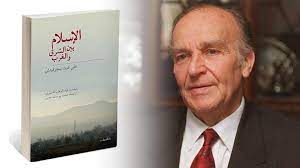
A reading of Islam Between East and West
By Alija Izetbegović, may God have mercy on him.
Alija Izetbegović (1925–2003), may God Most High have mercy on him, wrote this book amid the conflict between socialism and capitalism. He was widely acquainted with Western ideas and philosophical schools, including religious, spiritual and ethical thought as well as materialist thought, Marxism and capitalism. His knowledge extended to the works of Western artists, painters and poets, both ancient and modern. He was also a witness to many events of his time.
His book addresses the conflict between matter and spirit, or between religion and science, and Islam’s position in that conflict and its role in life. He argues that Islam alone serves human beings’ interests and places them on the right path. In his account, Islam offers solutions to contemporary problems, whether material or spiritual, that are unavailable in other schools, whether materialist or purely religious.
At the Center for Studies in the Interpretation of Islam, our interest in evaluating and correcting discussions of this kind prompted us to explain the book’s central idea and subject through a concise account of its principal discussions, followed by observations and criticisms concerning its interpretation of religion and worship.
Information about the book
Title: Islam Between East and West
Author: Alija Izetbegović.
Translator: Muhammad Yusuf Adas.
Foreword: Dr Abd al-Wahhab al-Messiri.
Publisher: Dar al-Shuruq, fourth edition, 2014, 379 pages.
An overview of the book’s subjects
The book attempts to answer the question: What is Islam’s position in the ideological clash between religion and science, and does Islam have a role in shaping the present world? It approaches this through three outlooks, each claiming to be suited to human life and to explain human existence, reality and role in the world. These are materialism, religion and Islam, which the author also associates with nature, conscience and the human being. A bitter struggle and prolonged conflict has taken place between religion and matter, each seeking to eliminate the other and establish its own suitability for this world.
We should explain that, in the author’s terminology, religion encompasses everything associated with the spirit, including ethics, values and art, whether genuine or false, whether heavenly religion or superstitious paganism. More precisely, it means the Western conception of religion as an individual relationship with God, the unseen and the spirit, whatever that relationship may be.
The author divides his book into two principal parts.
In the first, “Premises: Reflections on Religion,” he refutes attempts to abolish religion, the spirit and morality and replace them with matter. He begins with Darwin’s theory and evolution, presenting it as a purely materialist theory unable to explain morality from its own standpoint. Indeed, religiosity, which he says has been established as existing alongside human beings from their beginning, has no even remotely comparable counterpart among the animals from which humans are supposed to have evolved. He presents further objections that, in his account, evolutionary theory cannot escape.
He then discusses culture and civilisation and the difference between them. Civilisation has made substantial advances because it is connected with matter and technological progress, whereas culture is in continual decline and retreat. He addresses art and its relationship with religiosity, independently of science, and then morality through the distinction between duty and interest. Interest belongs to material, natural science, while duty belongs to morality, spirit and conscience. This leads to the conclusion that refusing to acknowledge God means refusing to acknowledge morality and moral duty. He then discusses culture’s relationship with history and, finally, idealism or utopianism, which is concerned with matter, organisation and a mechanical life in which feeling and freedom disappear for the sake of the ideal society.
Throughout, he explains that these concepts, proposed as substitutes for religion, spirit and morality, have been unable to solve the problems of the world or of human beings, or to fill the spiritual emptiness people experience. He supports this with testimony from leading materialist and spiritual philosophers and prominent Western thinkers, ancient and modern. He also draws on statistics and periodicals from Western countries that adopted materialist thought and neglected spiritual and moral needs, where crime, suicide, sexual permissiveness and the collapse of values and principles consequently spread.
After this extensive discussion, occupying more than half the book, the second part, “Islam: Bipolar Unity,” examines religion as represented by Judaism and Christianity, according to their adherents and scriptures. It describes their failure to keep pace with reality and satisfy actual human needs: Judaism was closer to materialism and thus resembled the first outlook, while Christianity adopted an entirely hostile stance towards matter and could therefore find no place in practical reality in its existing form.
Another chapter discusses Islam and how it combined material and spiritual requirements, reviewing the five pillars in that light. The author then considers Islam’s superiority in the field of law. He subsequently discusses the separation between Jesus, peace be upon him, as represented by Christianity and the Gospel, and the Church, represented by Paul’s epistles. In his account, it was the latter that survived because it abandoned the unreal idealism and hostility towards matter brought by Christ, peace and blessings be upon him.
He goes on to explain that neither the materialist nor the spiritual outlook could become realistic without relinquishing some principles that conflicted with human needs, or resorting to force and violence.
As in the first part, he quotes Western scholars, thinkers, philosophers and artists as witnesses to the validity of his argument, following the principle that the people of Mecca know its mountain paths best.
Throughout, he presents Islam’s balance between spirit and matter, which both preceding approaches had lost. Islam alone, he argues, untied the knot and solved the riddle that had placed materialist and spiritual thought in severe opposition. By reconciling them, it fulfilled the reality and humanity of the human being. Any attempt to pull Islam towards either materialism or pure religion would make it theoretical and imaginary rather than realistic and practical. It would consequently cease to be sound and reformative, as its existence is meant to be.
Towards the end, he describes serious Western attempts to bring Marxist materialism and Catholic spirituality closer together, and how England succeeded to some extent in reaching a middle course while neighbouring European countries remained sharply polarised between the two. He nevertheless explains that the problem persists: although compromise is better than polarisation, it remains incomplete unless Islam is adopted as the official religion and way of life of the state and society.
The book closes with a final reflection on the importance of surrender to God and belief in divine decree. However much our will develops and advances, and whatever precautions we take, God’s decree and power ultimately govern. Submission to God concerning outcomes therefore remains essential for continuing to live and experiencing tranquillity.
This is a concise account of the book’s substance and purpose.
Observations on the book
We have several criticisms and observations concerning the book’s interpretation of Islam, summarised in the following points.
Treating both spirit and matter, or this world and the hereafter, as fundamental objectives of Islam
This is a clear methodological problem in the book. It is unsound to place worldly or material demands, provided they are beneficial, on the same level as spiritual and immaterial concerns and what lies with God Most High. The Qur’an repeatedly censures worldly life and those who make its pleasures their ultimate purpose. Islam certainly does not demand complete rejection of the world, contrary to extreme ascetics and monks. Yet neither does it place worldly demands on an equal footing with religious demands, making them fundamental purposes or goals. Islam’s balanced explanation places the pursuit of worldly things among means rather than ends. This distinction matters.
Consider the following passage. The author reasons from the need to determine the times of prayer, pilgrimage and fasting, which required investigation into astronomy, mathematics and geography, that these sciences are themselves intended objectives of religion. He writes on page 280:
“The times of prayer, as well as fasting and pilgrimage, all depend on particular astronomical facts. The Qur’anic declaration, ‘Righteousness does not consist in turning your faces towards the east or the west’ [al-Baqarah 2:177], may appear closer to the concept of pure religion. Yet Islamic prayer, as commonly understood, comprises physical, natural elements alongside spiritual elements equally. In this respect prayer belongs to our world, defined by time and space. The rapid development of astronomy in the early Islamic centuries was closely connected with Muslims’ need to determine place and time precisely. We have many reasons to believe that this development was one of Islam’s objectives.”
He also writes on page 295:
“It is impossible to apply Islam in practice from a primitive level. Prayer cannot be performed correctly without determining time and direction in space.
Muslims, spread across the surface of the globe, must all face the Kaaba in prayer, adjusting their positions in space despite their different locations. Determining prayer times is governed by astronomical facts. The times of the five prayers must be precisely determined throughout every day of the year. This requires determining the earth’s position in its orbit around the sun. Zakat requires statistics, records and calculation. Pilgrimage involves travel and familiarity with the many facts required by someone travelling long distances. Put in the simplest terms, and leaving aside everything else in Islam, a Muslim society practising nothing beyond these five pillars must attain a minimum level of civilisation. This means that a person cannot be a Muslim and remain backward. This direction was undoubtedly intended. Evidence for it comes from the history of the Islamic sciences themselves: it shows us that the development of all scientific fields in the first Islamic century began with attempts to fulfil Islamic obligations as precisely as possible.”
We say that these passages, and others like them, clearly reveal a problem in the ordering of means and ends. The author, may God have mercy on him, makes Muslims’ need for sciences that assist in performing certain acts of worship an objective of Islam. Of course, such need does not arise everywhere: it varies from one period and place to another. The question is: Where were these objectives in the earliest period, when, as is well known, Muslims had not attained the subsequent level of knowledge in these sciences? If the answer is that they did not need them, that shows they are not purposes or goals. They are means used when needed, under the principles that “whatever is indispensable to fulfilling an obligation is obligatory” or that “a command to do something entails a command to fulfil its necessary requirements.”
Since this principle has been mentioned, I wish to draw attention to a point made by Shaykh al-Islam Ibn Taymiyyah, may God have mercy on him, in Dar’ Ta‘arud al-‘Aql wa-l-Naql [1:211–219]. When an obligation cannot be fulfilled without something else, he explains, that other thing becomes obligatory as a matter of rational necessity. It need not be an objective intended by the Lawgiver. Otherwise, invalid consequences would follow. Someone living far from Mecca, for example, must travel that distance to perform the pilgrimage incumbent upon him. Travelling that distance becomes obligatory for him by rational necessity, rather than as an independently prescribed religious obligation. Were it a religious obligation in that sense, someone who failed to perform pilgrimage without excuse would incur greater sin the further he lived from Mecca, because the distance he was obliged to travel exceeded that required of someone living nearby. That is certainly false. Accordingly, these sciences may be described as rationally required where particular circumstances make them necessary, but not as intended religious or legal ends, still less as objectives of Islam.
Moreover, an explicit text establishes that Islamic law is independent of, and does not require, these sciences in the detailed and developed form intended by the author. Al-Bukhari (1913) and Muslim (1080) report from Ibn Umar, may God be pleased with him, that the Prophet, peace and blessings be upon him, said: “We are an unlettered community: we neither write nor calculate. The month is like this and like this,” meaning sometimes twenty-nine days and sometimes thirty.
This hadith demonstrates the forbearance and ease of the rulings of Islamic law, and its suitability for every time and place. Its practice does not depend on sciences and knowledge that ordinary people would find difficult to acquire. Undoubtedly, the Prophet, peace and blessings be upon him, intended by these words to praise this community and explain its merit, rather than disparage or belittle it by mentioning this characteristic. Ibn Hajar writes in Fath al-Bari:
“The reference is to the Muslims present with him when he made this statement, understood as describing most of them; alternatively, it refers to the Prophet himself, peace and blessings be upon him. … Calculation here means calculating the stars and their movements. They knew very little of that as well. The ruling concerning fasting and other matters was therefore connected with sighting, to spare them the difficulty of working out such movements. The ruling concerning fasting remained in place even if people subsequently came to know these calculations. Indeed, the apparent context indicates that the ruling is not to be linked to calculation at all.”
Discussing the material benefits of Islam’s pillars and making them fundamental objectives
This observation develops what was outlined above. The author describes material, social and worldly benefits in the same light as religious purposes relating to the hereafter. He writes on page 285:
“The familiar Qur’anic formula combining prayer and zakat is simply a particular form of another, more frequent and more general, bipolar formula: ‘Believe and do good.’ This may be regarded as the essential foundation of the religious, moral and social injunctions of the Qur’an. The formula identifies the two indispensable pillars on which all of Islam rests. It may appropriately be regarded as Islam’s first and highest formulation. Islam in its entirety falls within the formula of bipolar unity.”
We review below some of his statements about the five pillars of Islam.
His position on the two testimonies of faith
He writes on pages 285–286:
“The pronouncement of the two testimonies by which a person declares acceptance of Islam takes place before witnesses because the act contains two meanings. The first is entry into a spiritual community, for which witnesses are unnecessary. Yet the person accepting Islam, whether man or woman, also joins a community with social and political dimensions, involving legal as well as moral obligations. The second meaning is that joining a religion does not require witnesses, since this is a relationship between a person and his Lord. Simply forming an intention or making an inward decision is entirely sufficient in this respect. Joining a religion in other people’s presence includes an element of publicity, unnecessary from the standpoint of pure religion. But Islam is not pure religion.”
His interpretation of ablution and prayer
He writes on page 278:
“Prayer is not merely an expression of Islam’s position towards the world. It also reflects the way Islam wishes to organise this world. Prayer declares two things: first, that there are two fundamental human goals; and second, that, although logically separate, these goals can be united in human life. There is no prayer without purification, and no spiritual effort without accompanying material and social effort. Prayer is the most complete representation of what we call Islam’s ‘bipolar unity.’ Through its simplicity, prayer has reduced this characteristic to an abstract expression, becoming the Islamic equation or ‘code.’”
This passage clearly shows the author’s conception of the demands of religion and worldly life as two fundamental goals, to use his expression. What is striking is that, after the preceding statement, he argues that the purification required before every prayer, represented by ablution, answers the material requirement in human beings, even if Islam adds something of an inward dimension to it, as he puts it. His evidence is that pure religion, among its unbelieving adherents, is entirely remote from cleanliness. Indeed, they regard abandoning cleanliness as a way to draw near to God, something that appears logical when religion is detached from matter.
This is, in truth, a strange argument. What sound mind considers approaching God through dirt, filth and impurity? What evidential value is there in the conduct of people whose minds and hearts God has sealed, such that it should become a standard for pure religion? The fact that cleanliness has a material aspect benefiting human beings does not mean that this aspect is unintelligible religiously or spiritually. On the contrary, it is entirely intelligible and clear, for God is beautiful and loves beauty.
His interpretation of zakat
He writes on page 281:
“With the proclamation of zakat, Islam began to take the position of a social movement and no longer functioned only as pure religion. Zakat acquired its true weight with the formation of the political community of Medina.”
He also writes:
“The obligation of zakat responded to a phenomenon that is not itself one-dimensional. Poverty is not a purely social issue. Its cause lies not only in want but also in the evil within human souls. Deprivation is poverty’s outward aspect, while its inward aspect is sin or greed. Otherwise, how do we explain the existence of poverty in wealthy societies?”
On page 282 he writes:
“Zakat is a mirror of people: it depends on them whether it is an imposed tax or a voluntary gift from one person to another. Zakat requires both financial funds and open hearts. It is a great river of goods flowing from heart to heart, from person to person. Zakat eliminates poverty among the needy and indifference among the wealthy. It reduces material inequality and brings people closer together.”
In these passages and others, he does not address worship through this great pillar at all. His concern is to correct the conception of zakat: its purpose is not only to relieve poverty and meet the needs of the needy, but its spiritual dimension of building affection, love and solidarity among people constitutes a second objective. Although this is true as a fruit and benefit of practising the rite, worship through zakat and drawing near to God by performing it are its fundamental purpose. It is therefore invalid without intention, meaning the worshipper’s intention to draw near to God through giving it.
His interpretation of fasting
He writes on page 286:
“Fasting undoubtedly has a similar aspect. Muslims have regarded fasting in Ramadan as an expression of the communal spirit. They are therefore sensitive to any public violation of this obligation. Fasting is not merely a matter of faith, or a personal matter concerning the individual alone. It is a social obligation. This interpretation of fasting as a religious rite is not understood in other religions. Islamic fasting is a unity combining ascetic devotion and happiness, even pleasure in certain circumstances. It is the most natural and powerful educational method put into human practice to this day.”
This passage distorts the text in which God Most High explains the obligation of fasting, making clear that its purpose is God-consciousness alone. Whatever benefits interpreters seek or infer from fasting cannot be its fundamental objectives. At most they are benefits and fruits, no more. The fundamental purpose is God-consciousness.
His interpretation of pilgrimage
He writes on page 286:
“What of pilgrimage to the Kaaba, the fifth pillar of Islam? Is it a religious rite, a trade fair, a political gathering, or all of these in one? It is certainly a religious rite, but in its Islamic form it is all in one.”
This is an unacceptable equation, confusing means with ends and benefits and fruits with ultimate purposes. It has neither evidence nor a supporting argument.
Moving from a particular case to a universal proposition
This is an important observation and a serious error into which many proponents of the political interpretation of Islam fall. They begin with a particular case arising in particular circumstances and subject to specific conditions, then make it general, turning it into a universal rule through which religion is interpreted. The author, may God have mercy on him, falls into this in his book.
Here I quote his words and part of a commentary on them from Shaykh Abd al-Haqq al-Turkmani’s An Introduction to the Interpretation of Islam. May God preserve him. Anyone seeking further discussion should consult that book, pages 45–50. The shaykh noticed this aspect and devoted an important chapter to it. Under the heading “The Error of Using a Particular Case to Argue for a Universal Proposition,” he writes:
“We must be alert to, and warn against, a mistaken and deviant method of deducing the ultimate purpose and determining the objective. It involves moving from one level to a higher one without evidence from Islamic law, comprehensive induction or a necessary rational proof. Instead, it proceeds by assertion, strained interpretation and exaggeration. The purpose of a ruling, or of a group of particular rulings, is treated as the purpose of religion as a whole. Prophethood, religion, worship and Islamic law are then interpreted through that purpose.
“For example, when a Muslim falls short in certain acts of worship, Islamic law requires deeds whose benefits extend to others, such as the expiation for an oath in God Most High’s words: ‘God does not hold you accountable for unintentional oaths, but He holds you accountable for oaths you have deliberately bound yourselves by. Its expiation is feeding ten needy people from the average of what you feed your families, or clothing them, or freeing a slave. Whoever cannot find the means must fast for three days. That is the expiation for your oaths when you swear. Guard your oaths. Thus God makes His signs clear to you, so that you may be thankful’ [al-Ma’idah 5:89].
“This ruling plainly concerns a specific, particular case. Nevertheless, Alija Izetbegović, may God have mercy on him, concludes from it [pages 286–287] that ‘socially beneficial actions in the external world have priority over purely spiritual actions. The latter are applied only as a substitute when the former cannot be performed. In this verse, fasting was an expression of remorse, an expiation and a prayer for forgiveness.’
“This is undoubtedly an extremely dangerous method, with profound consequences for distorting the essence and reality of religion. It is among the greatest causes of error among followers of religions, as well as adherents of philosophical theories and intellectual, social and political approaches. Some examples make this clear.
“If we examine the history of the emergence of associating partners with God and idolatry, after people had all followed the religion of monotheism, we find that a principal cause of deviation was the move from particular events and concepts to universal conceptions on which belief was then constructed. Associating partners with God began with exaggeration concerning righteous people. This happened among the people to whom Noah, peace and blessings be upon him, was sent, after such association had entered their lives through exaggerating the status of their righteous men: ‘They said: Do not abandon your gods; do not abandon Wadd, Suwa‘, Yaghuth, Ya‘uq or Nasr’ [Nuh]. Ibn Abbas, may God be pleased with them both, said: These were the names of righteous men among Noah’s people. When they died, Satan suggested to their people: Erect monuments where they used to sit and name them after those men. They did so, but the monuments were not worshipped until those people had died and knowledge had disappeared. Then they were worshipped.
“Undoubtedly, prophets, the utterly truthful, martyrs and righteous people have a special standing and high rank with God Most High. He has singled them out for favour, honour and acceptance. Extraordinary events may occur through them, as with the signs of the prophets and the wonders granted to God’s friends. Yet all these merits and virtues are particular matters. It is wholly irrational to move from them to a universal proposition: believing that such people possess lordship, or directing humility and worshipful servitude towards them.
“For this reason, the Qur’an’s method includes confronting idolaters with the rational necessity of denying that idols deserve worship, since they lack the universal qualities and attributes that warrant worship: lordship, creation, governance, knowledge, hearing and sight. God Most High relates of Abraham, peace and blessings be upon him: ‘When he said to his father and his people: What do you worship? They said: We worship idols, and remain devoted to them. He said: Do they hear you when you call, or benefit you, or harm you? They said: Rather, we found our fathers doing so’ [al-Shu‘ara’ 26:70–74]. Their answer implicitly acknowledges the absence of these universal attributes. They appeal to a particular matter, following their fathers, although such imitation is invalid because it contradicts revelation, innate human nature, reason and reality.
“The same applies to cosmic phenomena and remarkable creatures that fascinate some people, leading them to sanctify and worship them and believe that they bring benefit and harm. The Prophet, peace and blessings be upon him, drew attention to this when his son Ibrahim died, saying: ‘The sun and moon do not eclipse because of anyone’s death or life. They are two of God’s signs. When you see them, pray.’”
His approval of Sayyid Qutb’s interpretation of the declaration of monotheism
Sayyid Qutb, may God have mercy on him, is known for interpreting the testimony that there is no deity but God in terms of sovereignty, and for making rule and government the purpose of sending messengers and revealing scriptures. This unquestionably conflicts with what is established by recurrent transmission and consensus: the purpose of creation, the divine message, prophethood and the scriptures is to worship God alone. God Most High says: “I created jinn and human beings only to worship Me” [al-Dhariyat 51:56], and: “We sent no messenger before you without revealing to him: There is no deity but Me, so worship Me” [al-Anbiya’ 21:25].
Rule and sovereignty are among the obligations of religion. They have conditions and detailed provisions explained by jurists in works of jurisprudence and governance in Islamic law. Yet a mistaken ordering of religion and of its primary and secondary purposes led Izetbegović, may God have mercy on him, to welcome Sayyid Qutb’s interpretation of divinity. He writes on page 269:
“Islam’s two fundamental beliefs, ‘God is greatest’ and ‘There is no deity but God,’ are simultaneously Islam’s greatest revolutionary forces. Sayyid Qutb rightly regards them as a revolution against worldly authority that usurps the divine right to govern the world. Qutb holds that they mean wresting authority from priests, tribal chiefs, the wealthy and rulers, and returning it to God. Therefore, as Qutb concludes, ‘There is no deity but God’ opposes all holders of authority in every age and place.”
His approval of Western thinkers’ use of Ibn Sina’s philosophy to resolve the conflict between religion and matter, or reason and transmitted revelation
After discussing some English thinkers who helped find a middle course between religion and science, the author, may God have mercy on him, writes on page 352:
“One important fact about Bacon remains insufficiently studied or acknowledged: the father of English philosophy and science was, in fact, a devoted student of Arab-Islamic culture. Bacon was strongly influenced by Muslim thinkers, especially Ibn Sina, whom he considered the greatest philosopher to appear after Aristotle. This may explain the characteristics of Bacon’s thought, which established the ‘third way’ and stamped intellectual and practical life in England with it, distinguishing it from life elsewhere on the European continent.”
This is a difficulty into which some defenders of religion frequently fall when confronting the Western, materialist, anti-religious current that claims religion conflicts with reason and sensory experience. They then discover that some Western thinkers who try to bring religion closer to science drew on Ibn Sina or Ibn Rushd. They rejoice greatly, since these philosophers are counted as belonging to Islam, and conclude that Islam was the first to reconcile reason and transmitted revelation, or matter and spirit.
In truth, the second proposition is unquestionably correct: Islam does not conflict with reason or logic. The first proposition, however, is false: the claim that Ibn Sina or Ibn Rushd deserve credit for this. The beliefs of these two men and others who followed their approach rest on the view that the religion recorded in the Qur’an and Sunnah, that is, what comes through transmitted revelation, consists of imaginings or illustrative examples with no actual reality. These were introduced because society needed reform and the public needed governance. Truth cannot be disclosed to everyone, because most minds reject it unless they have attained a certain level of maturity. This is precisely esotericism.
Undoubtedly, this is the most suitable method for reconciling the altered religion found among Jews and Christians with reality. It is therefore unsurprising that Western thinkers seeking to reconcile their religion with reality should benefit from this remarkable philosophy. What is surprising is that someone unaware of the true beliefs of these atheistic philosophers should celebrate the West’s use of their philosophy to reconcile its false religion with sound science.
As for Islam, it has explained the invalidity of these altered religions, which consequently and unquestionably conflict with sound reason and logic. Anyone wishing to benefit from Islam’s approach to reconciling reason and transmitted revelation must therefore be Muslim, and must follow the guidance and truth followed by the Prophet, peace and blessings be upon him, his Companions, the Successors and the scholars of the community who followed them. Otherwise, in Ibn Sina or anyone else, he will find no reconciliation beyond an attempt to reconcile truth and falsehood. How far-fetched that is.
A final word
Alija Izetbegović’s Islam Between East and West, may God have mercy on him, is an original and profound intellectual work, rich in quotations and deep analyses of Western materialist and spiritual thought and philosophy. We seek excuses for the doctrinal, legal and intellectual deviations and errors into which its author fell. He grew up in an environment far removed from sound Islamic concepts, where power and predominance lay with Marxism and socialism on one side and liberalism and capitalism on the other. He turned to God’s religion through learning, practice, calling others to it, sacrifice and generosity, enduring great harm for its sake.
Yet he had not acquired the sciences of the Qur’an and Sunnah. His knowledge of Islam remained general, lacking firm foundations and detailed understanding. Indeed, he introduced most of the hadiths he mentioned as statements “attributed” to the Prophet, and some were not hadiths at all. Alongside Western thought, he was influenced by the literature of activist Islamists, and had no one at hand to teach him and alert him to these issues. God Most High knows his circumstances best. We ask God Most High to reward him abundantly for what he offered his religion, his community and his country, to forgive his slips and errors, and to encompass him in His vast mercy. Amen. Praise belongs to God, Lord of all worlds.
Center for Studies in the Interpretation of Islam
21 Sha‘ban 1442, corresponding to 3 April 2021.